Establishing secure connection…Loading editor…Preparing document…

Kentucky Name Change

This template is fully customizable. Edit the text, fill out the fields, and send it for signature. Give it a try!
Kentucky Name Change

What the Kentucky Name Change filing is and when it applies

A Kentucky Name Change is a court petition that legally changes an individual's name on public records and identification. The typical process requires filing a petition in the circuit court of the county where the petitioner resides, completing required forms, paying filing fees, and attending any required hearing. Courts review petitions for fraud, criminal history, and public notice requirements; minor name changes or changes connected to marriage or divorce can follow alternative administrative paths. This guide explains the steps, required information, timing, and related record updates.

Why a formal court order matters

A court order provides legal authority to update government IDs, financial accounts, and professional records. It ensures consistent identity across state and federal systems, reduces future verification friction, and creates a clear record for third parties such as employers, schools, and financial institutions.

Why a formal court order matters

Who typically completes a Kentucky Name Change

Each user should confirm local circuit court procedural rules, required attachments, and whether additional steps (publication notice or background checks) are mandated before a hearing or final judgment.

  • Adults changing their name after life events such as transition or personal preference
  • Parents or guardians filing name changes for minors with court approval
  • Attorneys and legal clerks preparing petitions and supporting affidavits

Key parts of a complete Kentucky Name Change petition

A professionally prepared petition combines factual statements, statutory references, and supporting evidence so the court can rule on identity and public interest issues.

Petition header

Court name, county, case caption and petitioner/contact information; identifies the court with jurisdiction and provides parties' names and addresses for service.
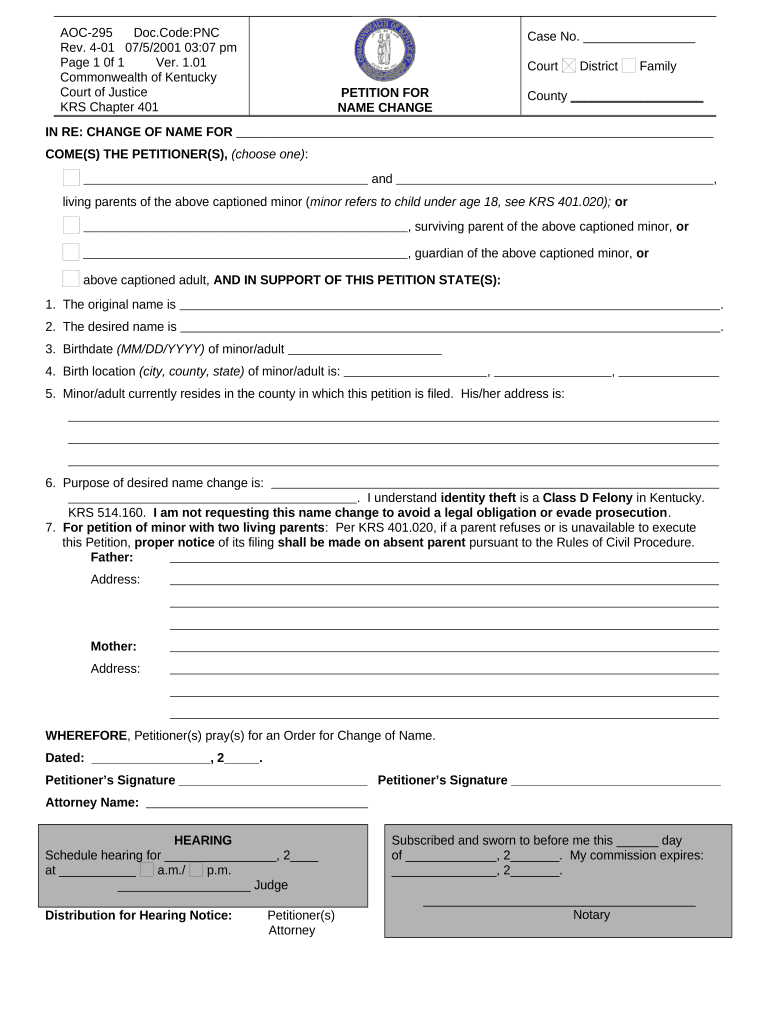
Statement of facts

Clear factual narrative explaining the reason for the change, length of residency in the county, absence of intent to defraud, and any prior names or aliases the court should consider.

Criminal history disclosure

Affirmation of criminal record status; courts may require disclosure of convictions, pending matters, and fingerprint or background documentation in some cases.

Publication or notice

Where required, a published or mailed notice to the public or affected parties demonstrating transparency and giving an opportunity for objection to the request.

Supporting exhibits

Certified copies of identification, birth certificate, marriage/divorce decrees, and any name-change-specific affidavits the court requires as attachments.

Order form

A proposed final judgment or order for the judge to sign that lists the new legal name, effective date, and instructions for record updates.

Required data elements on the petition

Full legal name: Current legal name
Requested name: New full name
Date of birth: MM/DD/YYYY
Residency: County and duration
Identification: State ID or birth certificate
Reason: Brief factual statement

Step-by-step: Preparing and filing the petition

Follow these core steps to prepare a typical Kentucky Name Change petition and move it through the court process efficiently.

  • 01
    Prepare forms: Complete the petition and proposed order with accurate personal data.
  • 02
    Gather evidence: Collect birth certificate, ID, and any required background documentation.
  • 03
    File with court: Submit petition and pay filing fee at the local circuit court clerk's office.
  • 04
    Attend hearing: Appear at scheduled hearing or await the signed order if hearing not required.

How the court review and order process typically works

The court evaluates the petition for statutory compliance, potential fraud, and public interest before entering a judgment.

  • Clerk intake: Clerk accepts petition, stamps and assigns case number.
  • Notice step: Court issues publication or service instructions where required.
  • Judicial review: Judge reviews petition and any objections, and may schedule a hearing.
  • Final order: Judge signs order declaring new legal name and effective date.

Configuring a digital workflow for the petition

Use a consistent electronic workflow to collect signatures, attachments, and notarization where permitted to reduce errors and improve tracking.

Field Configuration
Petition form Fillable PDF with required fields
Identity documents Attach scanned ID and birth certificate
Signature capture eSignature with audit trail
Notarization Remote or in-person per court rules

Typical timing and processing expectations

Processing times vary by county and case load; plan for local administrative steps and potential hearings when scheduling related updates to IDs and records.

Filing to docket:

1–7 business days

Publication/notice period:

2–6 weeks depending on local rules

Hearing scheduling:

2–12 weeks typical

Order issuance:

Same day to a few weeks

Record updates:

Allow 2–8 weeks for agencies

Common mistakes to avoid when preparing the petition

  • Using inconsistent names across attachments causes verification delays and possible court rejection.
  • Failing to include required identification or certified copies often triggers a clerical return or refile.
  • Skipping required publication or notice steps can result in the petition being set aside.
  • Not checking local circuit court forms and fee schedules leads to incorrect filing and lost time.

Consequences of incorrect or incomplete filings

Denial of petition: Court may dismiss
Delayed updates: IDs and records remain unchanged
Contempt risk: False statements can trigger sanctions
Civil liability: Third-party disputes possible
Identity mismatch: Credit and benefits issues
Additional costs: Refiling and legal fees

Digital signing and file formats accepted for submissions

Confirm local clerk preferences for uploaded formats, required notarization types, and whether remote notarization sessions meet court evidence standards.

  • File formats: PDF, DOCX accepted by most courts
  • Integrations: Salesforce, Microsoft 365, Google Workspace
  • Security: TLS 1.2/1.3 and AES-256 storage

eSignature vendor pricing and capability snapshot for name-change workflows

Compare common vendor pricing and basic capability criteria relevant to executing petitions and notarizations; signNow is listed first per platform comparison conventions.

signNow DocuSign Adobe Sign PandaDoc HelloSign
Starting Price $8/user/mo $15/user/mo $14/user/mo $19/user/mo $15/user/mo
Free Trial 7-day free trial Varies by plan Varies by plan Varies by plan Varies by plan
Bulk Send Yes Yes Yes Yes No
Audit Trail Yes Yes Yes Yes Yes
HIPAA Compliant Yes Yes Yes No No
Envelope Cap No cap 100 envelopes/user/year Varies Varies Varies

Frequently asked questions about Kentucky Name Change filings

Answers to common procedural and eSignature questions to help avoid common filing problems and ensure documents are accepted by the court and downstream agencies.


Need help? Contact support

be ready to get more
Join over 28 million airSlate SignNow users