Establishing secure connection…Loading editor…Preparing document…

Kansas Release of Lien

This template is fully customizable. Edit the text, fill out the fields, and send it for signature. Give it a try!
Kansas Release of Lien

What the Kansas Release of Lien Is and when it applies

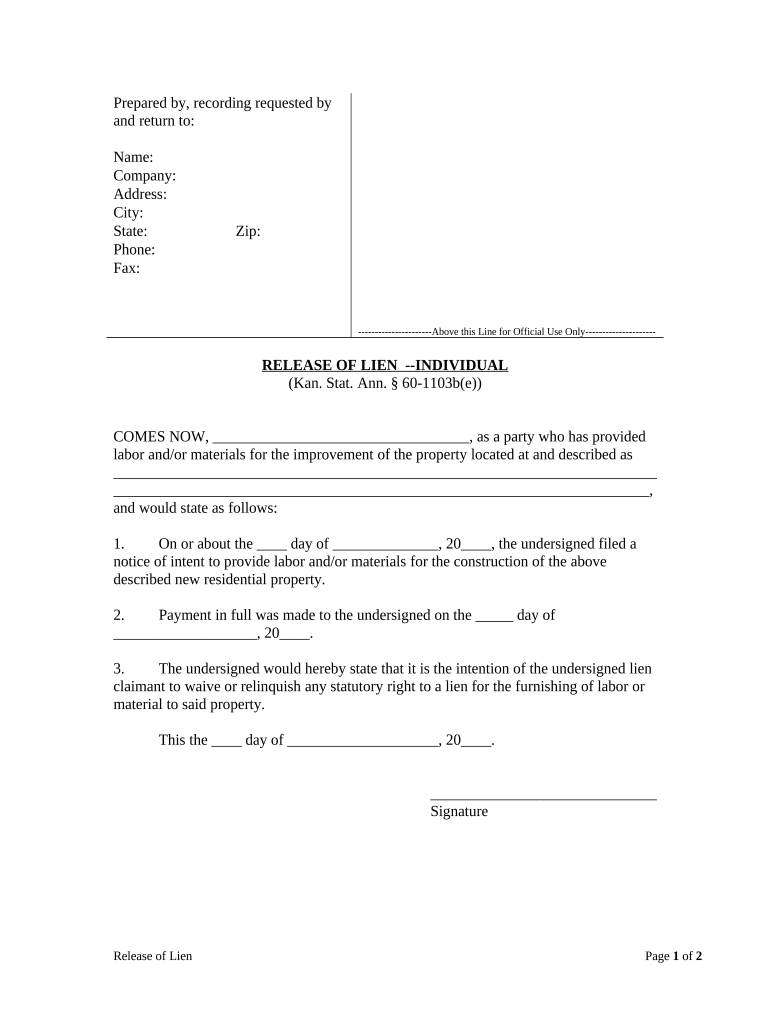
A Kansas Release of Lien is a written instrument used to remove or satisfy a previously recorded lien affecting real property in Kansas. It typically identifies the original lien document, the parties (lienholder and property owner), the recorded book/page or instrument number, and declares that the lien is released or satisfied. Once properly executed and recorded at the county register of deeds, the release clears the encumbrance from public land records and restores the owner’s free marketable title for transactions such as sale, refinancing, or reconveyance.

Why a clear, recorded release matters

Recording a correct Kansas Release of Lien ensures the public record reflects that the encumbrance has been satisfied, prevents title defects, and reduces the risk of disputes or delays in sale or refinancing transactions.

Why a clear, recorded release matters

Who commonly prepares and uses this document

Typical users include lienholders who must release security interests and property owners or title companies who need proof of clear title.

  • Lienholders and lenders who issued or hold the lien and must provide formal release documentation.
  • Property owners and title/escrow agents who need recorded evidence to close a sale or refinance.
  • Attorneys and settlement agents preparing or reviewing release language and facilitating county recording.

The parties above often coordinate notarization and county recording to finalize the release and update title records.

Primary signers and their roles

Lienholder

An authorized representative of the creditor or lienholder (title officer, loan servicer, or attorney) who must sign to acknowledge satisfaction or cancellation of the lien. The signer’s authority and corporate title should be included to validate the signature for recording and title company review.

Property Owner

The current recorded owner of the property who may confirm receipt of satisfaction language; owner signatures are sometimes included for clarity though not always required for release recording. Accurate owner identification avoids disputes about which parcel or interest is affected.

Essential components of a professional Release of Lien

A complete Release of Lien includes uniquely identifying information, an explicit release statement, accurate property description, signature blocks with notarization where required, and recording references to the original lien document.

Document Title

Clear heading such as 'Release of Lien' and a short caption linking it to the original lien instrument.
Identifying Reference

Original lien instrument date, book/page or instrument number, and county where initially recorded.

Release Statement

Explicit language stating that the lien is fully released or satisfied and identifying any limitations or partial releases.

Property Description

Legal description of the real property (metes and bounds or recorded plat reference) matching county records exactly.

Signatures and Authority

Printed name, title and signature of the authorized lienholder representative; include corporate capacity if applicable.

Notary Acknowledgement

Notary block meeting Kansas or county standards; include date and county for recorder acceptance.

Required data points to include

Lien ID: Original instrument number
Recording County: County name
Property: Full legal description
Parties: Lienholder and owner names
Date: Execution date (MM/DD/YYYY)
Notary: Notary acknowledgment details

Step-by-step: prepare, sign, and record a Kansas Release of Lien

Follow these sequential steps to ensure the release is valid, recorded, and reflected in title searches.

  • 01
    Identify Lien: Locate the original recorded lien instrument and confirm recording details.
  • 02
    Draft Release: Prepare release language referencing the original instrument and include full property description.
  • 03
    Sign & Notarize: Have authorized lienholder sign and obtain notarization per Kansas/county requirements.
  • 04
    Record & Distribute: Submit to the county register of deeds for recording and provide recorded copy to owner and title company.

Where to sign and where the release must go

A recorded release must be notarized and delivered to the county register of deeds where the property is recorded; distribute copies to interested parties after recording.

  • Prepare Document: Complete release and verify original lien reference and legal description.
  • Notarize: Obtain notary acknowledgment in the county of signing (or use RON if accepted).
  • Record with County: File the original signed release with the county register of deeds for the property.
  • Provide Recorded Copies: Give certified or stamped copy to property owner and title/escrow officer.

Digital handling and eSubmission considerations

Electronic preparation, signing, and submission can speed recording and distribution when supported by the county or by secure eDelivery to title companies.

  • File Format: PDF or scanned TIFF acceptable for most recorders
  • eSignature Authentication: Use signer attribution (email, SMS, or KBA) and retain audit trail
  • Integrations: Connect with systems like NetSuite, Microsoft 365, or Google Workspace for storage and routing

Confirm county recording rules before eSubmission; many counties still require original ink-signed notarized documents for recording.

Typical electronic workflow settings for completing the release

Set up fields and routing to ensure proper signature order and audit capture when using eSignature platforms.

Field Configuration
Signature Require signer name, title, and date
Notary Block Include dedicated notary acknowledgment area
Authentication Email + SMS code or platform 2FA
Storage PDF/A archived with audit trail

Common mistakes to avoid

  • Using an incorrect instrument number that misidentifies the lien
  • Submitting an unsigned or improperly notarized release for recording
  • Providing an incomplete legal description that doesn’t match county records
  • Failing to confirm county-specific recording format or electronic acceptance

Risks and consequences of an incorrect release

Recording Rejection: Delays or refusal
Title Clouded: Lingering encumbrance
Re-Recording Costs: Additional fees and time
Dispute Litigation: Potential court actions
Escrow Delays: Closings postponed
Credit/Finance Impact: Refinance may be blocked

Timing and practical deadlines to consider

Recording promptly after execution preserves lien priority status and prevents transaction delays; check county processing times for exact expectations.

Execution to Recording:

Record as soon as reasonably possible to reflect release in public record

Title Search Window:

Provide recorded release to title company prior to closing

Escrow Deadlines:

Meet lender and escrow timetables to avoid delays

RON Availability:

Confirm remote notarization acceptance before scheduling

Document Retention:

Retain recorded copy permanently for title proof

Real-world scenarios where a release is needed

Two short examples show typical situations that require a recorded release of lien.

Sale Closing

A homeowner refinanced and fully paid the construction lender

  • Title requested a recorded lien release
  • The recorded release allowed the refinance to close without title exceptions by the lender.

Mechanic’s Lien Satisfaction

A subcontractor accepted payment and issued a partial release

  • The release referenced the original mechanic’s lien instrument
  • Recording the partial release updated county records and cleared the affected units for sale.

eSignature vendor pricing and capabilities relevant to lien releases

Compare common eSignature vendors for preparing, signing, and delivering a Release of Lien; signNow is listed first per vendor comparison conventions.

signNow DocuSign Adobe Sign PandaDoc HelloSign
Starting Price $8/user/mo $15/user/mo $14/user/mo $19/user/mo $15/user/mo
Free Trial 7-day free trial No No Yes, limited Yes, limited
Bulk Send Yes Yes Yes Yes No
Audit Trail Yes Yes Yes Yes Yes
HIPAA Compliant Yes Yes Yes No No
Envelope Cap No cap 100 envelopes/user/year Varies by plan Varies by plan Varies by plan

Frequently asked questions about Kansas Release of Lien

Answers to common questions about validity, recording, signatures, and electronic options when handling a Release of Lien in Kansas.


Need help? Contact support

be ready to get more
Join over 28 million airSlate SignNow users