Notice of Lawsuit and Request for Waiver of Service of Summons
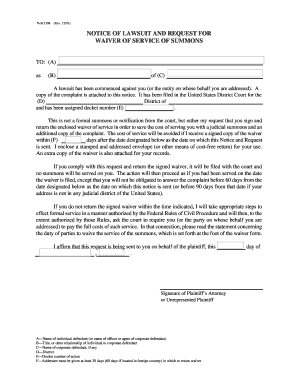
What the Notice of Lawsuit and Request for Waiver of Service of Summons Is
Why a Waiver Request Matters in Civil Litigation
Requesting a waiver can lower service expenses, streamline timing, and create documentary proof of notice while preserving the defendant’s response period under procedural rules.

Who Typically Prepares and Receives a Waiver Request
Common preparers include plaintiff counsel, corporate legal departments, and process-service vendors arranging waiver delivery.
- Plaintiff attorneys and paralegals prepare and track waivers for cost-effective service and case management.
- Corporate legal teams use waivers to centralize receipt and reduce repeated process-server expenses across multiple actions.
- Defendants and in-house counsel receive and sign waivers to avoid in-person service and to preserve defense timelines.
Step-by-step: Completing a Waiver Request Package
-
01Prepare Documents: Attach complaint, summons form, and waiver form in PDF format.
-
02Populate Recipient: Enter defendant name, address, and entity details precisely as registered.
-
03Select Delivery: Choose certified mail, email with consent, or supported e-delivery per applicable rules.
-
04Track Response: Record return date; if not returned, proceed to formal service steps.
Configuring an electronic waiver workflow
| Field | Configuration |
|---|---|
| Authentication | Email link with optional SMS code for added verification |
| Signature Type | Click-to-sign or drawn signature with audit trail |
| Expiry | Default 30 days; set reminders at 7 and 21 days |
| File Format | Send as locked PDF with embedded audit metadata |
How electronic waiver delivery typically works
-
Upload: Sender uploads complaint, waiver form, and any exhibits.
-
Tag Fields: Place signature, date, and identification fields for the recipient.
-
Deliver: Send via email link, certified mail, or verified e-delivery mechanism.
-
Receive: Recipient signs and returns the waiver; system captures a certificate of completion.
Technical considerations for e-delivery and signature
Confirm your platform supports required audit trails, preferred file formats, and the chosen signer authentication method.
- Integrations: Salesforce, NetSuite, Google Workspace supported
- File Types: PDF and DOCX accepted with embedded metadata
- Authentication: Email link, SMS code, or advanced signer ID
Use systems that retain tamper-evident audit logs, store a reproducible record, and meet ESIGN/UETA rules for enforceability.
Key timing rules and response periods to track
Request Sent Date:
The date you mail or transmit the waiver begins the defendant’s response period.
Domestic Response Period:
Defendant generally has 30 days to return a signed waiver if mailed within the United States.
International Response Period:
Defendants outside the United States typically get 60 days to sign and return the waiver.
File Proof If Unreturned:
If waiver not returned, you must effect formal service and file proof of service with the court.
Cost and Fee Timing:
If defendant refuses unreasonably, the court may award costs incurred after the waiver request date.
Common mistakes when preparing a waiver request
- Using an incorrect or incomplete defendant name causes delays or makes service ineffective in court.
- Sending to a P.O. box when rules require a physical address increases risk of disputed service.
- Failing to include a complete copy of the complaint and summons can void the waiver request.
- Neglecting to document transmission and receipt removes evidence needed to claim costs later.
Risks and potential consequences of errors
Comparing eSignature vendor capabilities for waiver workflows
| signNow | DocuSign | Adobe Sign | PandaDoc | HelloSign | |
|---|---|---|---|---|---|
| Starting Price | $8/user/mo | $15/user/mo | $14/user/mo | $19/user/mo | $15/user/mo |
| Free Trial | 7-day free trial | Trial varies by vendor | Trial varies by vendor | Trial varies by vendor | Trial varies by vendor |
| Bulk Send | Yes (Business Premium) | Yes | Yes | Yes | No |
| Audit Trail | Yes | Yes | Yes | Yes | Yes |
| HIPAA Compliant | Yes | Yes | Yes | No | No |
| Envelope Cap | No envelope cap | 100 envelopes/user/year | Varies by plan | Varies by plan | Varies by plan |
Frequently asked questions and troubleshooting
-
What if the defendant returns an unsigned waiver?
If the document is unsigned or the signature is disputed, treat the waiver as not returned and proceed with formal service. Preserve all transmission records and correspondence to show you attempted waiver service.
-
Can I send a waiver by email alone?
Email can be acceptable if the recipient consented to electronic service and the jurisdiction permits it; ensure you capture consent, use an audit trail, and confirm receipt per ESIGN and UETA standards.
-
What happens if the defendant refuses to waive?
If refusal is unreasonable, file for formal service and you may seek reimbursement of service costs or expenses incurred after the waiver request date, depending on court rules.
-
How do I prove receipt of a returned waiver?
Maintain a tamper-evident audit log showing signer identity, timestamp, IP address, and the signed PDF. Such metadata supports admissibility and shows attribution under ESIGN/UETA.
-
Does an eSignature meet legal requirements?
Electronic signatures meet the ESIGN Act and UETA when they show intent, consent, attribution, and retention. For consumer-facing matters, provide any required ESIGN consumer disclosures.
-
Are there platform features to reduce disputes?
Use strong signer authentication, document locking after signing, and a complete certificate of completion. Platforms with these features help establish reliability without changing substantive case law.