Establishing secure connection…Loading editor…Preparing document…

Order to Extend or Waive Lay Guardian Training Requirements

This template is fully customizable. Edit the text, fill out the fields, and send it for signature. Give it a try!
Order to Extend or Waive Lay Guardian Training Requirements

What this Order Does and When it Applies

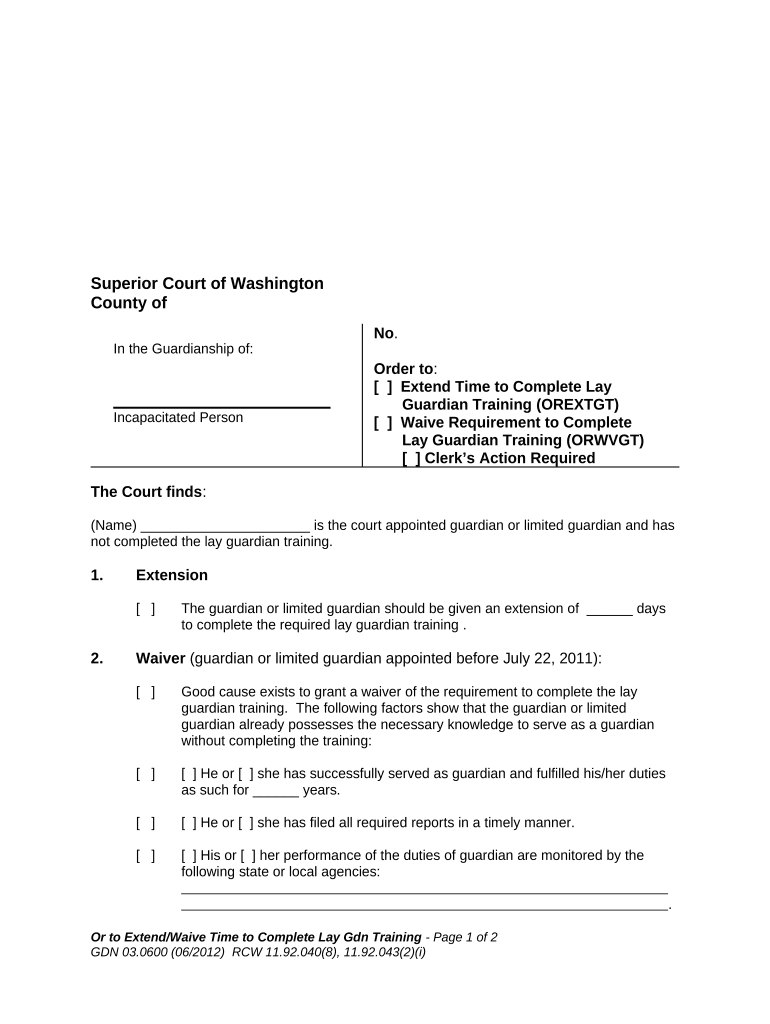
An Order to Extend or Waive Lay Guardian Training Requirements is a court directive used in guardianship proceedings to change the training obligations imposed on a lay guardian — typically a nonprofessional family member or friend appointed to care for a ward. The order either extends the deadline to complete mandatory guardian education or waives training entirely when the court finds good cause, such as incapacitating health issues, undue hardship, prior comparable experience, or demonstrated competency. The document must identify the guardian, the ward, the original training requirement, and the specific modification the court intends to make.

Why an Accurate Order Matters

A clear, correctly completed order protects the ward and the guardian by documenting judicial findings and ensuring compliance with statutory and local rules. It clarifies timing, obligations, and any future reporting requirements to the court or supervising agency.

Why an Accurate Order Matters

Who typically prepares and relies on this order

Courts, guardianship attorneys, court-appointed guardians ad litem, and family members commonly prepare or receive these orders when training deadlines or fitness issues arise.

  • Court clerks and judicial staff who docket and enter the order into the case file.
  • Attorneys for the ward or guardian who draft proposed orders for judge signature.
  • Lay guardians and family members who must know the modified obligations and deadlines.

Primary signers and their roles

Lay Guardian

A nonprofessional individual appointed by the court to serve as guardian; signs to acknowledge receipt of the order and any extended deadlines or waived obligations; must understand duties and recordkeeping obligations under state guardianship law.

Presiding Judge

A judicial officer who issues and signs the order after evaluating motions, evidence, and statutory criteria; the judge's signature makes the modification enforceable and establishes the court's factual findings supporting the extension or waiver.

Core components to include in a professional order

A complete order should present the court's findings, the parties, the relief granted, specific deadlines or conditions, and instructions for notice and docketing to avoid ambiguity.

Caption

Court name, case number, and title identifying the guardian, ward, and parties so the order is docket-ready and unambiguous for future reference.
Findings

Factual and legal findings supporting extension or waiver, including documented hardships, medical affidavits, or evidence of prior training or competence.

Relief

Explicit language granting extension (with new deadline) or waiver (full or partial), and any conditional or partial training obligations the court retains.

Instructions

Clear directions about who must be notified, how the guardian should document compliance, and whether periodic reporting to the court is required.

Signatures

Signature lines for the judge, the guardian (acknowledgement), and counsel where appropriate, with dates to establish effective timing.

Service

A certificate of service block stating how and when notice was provided to interested parties, which supports procedural due process.

Essential information fields to capture

Case Number: Court docket number
Guardian Name: Full legal name
Ward Name: Full legal name
Original Deadline: MM/DD/YYYY
New Deadline: MM/DD/YYYY
Judge Signature: Printed name and date

Step-by-step: preparing and filing the proposed order

Follow these sequential steps to prepare a legally sound order and minimize return or correction by the court clerk.

  • 01
    1. Gather records: Collect the guardianship petition, prior orders, and medical affidavits.
  • 02
    2. Draft findings: Write factual support showing good cause for extension or waiver.
  • 03
    3. Prepare proposed order: Insert precise relief language and signature blocks.
  • 04
    4. Serve parties: Provide notice and file a certificate of service with the court.

Post‑entry tasks after the order is signed

After the judge signs, complete administrative steps to ensure the order takes effect and parties comply.

01

File the order:

Clerk records entry.
02

Notify guardian:

Send certified or electronic notice.
03

Update case file:

Attach related affidavits.
04

Monitor compliance:

Set reminders for new deadlines.
05

Schedule reports:

If required, calendar periodic updates.
06

Close motion:

Prepare a docket entry closing the motion.

How to configure a digital workflow for this order

Set up a simple review-and-sign workflow to collect signatures, preserve the record, and notify interested parties automatically.

Field Configuration
Upload Template Use PDF or DOCX, include editable fields.
Place Fields Add signature, date, and service blocks.
Authentication Use email or SMS code for signer identity.
Retention Settings Enable audit trail and automatic archiving.

Routing and filing: where the order goes next

Knowing routing destinations prevents delays: docket the signed order, notify counsel and parties, and, if required, send copies to supervising agencies.

  • Court Clerk: File the signed order for the official record.
  • Guardian: Provide the guardian a dated copy for compliance.
  • Attorney of Record: Serve counsel for both sides per local rules.
  • Supervising Agency: Send copy when required by local guardianship oversight.

Digital signing and storage considerations

Ensure platform compliance with ESIGN/UETA and any applicable privacy rules; maintain a secured copy in the court file and with the guardian.

  • Document types: PDF and DOCX supported
  • Authentication: Email or SMS codes
  • Retention: Encrypted storage at rest

Typical deadlines and processing expectations

Key dates to track include the original training deadline, any new deadline the order sets, and dates for required status reports to the court.

Original Training Deadline:

Date previously ordered

Extended Deadline:

New date specified in order

Reporting Date:

Date for guardian status report

Service Deadline:

Date by which notice must be provided

Clerk Entry Date:

Date order is docketed

Key milestones after filing the motion

This timeline outlines milestones the court typically follows after a motion to extend or waive training is filed.

01

Motion Filed

Clerk accepts motion; case flagged for review

02

Notice Served

Parties receive notice per local rule

03

Hearing (if required)

Court hears evidence and argument

04

Order Entered

Judge signs extension or waiver order

Common drafting mistakes to avoid

  • Vague relief language such as 'more time as needed' without a specific new deadline creates enforcement problems and later disputes.
  • Failing to attach supporting affidavits or medical records when claiming hardship increases the chance of denial by the court.
  • Omitting a certificate of service leads to procedural defects and possible challenges to the order's validity.
  • Using inconsistent names or docket numbers on the order compared with the petition can result in the clerk returning the document for correction.

Risks and consequences of an incorrect order

Noncompliance: Court sanctions possible
Voidable Relief: Order may be set aside
Service Defects: Leads to rehearing requests
Privacy Breach: Exposure of medical data
Record Errors: Impedes future oversight
Delayed Care: Harms ward's interests

Typical eSignature pricing models to consider for filing and signing orders

Compare vendor pricing and basic plan capabilities; signNow is listed first for parity. Confirm plan details and features directly with each vendor before purchasing.

signNow DocuSign Adobe Sign PandaDoc HelloSign
Starting Price $8/user/mo $15/user/mo $14/user/mo $19/user/mo $15/user/mo
Free Trial 7-day free trial Varies by plan Varies by plan Varies by plan Varies by plan
Bulk Send Yes Yes Yes Yes No
Audit Trail Yes Yes Yes Yes Yes
HIPAA Compliant Yes Yes Yes No No

Practical examples of order usage

The following scenarios illustrate common factual bases for extending or waiving training requirements.

Medical Hardship Example

An elderly guardian with a recent stroke requested an extension supported by a physician affidavit.

  • Court granted a six-month extension to allow recovery.
  • The order required interim monthly status reports and set a firm new completion deadline to preserve oversight and ward protection.

Prior Experience Example

A family member demonstrated prior professional caregiving experience and requested a waiver.

  • Court reviewed CV and references.
  • The judge issued a partial waiver limited to classroom training, requiring the guardian to complete an online ethics module within 90 days.

Frequently asked questions and practical answers

Answers to common questions about drafting, filing, service, and digital execution of an order to extend or waive lay guardian training.


Need help? Contact support

be ready to get more
Join over 28 million airSlate SignNow users