Establishing secure connection…Loading editor…Preparing document…

Lay Off Letter

This template is fully customizable. Edit the text, fill out the fields, and send it for signature. Give it a try!
Lay Off Letter

What a Lay Off Letter Is and When Employers Use It

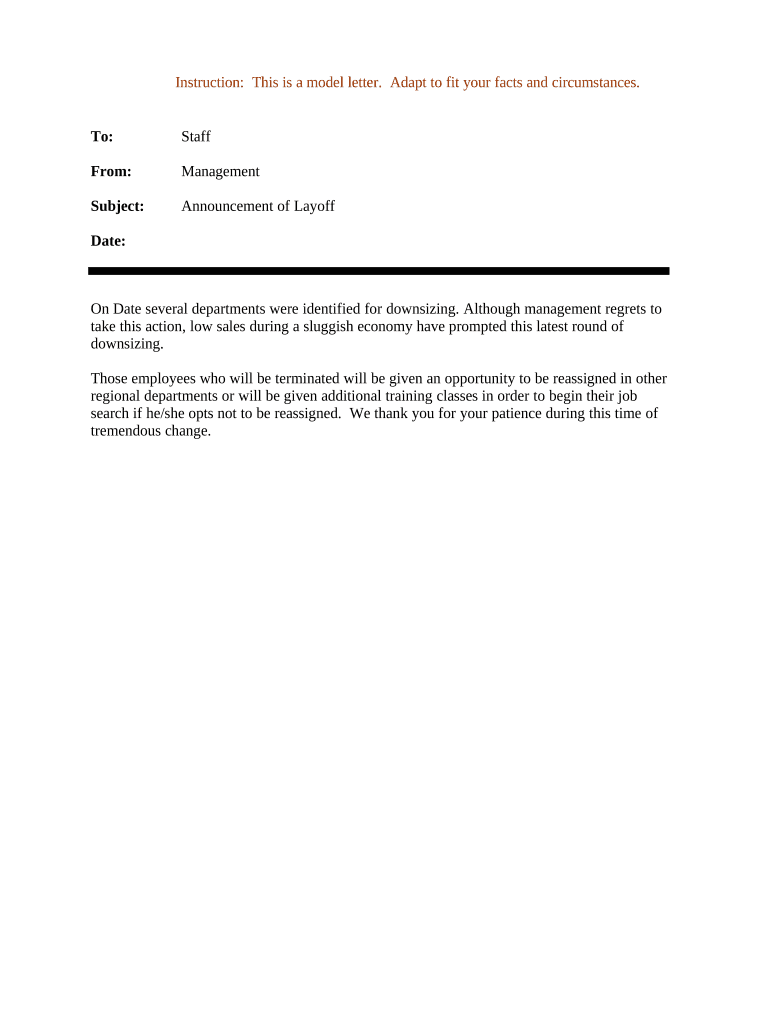
A Lay Off Letter is a written notice an employer provides to an employee when employment ends for reasons unrelated to the employee’s individual performance, typically because of business downturns, restructuring, or elimination of a position. The document establishes the effective separation date, explains any severance or benefits continuation, and records employer contact information for follow-up. In the United States, certain mass layoffs may trigger federal or state notice obligations such as the WARN Act; employers should coordinate the letter with human resources, payroll, and benefits teams to ensure compliance and to preserve records for unemployment and benefits administration.

Why a Clear Lay Off Letter Matters

A concise lay off letter reduces confusion about separation terms, supports benefits eligibility, and documents the employer’s compliance efforts under applicable notice rules.

Why a Clear Lay Off Letter Matters

Who Typically Prepares and Receives a Lay Off Letter

Prepare letters with recordkeeping in mind and route copies to personnel files, payroll, and benefits administrators to support downstream processes.

  • HR professionals and in-house counsel who coordinate compliance and benefits administration.
  • Managers and department heads implementing workforce reductions in coordination with HR.
  • Employees impacted by a position elimination who need official separation terms for unemployment and benefits.

Essential Elements to Include in a Professional Lay Off Letter

A well-constructed lay off letter contains clear, objective facts and avoids ambiguous language that could be construed as discriminatory or performance-related.

Separation Reason

State the business reason (e.g., position eliminated, budgetary constraints) in neutral terms to avoid implying misconduct.
Effective Date

Provide the exact last day of employment using MM/DD/YYYY format so payroll and benefits teams have a definitive cutoff.

Final Pay

Describe the final paycheck timing and what pay elements are included (unused vacation, bonuses) consistent with state law.

Benefits & COBRA

Note continuation options for health benefits, contact for COBRA notices, and the employee’s responsibility to elect coverage if applicable.

Severance Terms

List any severance pay, calculation method, payment schedule, and any conditions (e.g., release of claims) tied to the payment.

Point of Contact

Include a company contact name, title, phone, and email for questions about benefits, references, or return of company property.

Step-by-Step: Preparing and Delivering a Lay Off Letter

Follow a documented sequence to confirm facts, coordinate payroll/benefits, and deliver the notice in a compliant and respectful manner.

  • 01
    Confirm Eligibility: Verify position elimination, budget approvals, and corporate authorization to proceed.
  • 02
    Coordinate Payroll: Determine final wages, accrued PTO payout, and tax withholdings before issuing the letter.
  • 03
    Prepare Letter: Populate required fields, review legal language, and obtain required internal approvals.
  • 04
    Deliver Notice: Provide the letter in person or via secure electronic delivery and retain proof of receipt.

Where to Send and File a Lay Off Letter

After delivery, route the letter to all relevant internal and external recipients to support benefits, compliance, and recordkeeping processes.

  • Employee Delivery: Provide the employee a signed copy and document the delivery method and time.
  • HR Record: Upload the signed letter to the employee’s personnel file in HRIS or document management.
  • Payroll: Send final pay and accrual details to payroll to schedule the final paycheck.
  • Benefits Administrator: Notify benefits vendor for COBRA, retiree plan handling, and health plan terminations.

Digital Workflow Settings for eDelivery and Recordkeeping

Set up a consistent e-delivery workflow to capture signatures, timestamps, and retention automatically.

Field Configuration
Document Format PDF/A or DOCX — preserve layout and metadata
Signer Authentication Email link or SMS code; consider stronger methods for sensitive cases
Audit Trail Record IP, timestamp, and signer events for each document
Retention Policy Automate archival and access controls per corporate retention rules

Technical Requirements for eSigning and Secure Delivery

Ensure the chosen solution can export signed documents with immutable audit records and store them according to retention policy.

  • File Types: PDF, DOCX supported
  • Authentication: Email link, SMS code, or advanced methods
  • Integrations: HRIS and cloud storage integrations

Security and Compliance Considerations for Electronic Lay Off Letters

Encryption: TLS 1.2/1.3 in transit; AES-256 at rest
Audit Trail: Detailed signer timestamps and IP addresses
Access Controls: Role-based permissions and SSO
HIPAA Support: BAA available when PHI present
Compliance Standards: SOC 2 Type II and ISO 27001
Data Privacy: GDPR and CCPA controls

Key Timing Rules and Deadlines to Watch

Timelines for notices and payments are time-sensitive and may trigger penalties or claims if missed; check federal and state deadlines when finalizing the letter.

WARN Act Notice:

60-day notice for covered mass layoffs in many cases

Final Pay Timing:

State rules vary; some require immediate payment at termination

COBRA Election Window:

Typical election period is up to 60 days following notice

Unemployment Filing:

Employees should file promptly; employers must timely respond to claims

Record Retention:

Retain separation records per corporate retention policy and legal requirements

Common Pitfalls When Preparing a Lay Off Letter

  • Using vague language about the reason for separation, which can create ambiguity and invite litigation.
  • Failing to coordinate with payroll and benefits, causing delayed final pay or incorrect benefits termination dates.
  • Neglecting required mass layoff notices (e.g., WARN Act), which can lead to statutory penalties and back pay liabilities.
  • Delivering the letter without securing proof of receipt or an audit trail for future disputes.

Risks and Potential Consequences of an Incorrect Lay Off Letter

WARN Penalties: Potential back pay and benefits liability
Unemployment Disputes: Increased contested claims and employer response obligations
Discrimination Risk: Ambiguous reasons can trigger discrimination claims
COBRA Violations: Incorrect notices can cause statutory damages
Payroll Errors: Late or inaccurate final wages invite state penalties
Data Exposure: Improper delivery risks personal data breaches

eSignature Platform Comparison for Delivering Lay Off Letters

Compare baseline pricing and core features for common eSignature platforms when selecting a solution to issue, sign, and retain layoff notices.

signNow DocuSign Adobe Sign PandaDoc HelloSign
Starting Price $8/user/mo $15/user/mo $14/user/mo $19/user/mo $15/user/mo
Free Trial 7-day free trial No No Yes, limited Yes, limited
Bulk Send Yes Yes Yes Yes No
Audit Trail Yes Yes Yes Yes Yes
HIPAA Compliant Yes Yes Yes No No

Real-World Examples of Digital Notice and Recordkeeping

Practical examples show how organizations combine standardized letters with digital workflows to document separations and retain evidence.

Optica Ventures

Optica standardized layoff notices across its portfolio to reduce administrative delays.

  • They used consistent fields and centralized records.
  • The standardized approach shortened HR processing time and produced a single, auditable record for each separation, which simplified unemployment responses and internal audits.

Martin Properties

A regional real estate firm digitized separation letters during a restructuring.

  • They captured signed acknowledgements electronically.
  • Digital delivery and archived audit trails reduced time to issue final pay and improved coordination between property managers, payroll, and benefits vendors.

Frequently Asked Questions About Lay Off Letters

Answers to common questions about content, delivery, signature methods, and record retention for layoff notices.


Need help? Contact support

be ready to get more
Join over 28 million airSlate SignNow users