Establishing secure connection…Loading editor…Preparing document…

Letter Confirming Acceptance of Order

This template is fully customizable. Edit the text, fill out the fields, and send it for signature. Give it a try!
Letter Confirming Acceptance of Order

What the Letter Confirming Acceptance of Order Is

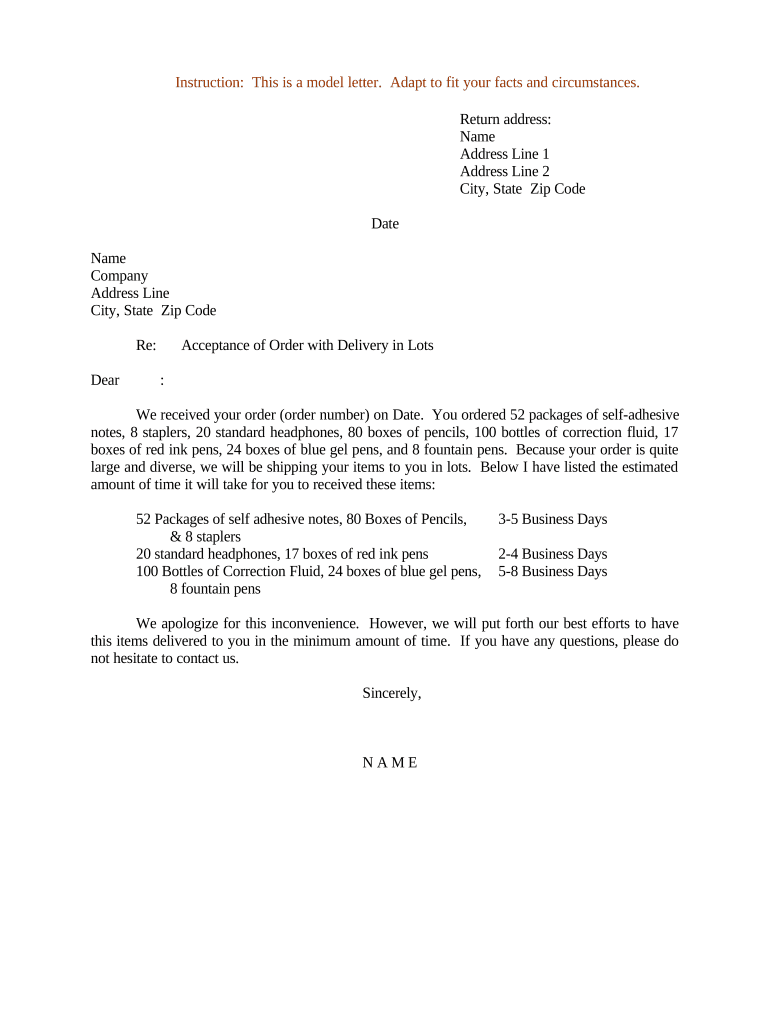
A Letter Confirming Acceptance of Order is a formal business letter that acknowledges receipt of a buyer's purchase order and confirms the seller's acceptance under the stated terms. It records the order number, describes the accepted goods or services, repeats price, delivery dates, and payment terms, and identifies any conditions or exceptions. The letter creates a written record for procurement, logistics, and accounting, and can reduce disputes by confirming mutual understanding of key commercial terms before fulfillment begins.

Why this letter matters for your transactions

Confirming acceptance promptly reduces miscommunication, documents the contract formation, and creates evidence of agreed delivery and payment terms. It protects both buyer and seller by setting expectations and limiting downstream disputes.

Why this letter matters for your transactions

Who typically prepares or receives this letter

Procurement, sales, and accounts teams commonly prepare or review acceptance letters to record order terms and trigger downstream processes.

  • Purchasing departments and buyers who need confirmation before releasing payment or scheduling delivery.
  • Sales or order management teams who accept orders and set fulfillment instructions.
  • Accounting and logistics teams that require written terms to invoice, ship, and reconcile orders.

Core components to include in the acceptance letter

A professional acceptance letter follows a clear structure that confirms mutual agreement and provides operational detail for fulfillment and recordkeeping.

Header

Date, seller name and address, buyer name and address, and the purchase order number to uniquely identify the transaction.
Acceptance statement

A direct sentence confirming that the seller accepts the buyer's purchase order, noting any exceptions or conditions to acceptance.

Order details

Clear description of goods or services, SKU or part numbers, quantities, unit prices, and total order value for accurate processing.

Delivery terms

Agreed delivery date or schedule, shipping method, delivery location, and responsibilities for freight, insurance, or customs.

Payment terms

Invoice timing, payment method, net days, discounts for early payment, and any penalties for late payment or returned goods.

Signatures

Printed name, title, signature, and date from an authorized representative for legal effect and internal approval traceability.

Required information fields at a glance

Order number: Mandatory reference
Party names: Seller and buyer
Item details: Description and SKUs
Quantity and price: Units and totals
Delivery terms: Date and method
Authorized signature: Name and title

Step-by-step: completing the acceptance letter

Follow these sequential steps to create a clear, enforceable acceptance letter that aligns with the buyer's purchase order and your internal controls.

  • 01
    1. Verify PO: Confirm purchase order number and compare items, quantities, and prices.
  • 02
    2. Write acceptance: State acceptance clearly and list any exceptions or qualifications.
  • 03
    3. Add logistics: Include delivery date, location, and carrier instructions.
  • 04
    4. Authorize: Obtain signature from an authorized representative and date the letter.

Customizing the letter in an online workflow

When digitizing the letter, set up fields and routing so approvals, signatures, and archive actions occur automatically.

Field Configuration
PO Number Field Required text field, validate numeric format
Item List Table Repeatable rows for SKU, description, qty, unit price
Delivery Date Date picker in MM/DD/YYYY format
Signature Block Signer role, authentication level, and timestamp

Where to send the completed letter and next steps

Routing the acceptance letter correctly ensures accounting, logistics, and the buyer receive records needed to proceed.

  • To buyer: Email or eDeliver signed copy to buyer contact on PO
  • To accounting: Attach to invoice queue to trigger billing
  • To logistics: Provide delivery instructions to shipping team
  • Archive: Store signed copy in document management system

Distribution and digital signing considerations

Choose distribution channels and signer authentication that match your risk profile and regulatory obligations.

  • Email delivery: Common for buyer-seller exchange
  • Secure portal: Preferred for high-value orders
  • eSignature: Audit trail and timestamp

Ensure the platform supports your required signature authentication, audit trail detail, and archival format; integrate with ERP or document storage where possible to automate downstream processing.

Timelines and timing expectations

Common internal timelines help set expectations for response, fulfillment, and invoicing after acceptance.

Response time:

Acknowledge the PO within 24–72 business hours

Delivery schedule:

Confirm promised ship or delivery date in the letter

Invoice timing:

Invoice per agreed payment terms upon shipment or delivery

Discrepancy notice:

Notify buyer of shortages within 5 business days

Record retention:

Retain a signed copy per policy and legal requirements

Common mistakes to avoid

  • Failing to quote the purchase order number precisely, causing mismatched records and delays in processing.
  • Omitting delivery or payment terms, which can lead to misunderstandings and late shipments or payment disputes.
  • Using ambiguous acceptance language such as 'we will attempt to fulfill' instead of a clear acceptance statement.
  • Not obtaining an authorized signature, leaving acceptance open to challenge or internal control failures.

Risks and potential consequences of errors

Contract disputes: May arise from ambiguous acceptance
Delayed shipments: Operational and financial impact
Incorrect invoicing: Triggers reconciliation issues
Regulatory exposure: Industry rules may require accurate records
Tax reporting: Mismatched documents complicate audits
Credit risk: Unclear terms increase payment risk

eSignature vendor pricing comparison for sending acceptance letters

Compare basic starting prices and core capabilities for eSignature providers often used to sign and distribute acceptance letters and supporting documents.

signNow DocuSign Adobe Sign PandaDoc HelloSign
Starting Price $8/user/mo $15/user/mo $14/user/mo $19/user/mo $15/user/mo
Free Trial Yes, 7-day free trial Varies Varies Varies Varies
Bulk Send Yes Yes Yes Yes No
Audit Trail Yes Yes Yes Yes Yes
HIPAA Compliant Yes Yes Yes No No
Envelope Cap No cap 100 envelopes/user/year Varies Varies Varies

Frequently asked questions about acceptance letters

Answers to common questions about timing, validity, signatures, and eSigning help prevent errors and ensure enforceable confirmations.


Need help? Contact support

be ready to get more
Join over 28 million airSlate SignNow users