Letter of Apology for Payment Error
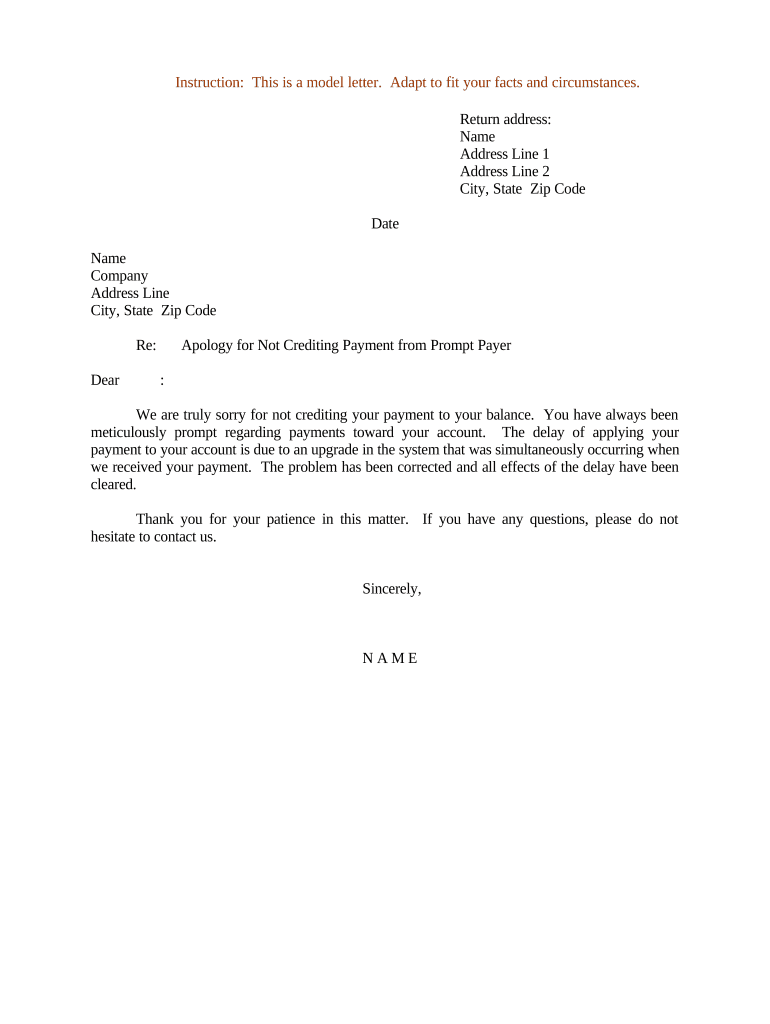
What a Letter of Apology for Payment Error Is
Why sending a clear apology letter matters
Prompt, factual apology letters restore trust, reduce escalation risk, and create a written record of the error and remedy. For businesses they help protect accounting integrity, limit disputes, and document corrective action for audits or regulators.

Who typically prepares and receives this letter
Common senders and recipients vary by context; the letter is practical for both organizations and individuals.
- Accounts payable departments notifying vendors of an overpayment and refund arrangements.
- Customer service or billing teams informing customers about incorrect charges and remedial steps.
- Vendors or suppliers notifying buyers that a misapplied payment has been corrected.
Tailor tone and technical detail to the recipient: use formal accounting language for vendors and plain language for consumers.
Step-by-step: drafting and issuing the apology letter
-
01Confirm the error: Verify transaction details in your accounting system.
-
02Calculate remedy: Determine refund, credit, or offset amounts precisely.
-
03Draft clear letter: State error, correction, and next steps succinctly.
-
04Send and retain: Deliver via recorded method and save copy for records.
How the correction process typically flows
-
Identification: Internal review flags the payment discrepancy.
-
Communication: Send the apology letter and correction details.
-
Remediation: Issue refund, credit memo, or ledger adjustment.
-
Documentation: Retain signed copies and ledger notes.
Configuring an online workflow for this letter
| Field | Configuration |
|---|---|
| Template name | Create 'Payment Error Apology' template |
| Signer roles | Billing agent signs; finance approves |
| Authentication | Email plus optional SMS code |
| Storage | Archive signed PDF in document store |
Digital delivery and file format considerations
Choose a platform that supports PDF and DOCX templates, secure storage, and an audit trail for signed letters.
- File formats: PDF, DOCX supported
- Integrations: CRM and accounting systems
- Authentication: Email or SMS codes
Ensure the chosen solution logs signer identity, timestamps, and IP addresses and stores a tamper-evident copy for compliance and audit purposes.
Timelines and practical deadlines to follow
Immediate notification:
Notify recipient as soon as error is verified, ideally within 1–3 business days.
Corrective payment:
Issue refund or credit within the timeframe promised in the letter.
Accounting entry:
Post correction in the same accounting period where possible to minimize reconciliation gaps.
Tax record timing:
Provide corrected year-end information and forms when applicable.
Retention start:
Begin retention from the correction date and retain per policy.
Common pitfalls to avoid when preparing an apology
- Vague descriptions of the error that make reconciliation impossible for accounting teams or vendors.
- Failing to attach transaction IDs, original invoices, or proof of overpayment to the letter.
- Delaying notification until reconciliation deadlines or tax reporting deadlines pass, increasing dispute risk.
- Using unclear remediation language that omits whether refunds, credits, or reversals will occur.
Key legal and financial risks to watch
Practical tips to ensure accuracy and speed
Real-world examples of correcting payment errors
Optica Ventures — billing clarity
Optica identified a duplicated invoice and notified the vendor immediately.
- The vendor accepted a credit memo.
- Brian Fitzgibbons observed that the simple, clear interface helped customers understand the correction and sped reconciliation for both parties.
Xerox — systems integration
A misapplied payment was traced to a mapping error in NetSuite and corrected.
- Integration logs confirmed the adjustment.
- Kodi-Marie Evans noted signNow's flexibility enabled attaching corrected ledger entries and restoring correct account balances without in-person signatures.
eSignature pricing and feature snapshot for correction letters
| signNow | DocuSign | Adobe Sign | PandaDoc | HelloSign | |
|---|---|---|---|---|---|
| Starting Price | $8/user/mo | $15/user/mo | $14/user/mo | $19/user/mo | $15/user/mo |
| Free Trial | 7-day free trial | No | No | Yes, limited | Yes, limited |
| Bulk Send | Yes | Yes | Yes | Yes | No |
| Audit Trail | Yes | Yes | Yes | Yes | Yes |
| HIPAA Compliant | Yes | Yes | Yes | No | No |
| Envelope Cap | No cap | 100 envelopes/user/year | Varies by plan | Varies by plan | Varies by plan |
Frequently asked questions about apology letters for payment errors
-
Do I need to notarize this letter?
Usually no. Simple apology letters and credit memos do not require notarization. Notarization is only needed if a document must be executed as an acknowledged legal statement or if a contract demands a notarized statement.
-
Can this letter be signed electronically?
Yes. Electronic signatures are enforceable under the ESIGN Act (15 U.S.C. ch. 96) and UETA in most states, provided intent, consent, attribution, and record retention requirements are met.
-
Will a correction affect tax reporting?
Possibly. If corrected payments change reportable amounts, you may need to issue corrected information returns or provide supplemental documentation to counterparties for year-end tax forms.
-
How long should I retain the signed letter?
Retain for at least the federal minimums relevant to the transaction: generally three years for tax records per IRC §6501(a) and up to six years for HIPAA-related records where applicable.
-
What if the recipient disputes the correction?
Keep communications factual, preserve supporting ledger entries, and escalate to legal or accounting review. Document all offers and responses to create an audit trail.
-
Should consumer disclosures be included?
Yes for consumer-facing corrections when required by law. ESIGN requires consumer-facing transactions to include consent to electronic records and a clear method to withdraw consent.