Establishing secure connection…Loading editor…Preparing document…

Letter Regarding Violations of Fair Debt Collection Practices Act

This template is fully customizable. Edit the text, fill out the fields, and send it for signature. Give it a try!
Letter Regarding Violations of Fair Debt Collection Practices Act

What a Letter Regarding Violations of the Fair Debt Collection Practices Act Is

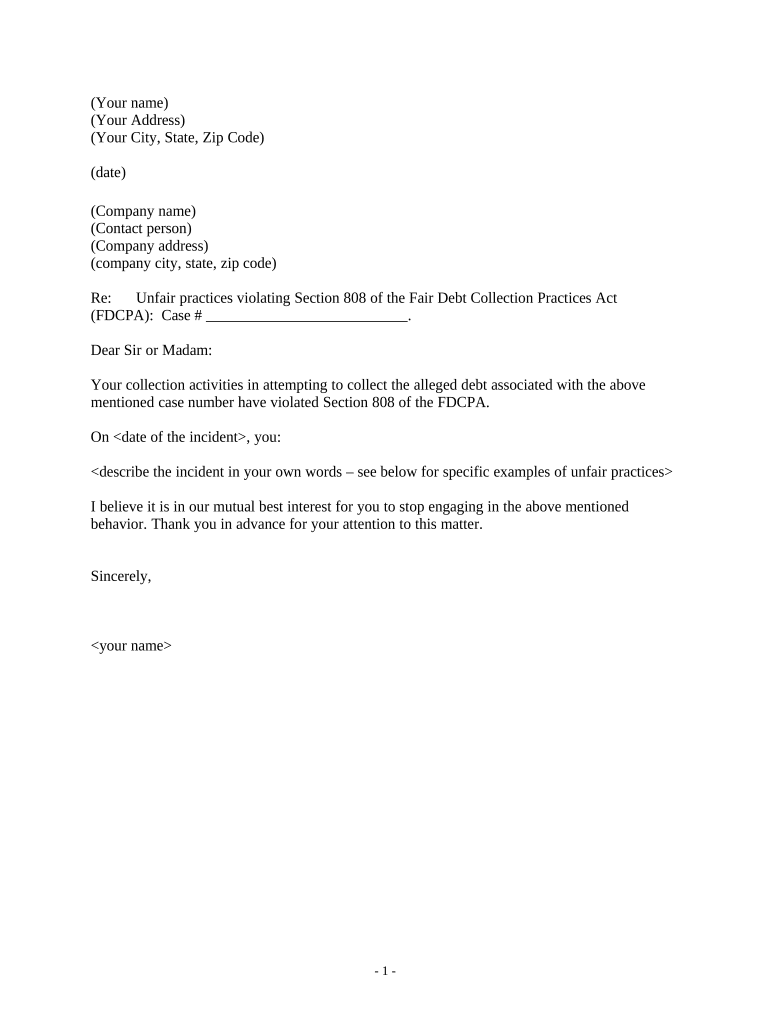
A Letter Regarding Violations of the Fair Debt Collection Practices Act is a formal written notice a consumer sends to a debt collector that describes alleged FDCPA violations, identifies the account and communications at issue, and requests verification, cessation, correction, or other remedies. The letter creates a dated record that preserves facts and supporting exhibits for regulatory complaints, dispute resolution, or litigation under the FDCPA (15 U.S.C. §1692 et seq.). Drafting with clarity and attachments improves enforceability and administrative review.

Why a Clear FDCPA Violation Letter Matters

A properly drafted Letter Regarding Violations of the Fair Debt Collection Practices Act documents misconduct, starts a dispute record, and preserves legal remedies under federal law. It notifies the collector of statutory claims, prompts verification steps, and supports complaints to the CFPB or state regulators.

Why a Clear FDCPA Violation Letter Matters

Who Typically Prepares and Uses This Letter

Consumers, consumer attorneys, and compliance officers commonly use this letter to document alleged FDCPA violations and to preserve evidence for regulatory or legal action.

  • Individual consumers disputing debt accounts, seeking verification, or objecting to harassing collection conduct.
  • Consumer attorneys assembling a written record to support FDCPA complaints or civil litigation.
  • Compliance officers documenting third-party debt collector conduct for internal review and regulatory reporting.

Core Elements to Include in the Letter

Essential elements of an FDCPA violation letter ensure clarity, traceability, and enforceability when challenging unlawful collection practices or documenting statutory breaches.

Case Identification

Include account number, original creditor, collector name, and exact dates of calls or letters, and account balances. Accurate identifiers reduce ambiguity and support regulator or court review.
Violation Details

Describe the specific collector actions that violated FDCPA provisions (harassment, false statements, unauthorized communication), with dates, times, participant names, and quoted language where possible and reference statute sections.

Statutory Reference

Reference the Fair Debt Collection Practices Act, 15 U.S.C. §1692 et seq., and cite the specific statutory subsection that aligns with the alleged conduct for clarity.

Remedy Requested

State the relief you seek—verification, cessation of calls, correction of credit reporting, or damages—and provide clear timeframes and methods for compliance, including written confirmation.

Documentation

Attach copies of collection notices, voicemail transcriptions, call logs, credit reports, and any correspondence. Label attachments and reference them within the body of the letter.

Signature Block

Sign with your full legal name, date, and contact information, and if represented include attorney contact and a statement authorizing contact through counsel; retain a copy for your records.

Step-by-Step: Prepare and Send the FDCPA Violation Letter

Follow these steps to prepare and send an FDCPA violation letter that documents alleged misconduct and preserves remedies.

  • 01
    Gather Evidence: Collect notices, logs, and credit reports.
  • 02
    Draft Letter: State facts, violations, and remedies requested.
  • 03
    Attach Documents: Attach copies of supporting documents and label them.
  • 04
    Send Certified: Mail via certified mail with return receipt.

Configuring an Online Workflow to Complete and Track the Letter

Key settings for completing and submitting the letter online, including authentication and attachment handling and delivery tracking.

Field Configuration
Authentication Method Email link default; enable SMS code or ID verification.
Attachments Allow PDF/JPEG upload; auto-attach exhibits.
Signature Type Electronic signature with audit trail; consider PKI for higher assurance.
Delivery Proof Store delivery receipts and audit trail PDF.

Platform Capabilities for Secure eSubmission and Recordkeeping

For secure eSubmission, choose a platform that supports configurable signer authentication, tamper-evident signed PDFs, persistent audit trails, and retrievable archives for regulator or court review.

  • Formats Supported: PDF, DOCX, and image files.
  • Authentication Options: Email, SMS, KBA, or ID verification.
  • Integrations: CRM, storage, and case management systems.

Common Submission Paths and Expected Handling

Routing options and handling expectations for the letter include sending to the collector, filing a regulator complaint, and preserving proof of delivery.

  • To Collector: Send certified mail to collector's business address.
  • To Original Creditor: Copy the original creditor if appropriate.
  • Regulator Filing: File a complaint with CFPB or state agency.
  • Legal Counsel: Provide letter to attorney for review.

Timing and Response Expectations After Sending the Letter

Time expectations for collector response, dispute resolution, and regulator complaint windows after sending an FDCPA violation letter.

Collector Response Time:

No fixed federal deadline; collectors must respond to written dispute and provide verification.

Certified Mail Receipt:

Retain return receipt as proof; it helps establish delivery date.

CFPB Complaint Period:

File anytime after sending letter; include copies and proof of mailing.

Statute of Limitations:

Check state law; FDCPA claim deadlines vary by state and cause of action.

Credit Report Disputes:

Dispute inaccuracies with credit bureaus promptly; FCRA processes commonly begin within 30 days.

Key Milestones From Notice to Escalation

Milestones from sending the letter to potential legal action, presented as sequential stages to track progress.

01

Draft and Attach

Prepare letter, gather evidence, and attach exhibits.

02

Send and Document

Mail certified and save return receipt and tracking.

03

Await Response

Allow time for verification or collector reply; document any contact.

04

Escalation or Filing

File CFPB/state complaint or consult counsel for civil action.

Common Mistakes to Avoid When Preparing the Letter

  • Vague allegations without dates or specifics make it difficult for a collector, regulator, or court to match claims to records and validate the dispute.
  • Failing to use traceable delivery methods or omitting retainable proof such as return receipts undermines evidence of notice and delivery dates.
  • Mixing emotional language or threats with factual statements can reduce credibility and complicate legal evaluation of the alleged violations.
  • Not keeping copies of attachments, original notices, or a complete communication log may prevent establishing a pattern of repeated violations.

Potential Consequences and Risks

Statutory Damages: Statutory damages up to $1,000.
Actual Damages: Compensation for proven losses.
Attorney Fees: Court may award reasonable fees.
Credit Impact: Incorrect disputes may not halt reporting.
Counterclaims: Collector may assert defenses or countersuit.
Regulatory Enforcement: Potential CFPB or state enforcement action.

Practical Examples Showing How Documentation Supports Enforcement

Representative examples below illustrate how a well-documented FDCPA letter can support regulator complaints and civil claims through clear facts and evidence.

Martin Properties

Tim Martin, founder of Martin Properties, prepared a written FDCPA violation letter after repeated third-party collector calls regarding an expired tenant account.

  • He attached call logs and notices.
  • He used a secure e-signature workflow to collect signatures, preserve audit trails, and retain return receipts; those records supported his complaint and enabled compliant, efficient document execution across devices.

BIS

Dan Rotelli, CEO of BIS, documented deceptive collection statements in a formal FDCPA letter to preserve regulatory evidence and support potential litigation.

  • He cited 15 U.S.C. §1692 provisions.
  • By preserving contemporaneous exhibits and delivering the letter via certified mail, his team established a clear paper trail for counsel and regulators and emphasized the importance of secure, auditable records for dispute resolution.

Essential Information Elements to Include and Preserve

Full Legal Name: Enter name exactly as on government ID.
Account Identifier: Account number or collector reference.
Contact Details: Current address, phone, and email.
Dates of Contact: MM/DD/YYYY format for each interaction.
Attached Evidence: Copies of notices, calls, reports.
Signature and Date: Typed or handwritten signature with date.

Comparing eSignature Vendors for Letter Execution and Tracking

Vendor pricing and feature differences affect cost, auditability, and compliance when preparing and serving FDCPA violation letters; signNow is listed first for direct comparison.

signNow DocuSign Adobe Sign PandaDoc HelloSign
Starting Price $8/user/mo $15/user/mo $14/user/mo $19/user/mo $15/user/mo
Free Trial Yes, 7-day trial Varies by plan Varies by plan Varies by plan Varies by plan
Bulk Send Yes Yes Yes Yes No
Audit Trail Yes Yes Yes Yes Yes
HIPAA Compliant Yes Yes Yes No No
Envelope Cap No envelope cap 100 envelopes/user/year Varies by plan Varies by plan Varies by plan

Frequently Asked Questions About Drafting and Submitting the Letter

Answers to common questions about drafting, sending, and preserving FDCPA violation letters and about eSigning and evidentiary issues encountered in practice.


Need help? Contact support

be ready to get more
Join over 28 million airSlate SignNow users