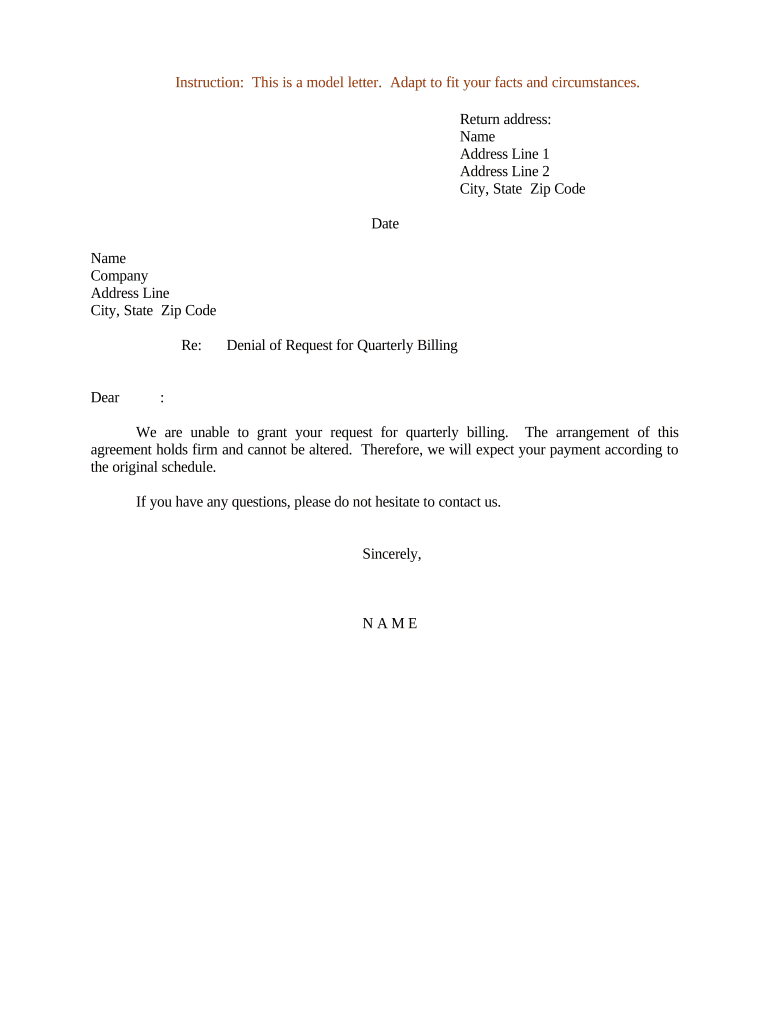
Letter Denying Request for Quarterly Billing
What the Letter Denying Request for Quarterly Billing Is
Why a Clear Denial Letter Matters
A concise, well-documented denial protects the billing party by documenting the decision, referencing contractual terms or policy, reducing misunderstandings, and preserving rights for collections or dispute resolution while maintaining a record for audits.
Who Typically Issues and Receives This Letter
Organizations across billing, finance, legal, and account management issue this letter when a customer requests a change to quarterly billing that cannot be approved.
The letter also serves internal stakeholders (audit, collections, legal) by creating a dated record of the response and next steps.
Step-by-Step: Preparing the Denial Letter
-
01Gather account details: Collect contract, invoice history, and the original request details.
-
02Identify authority: Confirm who is authorized to deny billing changes under company policy.
-
03Draft the explanation: Cite the contract or policy reason and note relevant dates.
-
04Record and distribute: Sign, date, store the letter, and send to recipient and internal teams.
How the Process Typically Flows
-
Receive request: Customer submits a billing cadence change request via email or portal.
-
Review terms: Billing or legal reviews contract language and payment history.
-
Issue denial: Authoritative signer prepares a dated denial letter with reasoning.
-
Distribute record: Send to recipient, update CRM, and retain in records.
Configuring an Online Workflow for Denial Letters
| Field | Configuration |
|---|---|
| Request Intake | Auto-capture request date and requester contact |
| Review Task | Assign to billing/legal with SLA |
| Approval Step | Manager or legal signs and dates |
| Distribution | Send signed copy to recipient and archive |
Digital Distribution and Signing Requirements
Use an e-signature-capable platform that provides a tamper-evident audit trail and reliable record export.
- Document formats: PDF or DOCX for consistent rendering
- Authentication: Email link or SMS code for signer attribution
- Audit data: IP, timestamp, and action log retained
Ensure the chosen platform supports ESIGN/UETA compliance, secure storage, and export of signed documents for internal retention and potential audits.
Timing to Communicate and Process Denials
Acknowledgment timeline:
Acknowledge receipt within 2 business days
Review period:
Complete internal review within 5–10 business days
Formal response:
Send denial letter within agreed SLA
Appeal window:
State any appeal timeframe (e.g., 30 days)
Record retention:
Archive signed letter immediately after sending
Key Processing Milestones
Request Received
Log request and notify reviewer.
Contract Review
Confirm whether policy allows cadence change.
Decision Issued
Prepare and sign the formal denial letter.
Archive and Notify
Store signed copy and notify the requester and internal teams.
Common Pitfalls to Avoid
- Using vague language that fails to cite the relevant contract clause or policy can invite disputes and delay collections.
- Failing to include exact account or invoice identifiers makes reconciliation difficult and slows resolution.
- Not recording the denial in internal systems (CRM or AR) increases risk of duplicate requests and inconsistent messaging.
- Allowing an unauthorized employee to sign can render the response ineffective and require re-issuance.
Potential Risks of an Inadequate Denial Letter
eSignature Vendor Pricing Snapshot for Denial Letters
| signNow | DocuSign | Adobe Sign | PandaDoc | HelloSign | |
|---|---|---|---|---|---|
| Starting Price | $8/user/mo | $15/user/mo | $14/user/mo | $19/user/mo | $15/user/mo |
| Free Trial | 7-day free trial | Varies | Varies | Varies | Varies |
| Bulk Send | Yes | Yes | Yes | Yes | Yes |
| Audit Trail | Yes | Yes | Yes | Yes | Yes |
| HIPAA Compliant | Yes | Yes | Yes | No | No |
Real-World Examples of Denial Letters in Use
Small Business Response
A vendor declines quarterly billing citing cash-flow policy
- Customer offered split-payment alternative
- The vendor documented the denial, updated AR, and saved the signed PDF to the customer file for audit purposes.
Enterprise Reply
An enterprise billing team denies the request citing master services agreement terms
- Finance requested a formal waiver process
- The denial letter referenced the contract clause and instructed the customer on how to request a one-time exception.
Best Practices for Clear, Enforceable Denial Letters
Frequently Asked Questions About Denying Quarterly Billing
-
Is an electronic denial letter enforceable?
Yes. Electronic signatures are legally valid in the United States when they show intent, consent, attribution, and are retained in a reproducible record (see ESIGN Act, 15 U.S.C. ch. 96). Ensure the e-signature process captures these elements.
-
Do I need a notary or witness for this letter?
Typically no. Most denial letters do not require notarization or witnesses. If state law or a contract specifically requires notarization for notices, follow that requirement and use a notary or RON service.
-
What if the requester disputes the denial?
Document the dispute, provide copies of the denial and supporting contract language, and follow your internal dispute resolution workflow; preserve all communications for potential legal review.
-
Can someone other than the signer send the letter?
Yes, but the signer should be an authorized representative. Maintain delegated authority records and ensure the signer’s name and title are included in the signature block.
-
How do I correct an error in a sent denial letter?
Issue a corrected letter that expressly supersedes the prior version, explain the correction, and follow the same signing and distribution process to maintain auditability.
-
Which systems should store the signed letter?
Store in your CRM, accounts receivable ledger, and secure document repository with restricted access; ensure exportable, tamper-evident copies are available for audits or legal requests.