Establishing secure connection…Loading editor…Preparing document…

Employment Application Letter

This template is fully customizable. Edit the text, fill out the fields, and send it for signature. Give it a try!
Employment Application Letter

What an Employment Application Letter Is and Why It Matters

An Employment Application Letter is a written statement from a job applicant describing interest in a specific role, relevant qualifications, availability, and contact details. Employers use the letter to screen candidates, confirm basic eligibility, and start a hiring record. The letter often accompanies a resume or a standardized application form and may be retained in personnel records. Electronic versions are acceptable under U.S. e-signature law when intent, consent, attribution, and retention are demonstrable.

Benefits of Using a Clear Employment Application Letter

A well-structured Employment Application Letter clarifies applicant intent, reduces back-and-forth for basic information, creates an auditable hiring record, and supports consistent review across candidates while enabling lawful digital submission under ESIGN and UETA.

Benefits of Using a Clear Employment Application Letter

Who Prepares and Reviews Employment Application Letters

Several parties interact with application letters during hiring: applicants, HR staff, and hiring managers.

  • Applicants submitting personal details, employment history, and availability for a specific job opening.
  • Human resources teams that screen applications, record completion status, and coordinate background checks.
  • Hiring managers who review qualifications, request interviews, and retain the letter in the candidate file.

Typical Signatories and Their Responsibilities

Hiring Manager

The hiring manager reviews the application letter for role fit, documents interview outcomes in the personnel file, and signs any internal acknowledgement to confirm receipt and next steps.

Applicant

The applicant signs or electronically authenticates the letter to confirm accuracy of provided information, consent to background checks where required, and acceptance of electronic record handling when applicable.

Required Data Elements in an Employment Application Letter

Full Legal Name: Provide given and family name.
Contact Information: Phone, email, street address.
Position Applied: Specify job title or requisition ID.
Work Authorization: U.S. work eligibility status.
Employment History: Recent employers and dates.
Signature and Date: Signed name and MM/DD/YYYY date.

Consequences of Incorrect or Incomplete Letters

Application Rejection: Missing essential facts.
Offer Delay: Incomplete availability or references.
Compliance Exposure: Unauthorised data handling.
Background Check Denial: Inaccurate employer history.
Payroll Errors: Mismatched legal name or SSN.
Recordkeeping Penalty: Failure to retain required documents.

Common Mistakes to Avoid When Preparing the Letter

  • Using informal or incomplete contact details makes follow-up difficult and can disqualify the application.
  • Omitting clear position identifiers (job title or requisition number) causes processing delays and misrouting within applicant tracking systems.
  • Submitting handwritten or low-quality scans that hinder automatic parsing increases manual processing and error risk.
  • Neglecting required consent statements for background checks or drug testing may violate hiring policies and delay onboarding.

Step-by-Step: How to Complete an Employment Application Letter

Follow these core steps to prepare an accurate, professional application letter that supports consistent processing and lawful electronic submission.

  • 01
    Prepare: Gather IDs, work history, and references.
  • 02
    Write: State role, summarize qualifications, include availability.
  • 03
    Verify: Check names, dates, and contact accuracy.
  • 04
    Sign: Sign and date physically or via compliant eSignature.

Where to Send or File the Completed Letter

After completion, route the application according to employer instructions and retain a copy for your records.

  • Applicant Tracking System: Upload as PDF to the job portal.
  • HR Email: Send to the HR inbox when requested.
  • Secure eSignature Platform: Complete and sign using a compliant eSign service.
  • Paper File: Provide printed copy if employer requests.

Elements of a Professional Employment Application Letter

A professional letter balances clarity, relevance, and formality. Each section supports accurate review and creates a reliable record for hiring decisions.

Header

Include your full legal name, contact details, and the date at the top so reviewers can immediately identify and file the document correctly.
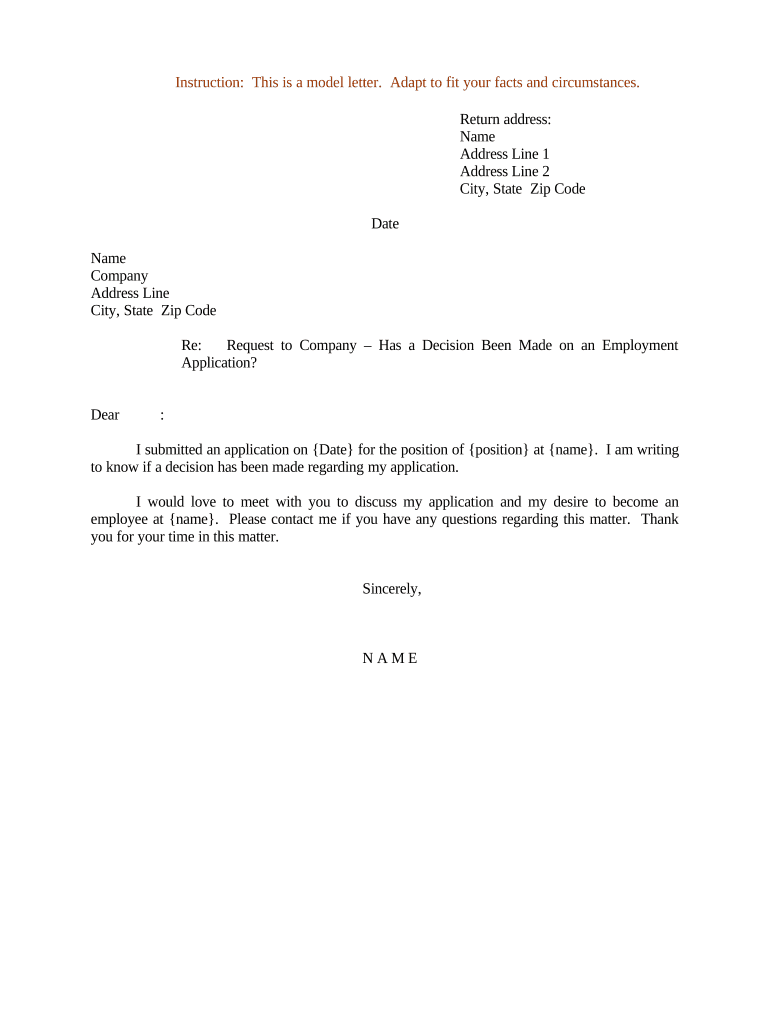
Opening Salutation

Address the hiring manager or use a neutral greeting; include the job title or requisition number to ensure correct routing within HR systems.

Introductory Statement

Briefly state the role you are applying for and summarize your top qualification or experience relevant to the position.

Core Qualifications

Provide concise bullet points or short paragraphs highlighting specific skills, certifications, and measurable results tied to the job.

Availability and Logistics

State start date availability, preferred contact times, and whether relocation or travel is required.

Closing and Signature

End with a formal closing, signed name, and the date; include electronic signature details if the letter is signed digitally.

Configuring an Electronic Submission Workflow

If you deliver or accept letters electronically, configure authentication, routing, and storage to match compliance and HR needs.

Field Configuration
Authentication Email link plus optional SMS code
Routing Auto-forward to HR and hiring manager
Retention Store in secure HR system with access controls
Export Format PDF/A for long-term archiving

Digital Signing and Technical Requirements

Use platforms and file formats that preserve signature evidence and meet regulatory needs.

  • File Formats: PDF, DOCX supported.
  • Integrations: Connectors for ATS and HRIS.
  • Security: TLS in transit; AES-256 at rest.

Timelines and Typical Processing Expectations

Know common processing windows so you can follow up appropriately and meet verification deadlines during hiring.

Initial Acknowledgement:

Employers typically acknowledge receipt within 3–5 business days.

Interview Scheduling:

Expect outreach within 1–3 weeks for shortlisted candidates.

I-9 Completion:

Complete I-9 within three business days of hire per 8 CFR §274a.2.

Background Checks:

Often take 3–10 business days depending on scope.

Offer Validity:

Verbal offers often expire in 3–7 business days unless specified.

Key Milestones from Submission to Hire

This milestone sequence outlines common stages an application letter triggers in the hiring workflow.

01

Submission Received

HR records the application and assigns a candidate ID.

02

Screening Review

Recruiter checks qualifications and required documents.

03

Interview & Assessment

Hiring manager schedules interviews and evaluates fit.

04

Offer & Onboarding

Offer issued, I-9 and background checks completed before start.

eSignature Pricing Comparison for Employment Application Letters

Basic pricing and core capabilities for common eSignature vendors. signNow is listed first per comparison conventions; verify current plan terms on each vendor site.

signNow DocuSign Adobe Sign PandaDoc HelloSign
Starting Price $8/user/mo $15/user/mo $14/user/mo $19/user/mo $15/user/mo
Free Trial 7-day free trial Varies by vendor Varies by vendor Varies by vendor Varies by vendor
Bulk Send Yes Yes Yes Yes No
Audit Trail Yes Yes Yes Yes Yes
HIPAA Compliant Yes Yes Yes No No
Envelope Cap No envelope cap 100 envelopes/user/year Varies by plan Varies by plan Varies by plan

Frequently Asked Questions About Employment Application Letters

Answers to common questions about signing, submitting, correcting, and retaining application letters in the U.S. hiring context.


Need help? Contact support

be ready to get more
Join over 28 million airSlate SignNow users