Establishing secure connection…Loading editor…Preparing document…

Letter to Client Outlining Services and Fees

This template is fully customizable. Edit the text, fill out the fields, and send it for signature. Give it a try!
Letter to Client Outlining Services and Fees

What this Letter Is and When to Use It

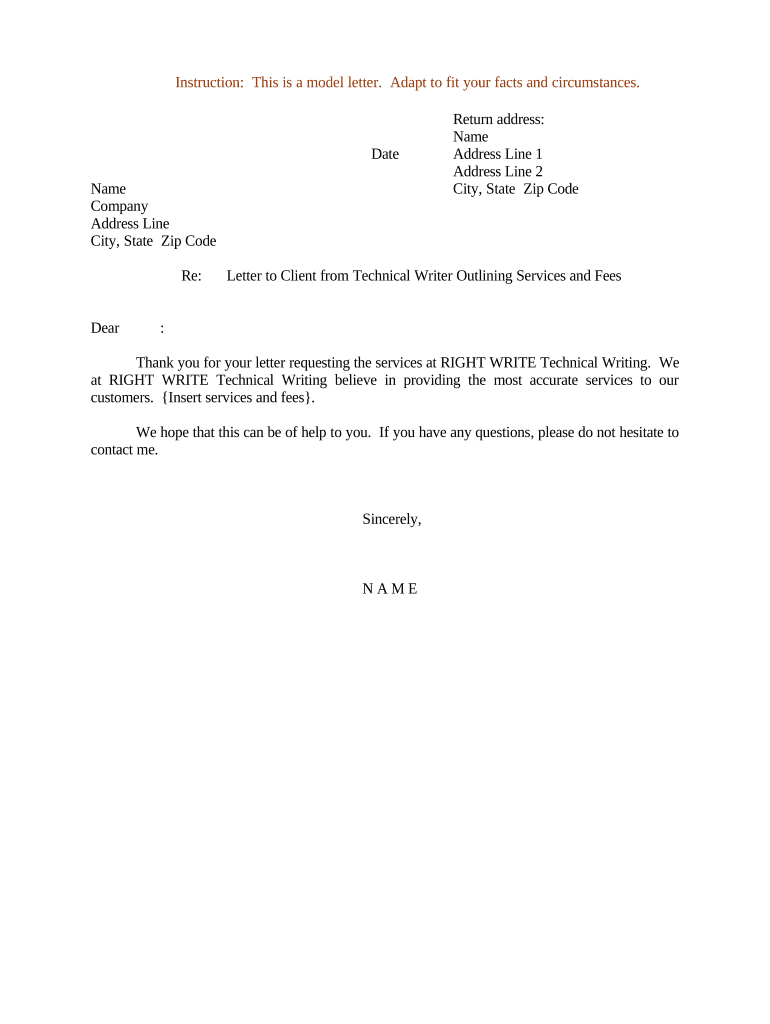
A Letter to Client Outlining Services and Fees is a professional written notice that summarizes the services a firm will provide, the fees or rates charged, billing arrangements, and any terms governing the engagement. It serves as a record of the parties’ expectations, helps prevent disputes, and provides a clear basis for invoicing and collection. Use this letter before starting work, when scope or pricing changes, or to confirm a one-off project. Keep language precise, list deliverables, and state how fee adjustments, expenses, and payment timing will be handled.

Why a Clear Services-and-Fees Letter Matters

A concise letter reduces misunderstandings, documents client consent to scope and payment terms, and creates a defensible record if billing disputes arise. It also supports compliance with consumer-disclosure rules when applicable and helps internal billing and audit processes.

Why a Clear Services-and-Fees Letter Matters

Who Typically Sends and Receives These Letters

Recipients include individual clients, corporate purchasing contacts, or third-party payers; tailor tone and detail to the audience.

  • Law firms, accounting firms, and consultants who bill hourly or on a project basis.
  • Agencies and service providers issuing statements of work or retainer confirmations.
  • In-house legal, procurement, or finance teams documenting externally provided professional services.

Who Can Sign and Represent Parties

Service Provider — Authorized Signatory

An officer, partner, owner, or delegated manager usually signs for the provider. Signatory authority should match internal delegation policies and be recorded; outside counsel review is advisable for novel fee arrangements or contingent-fee structures.

Client — Contracting Representative

A named client contact, purchasing agent, or corporate officer signs for the client. For organizations, require evidence of authority (purchase order, delegation memo) to avoid later disputes about enforceability.

Core Components to Include in the Letter

A complete letter lists scope, fee structure, billing schedule, payment terms, expenses, and any conditions or limits. Use clear, numbered sections and define ambiguous terms.

Scope of Services

Describe deliverables and exclusions clearly so both parties share the same expectations and so future change orders can be isolated and priced.
Fee Structure

State hourly rates, flat fees, retainers, or contingency terms and specify how time is measured and billed (e.g., 0.1 hour increments).

Billing Schedule

Note invoice timing (monthly, milestone-based), due date, and acceptable payment methods to reduce payment delays and clarify cash flow.

Expenses and Disbursements

List reimbursable expenses (travel, filing fees) and whether markup applies; include approval process if thresholds exist.

Termination and Change

State how scope or fees change, notice periods, and any early-termination charges or refund mechanics for prepaid retainers.

Dispute Resolution

Specify governing law, venue, and whether mediation/arbitration is required to streamline dispute handling and set expectations.

Essential Information to Present

Client Name: Full legal name
Provider Name: Legal business name
Effective Date: MM/DD/YYYY
Payment Terms: Net days or milestone
Rates: Hourly or fixed
Contact Details: Email and phone

Step-by-Step: Preparing and Sending the Letter

Follow a consistent sequence to draft, approve, send, and retain the letter so each engagement starts with aligned expectations.

  • 01
    Draft Letter: Write scope, fees, and terms clearly.
  • 02
    Internal Review: Finance or legal reviews billing language.
  • 03
    Client Delivery: Send via email or secure portal.
  • 04
    Obtain Signature: Secure written or electronic acceptance.

How to Configure an Online Letter Workflow

Map required fields and signer steps before you upload the template to an e-signature platform to ensure accurate routing and automation.

Field Configuration
Scope Field Multi-line text, required
Fee Field Numeric with currency
Signature Signer name + date required
Approval Route Sequential signer order

Where to Send or File the Signed Letter

Decide recipient addresses and internal filing locations before sending to ensure timely payment and a retained record for audits.

  • Primary Recipient: Client accounting or procurement contact
  • Copy to: Project manager and billing
  • Internal Archive: Document management system
  • Accounting System: Attach to client account

Digital Signing and Delivery Requirements

Ensure the solution you select allows reliable reproduction of signed records and meets any industry-specific compliance needs.

  • File Formats: PDF or DOCX recommended
  • Authentication: Email/SMS or stronger
  • Audit Trail: Timestamp and IP capture

Typical Timing and Deadlines to Note

Track invoice due dates and any regulatory deadlines tied to payment or tax reporting. Timely issuance and retention reduce compliance risk.

Provide Letter:

Before work or upon engagement acceptance

W-9 Provision:

No filing deadline; give upon payer request

1099-NEC Deadline:

Issue to recipient and IRS by Jan 31

1099-MISC Deadlines:

Recipient by Jan 31; paper to IRS Feb 28, electronic Mar 31

Tax Return:

Individual returns due April 15; extensions to Oct 15

Key Milestones in the Engagement Timeline

A simple milestone timeline helps coordinate delivery, invoicing, and payment follow-up across parties.

01

Engagement Start

Scope agreed and effective date set

02

Deliverable Milestone

Client review and acceptance window

03

Invoice Issued

Invoice generated per billing schedule

04

Payment Received

Payment applied and allocation confirmed

Common Mistakes to Avoid

  • Vague scope descriptions that lead to scope creep and billing disputes.
  • Omitting billing increments or rate effective dates, producing confusion about charges.
  • Failing to document expense approval processes, causing reimbursement disagreements.
  • Not retaining a signed copy in a searchable archive for audits or collections.

Consequences of Inaccurate or Missing Letters

Delayed Payment: Lost cash flow
Tax Penalties: 1099 fines $60–$330 per form
I-9 Violations: $281–$2,789 per violation
Contract Disputes: Increased legal costs
Client Relationship: Reputational damage
Regulatory Risk: Industry fines

Comparing eSignature Providers for Sending This Letter

Basic pricing and feature availability for common eSignature providers. Place platform selection in the context of authentication, HIPAA needs, and volume.

signNow DocuSign Adobe Sign PandaDoc HelloSign
Starting Price $8/user/mo $15/user/mo $14/user/mo $19/user/mo $15/user/mo
Free Trial Yes, 7-day trial No No No No
Bulk Send Yes Yes Yes Yes No
Audit Trail Yes Yes Yes Yes Yes
HIPAA Compliant Yes Yes Yes No No

Real-World Examples of Use

Practical examples show how the letter functions across organizations and why clarity matters for execution and compliance.

Optica Ventures LLC

The interface is simple and easy-to-use for our team; more importantly, it is just as easy for our customers.

  • The letter clarified billing milestones.
  • As a result, Optica reduced billing disputes and shortened collections cycles while keeping client relationships intact.

Martin Properties

I can process and execute all of these documents online with 100% compliance and built-in security.

  • Signatures obtained remotely for lease addenda.
  • This allowed Martin Properties to close renewals faster and maintain a consistent audit trail for property records.

Practical Tips for Accurate and Efficient Letters

Adopt consistent templates, require sign-off from internal reviewers, and automate delivery to minimize errors and speed client acceptance.

Use a Standard Template
Maintain a template that includes mandatory fields and language blocks for scope, fees, expenses, and termination to reduce drafting errors and ensure uniform client communication.
Require Internal Approval
Have finance or legal review non-standard fee terms or unusual expense arrangements before sending to the client to avoid later renegotiation or disputes.
Document Versioning
Keep version-controlled copies and log changes when scope or fees are amended, including who authorized the change and why, to aid transparency.
Archive Signed Copies
Store signed letters in a secure, searchable repository with retention metadata to support audits, tax reporting, and potential dispute resolution.

Frequently Asked Questions and Troubleshooting

Common questions about signature validity, delivery, and how to correct or rescind a Letter to Client Outlining Services and Fees.


Need help? Contact support

be ready to get more
Join over 28 million airSlate SignNow users