Establishing secure connection…Loading editor…Preparing document…

Notice of Inability to Fill Orders

This template is fully customizable. Edit the text, fill out the fields, and send it for signature. Give it a try!
Notice of Inability to Fill Orders

What the Notice of Inability to Fill Orders Is

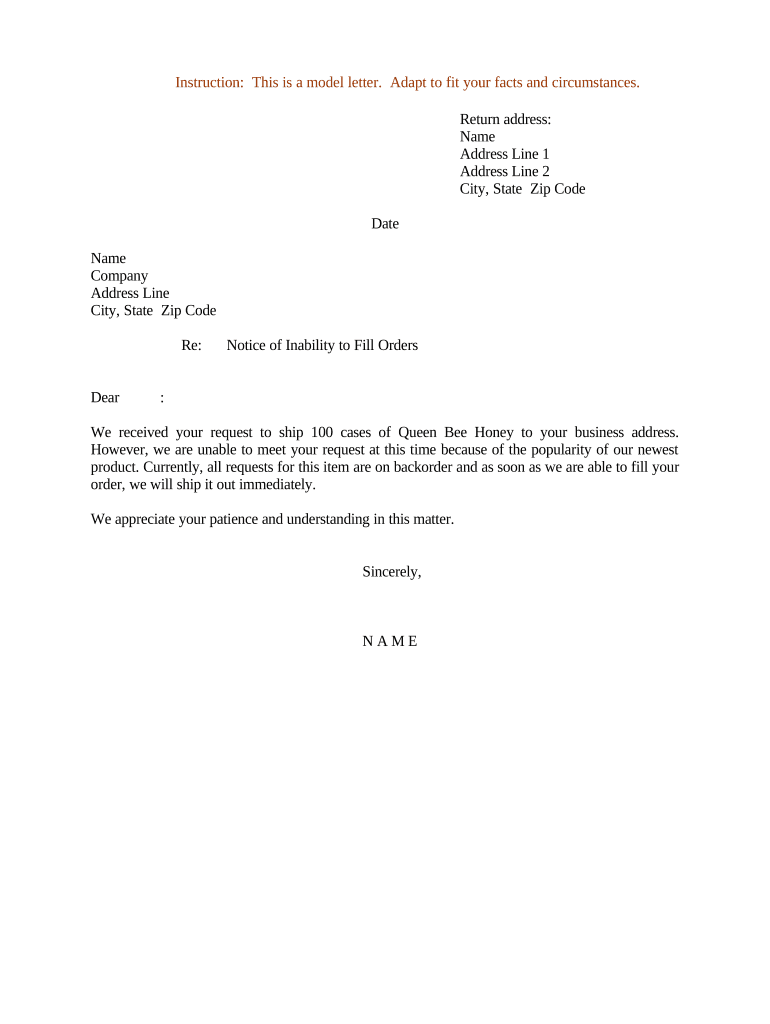
A Notice of Inability to Fill Orders is a formal written communication from a supplier, manufacturer, or distributor informing a buyer that one or more purchase orders cannot be fulfilled as expected. The notice explains which items, quantities, or delivery dates are affected, gives the reason for the shortfall or delay, and offers any proposed next steps such as partial shipments, revised delivery estimates, cancellation options, or alternatives. It serves as a record for commercial, contractual, and regulatory purposes and helps preserve contractual defenses and mitigation rights.

Why Issuing This Notice Matters

Issuing a clear, timely notice preserves contractual rights, documents the supplier’s efforts to mitigate loss, and reduces exposure to claims for breach of contract or damages under commercial law.

Why Issuing This Notice Matters

Who Typically Prepares and Receives This Notice

The notice is prepared by suppliers, procurement teams, logistics managers, or contract administrators when fulfillment issues arise.

  • Supplier operations teams who manage inventory and customer commitments; they document shortages and proposed remedies to maintain contractual defenses.
  • Buyers' procurement and accounts payable teams that need an official record for rescheduling, accepting partial delivery, or initiating cancellation and credit procedures.
  • Legal or contract managers on either side who need a dated, documented communication to assess remedies or preserve dispute-resolution rights.

Use the notice as the formal business record; keep copies with order and invoice files to support reconciliation and potential claims.

Step-by-step: Preparing the Notice

Follow these steps to create a clear, defensible Notice of Inability to Fill Orders.

  • 01
    Identify impacted orders: List PO numbers, SKUs, quantities, and expected ship dates.
  • 02
    State the reason: Explain supply, production, or logistics cause in factual terms.
  • 03
    Offer remedies: Propose partial shipments, substitute items, or revised ETAs.
  • 04
    Document delivery: Record date, sender, and method of notice transmission.

Where the Notice Should Be Sent and Tracked

Route the notice through documented channels to create a reliable record for both parties and any auditors.

  • Primary Recipient: Buyer’s procurement or purchasing contact on the PO.
  • CC Legal/Contracts: Copy contract management or legal teams for escalation and recordkeeping.
  • Logistics Team: Notify shipping and warehousing for inventory adjustments.
  • Accounting: Inform accounts payable for invoice and credit processing.

How to Configure an Online Notice Workflow

Set up an online template and routing to ensure consistent, auditable notices for all affected orders.

Field Configuration
Template Name Use clear naming: Notice of Inability to Fill Orders
Required Fields PO number, SKU, quantity, reason, proposed remedy
Routing Auto-send to procurement, legal, logistics, accounting
Retention Policy Attach to PO record and retain per company policy

Digital delivery and signing considerations

Use an e-signature-enabled workflow and secure delivery channels to create an auditable notice and preserve legal effect.

  • File formats: PDF or PDF/A for stable, archivable records
  • Authentication: Email plus SMS or SSO reduces signer repudiation risk
  • Integrations: Connect with ERP or procurement systems for automatic attachment

Ensure the platform captures an audit trail (timestamp, IP, signer identity) and stores the signed notice alongside the original PO for compliance and dispute defense.

Core elements to include in a professional notice

A complete notice balances factual detail with clear options; include these six elements to reduce ambiguity and support mitigation.

Header Information

Date, supplier legal name, supplier contact details, buyer legal name and buyer contact to tie the notice to the correct commercial relationship and enable immediate follow-up.
Order References

Every impacted PO number, line item, SKU, and quantity must be listed so the notice unambiguously maps to existing contractual obligations and invoices.

Cause of Nonperformance

Provide a concise factual explanation (e.g., raw material shortage, force majeure, capacity constraint), avoiding speculative language while documenting the operational basis for the inability to perform.

Impact Summary

State exact shortfalls or delays, including whether partial fulfillment is possible and which dates or quantities are affected, so the buyer can make informed mitigation decisions.

Proposed Remedies

Offer concrete alternatives such as partial shipment dates, substitution SKUs with pricing and specs, expedited future shipments, or cancellation terms to facilitate negotiation and reduce dispute risk.

Record and Next Steps

Request buyer acknowledgment, provide a deadline for buyer response, and confirm how the notice will be documented in both parties' systems for audit purposes.

Required technical and compliance details

Secure Transmission: TLS 1.2/1.3
Data at Rest: AES-256 encryption
Regulatory Compliance: ESIGN and UETA accepted
Audit Trail: Timestamp and IP logged
Authentication: Email, SMS, or MFA
HIPAA Consideration: BAA required if PHI included

Common mistakes to avoid when preparing the notice

  • Using vague language about causes or dates, which increases dispute risk and may forfeit defenses based on mitigation efforts.
  • Failing to reference the exact purchase order and line items, causing accounting mismatches and late credits or payments.
  • Not proposing any remedy or timeline, leaving the buyer without clear options and increasing the chance of claims.
  • Sending the notice through informal channels only (text or untracked email), which weakens the evidentiary chain in disputes.

Potential consequences of not issuing or preparing an incorrect notice

Contract Damages: Monetary liability
Procurement Sanctions: Debarment or loss of contract eligibility
Reputational Harm: Customer churn risk
Increased Costs: Expedited shipping or penalty fees
Insurance Denial: Coverage refusal if notice absent
Tax Withholding: Backup withholding risk

Typical timelines and response expectations

Set and communicate clear internal and external deadlines to minimize disruption and meet contractual notice obligations.

Issue the notice promptly:

Send as soon as inability is known, typically within 1–3 business days.

Buyer response period:

Request acknowledgment or decision within 5–10 business days.

Provide revised ETA:

Offer a new delivery date within 10 business days if feasible.

Escalation window:

If unresolved, escalate to contract managers after 10–15 business days.

Record retention start:

Retention clock begins on the notice date.

eSignature vendor comparison for issuing notices

Pricing and feature availability vary by vendor and plan; signNow appears first for neutral comparison of starting price and common features.

signNow DocuSign Adobe Sign PandaDoc HelloSign
Starting Price $8/user/mo $15/user/mo $14/user/mo $19/user/mo $15/user/mo
Free Trial 7-day free trial, no credit card required Varies by plan Varies by plan Varies by plan Varies by plan
Bulk Send Yes Yes Yes Yes No
Audit Trail Yes Yes Yes Yes Yes
HIPAA Compliant Yes Yes Yes No No

Frequently asked questions about the Notice of Inability to Fill Orders

Answers to common questions about timing, content, digital signing, and next steps when an order cannot be filled.


Need help? Contact support

be ready to get more
Join over 28 million airSlate SignNow users