Establishing secure connection…Loading editor…Preparing document…

Letter Reporting Lost Credit Card

This template is fully customizable. Edit the text, fill out the fields, and send it for signature. Give it a try!
Letter Reporting Lost Credit Card

What a Letter Reporting Lost Credit Card Is

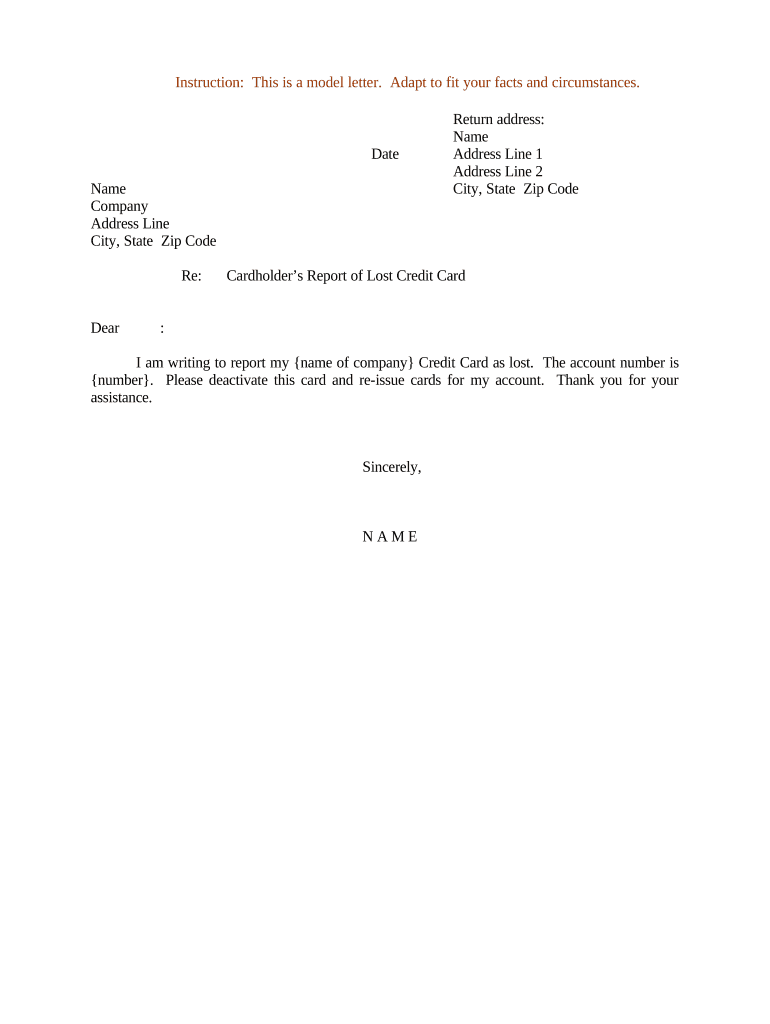
A Letter Reporting Lost Credit Card is a written notification from a cardholder or authorized representative to a card issuer that documents the loss or theft of a payment card and requests cancellation, replacement, and fraud prevention steps. The letter creates a dated record of the report, identifies the account (typically by cardholder name and last four digits), summarizes circumstances, and lists requested actions such as card cancellation, dispute of unauthorized charges, and issuance of a replacement. Maintaining a copy supports later disputes, fraud investigations, and proof of timely notice to the issuer.

Why a Formal Written Notice Matters

A written letter documents the date and content of your report, helps limit liability for unauthorized charges, and creates an audit trail for the issuer and any investigators. Written notice complements phone reporting and may be required by cardholder agreements to preserve dispute rights.

Why a Formal Written Notice Matters

Who Typically Prepares This Letter

Several parties prepare or submit a lost-card letter depending on the situation and account ownership.

  • Individual cardholders notifying their bank directly about a lost or stolen personal credit card, requesting cancellation and replacement.
  • Authorized account administrators or finance staff reporting corporate card loss for business accounts and initiating internal reconciliation.
  • Protected-party representatives (power of attorney or guardian) submitting notices when acting on behalf of an incapacitated or minor cardholder.

Choose the signer whose name matches account records and who can provide identity proof if the issuer requests verification.

Core Elements to Include in Your Letter

A professional letter Reporting Lost Credit Card is concise and structured so the issuer can act quickly. Include document header, clear identification, circumstances, requested actions, contact information, and signature with date.

Header

Issuer name and mailing or secure email address at the top so the notice can be routed to the correct department and documented in the issuer's fraud system.
Card details

Provide the cardholder name and the card account's last four digits. Do not include the full primary account number in unsecured communications.

Incident description

Briefly state when and where the card was lost or stolen, and whether a police report was filed. Include dates and times if known.

Requested actions

State specific requests such as immediate card cancellation, investigation of recent transactions, reversal of unauthorized charges, and issuance of a replacement card.

Contact details

List daytime phone number, email, and mailing address so the issuer can verify identity and notify you of investigation outcomes.

Signature

Signer printed name, relationship to account, signature, and date. If someone else reports for you, note authority (POA, trustee, corporate role).

Essential Information to Provide

Cardholder name: Full legal name
Account identifier: Last 4 digits
Date/time lost: MM/DD/YYYY
Location details: Where last used
Contact phone: Best daytime number
Reporting party: Relationship to account

Step-by-Step: Prepare and Send the Letter

Follow a short, consistent sequence to ensure the issuer receives a complete report and you retain proof of notice.

  • 01
    Gather details: Collect account info, incident date, and ID documents before drafting.
  • 02
    Draft letter: Use clear headings and include required account identifiers and requests.
  • 03
    Sign and date: Sign as the account holder or authorized representative and add the date.
  • 04
    Send securely: Transmit via issuer portal, certified mail, secure email, or an eSignature service and retain proof.

Where to Send a Letter Reporting Lost Credit Card

Choose the issuer channels that provide fastest acknowledgement and an auditable receipt of your notification.

  • Issuer secure portal: Preferred channel; attaches report to your account immediately.
  • Certified mail: Creates a dated delivery record if portal or email are unavailable.
  • Issuer fraud email: Use only the official secure email address listed on the issuer site.
  • Local police copy: Provide a police report number if a theft occurred and include a copy with your letter.

Digital Delivery and Platform Considerations

Use secure delivery methods that produce an audit trail and preserve sensitive data when sending the letter electronically.

  • File Format: PDF or PDF/A preserves content and signatures
  • Authentication: Email+SMS or platform authentication strengthens attribution
  • Integrations: Connectors like Salesforce, Microsoft 365, and NetSuite streamline routing

If using an eSignature or document-management service, confirm encryption in transit and at rest and retain the completion certificate as proof of notice.

Timelines and Processing Expectations

Report loss promptly; many cardholder protections depend on timely notice and issuer procedures vary for investigation and provisional credits.

Report immediately:

Notify issuer as soon as loss is discovered to limit liability.

Issuer acknowledgement time:

Some issuers confirm receipt within 24–48 hours after secure submission.

Dispute investigation window:

Investigations commonly take 30–90 days depending on complexity.

Provisional credit timing:

Issuers may provide provisional credits within 10 business days in many cases.

Follow-up actions:

Expect requests for ID or police report to complete the investigation.

Common Mistakes to Avoid When Preparing the Letter

  • Including the full card number in unsecured email or message, which increases fraud risk and may violate issuer guidelines.
  • Providing incomplete incident details (no date/time or last use) so the issuer cannot correlate transactions for investigation.
  • Failing to sign the letter or to indicate authority when submitting on behalf of another person or business, leading to verification delays.
  • Not retaining a copy and proof of delivery; without evidence of timely notice you may lose dispute protections.

Consequences of Inadequate or Late Notification

Increased liability: Higher out-of-pocket charges
Delayed refunds: Longer dispute resolution
Credit impact: Unauthorized balances may affect score
Identity theft risk: Extended exposure to fraud
Administrative denials: Issuer may decline dispute if late
Legal costs: Possible collection or litigation fees

How to Customize an Online Version of the Letter

Configure fields and authentication to collect the exact information issuers require while preserving an audit trail.

Field Configuration
Signature Type eSignature with audit trail and timestamp
Authentication Email verification plus optional SMS code
Attachments Allow ID or police report upload (PDF or image)
Save Format PDF or PDF/A with certificate of completion

eSignature Pricing Snapshot for Sending This Letter

Compare common eSignature vendors for basic use — signNow appears first in the table and offers a range of plans that address single-user and high-volume needs.

signNow DocuSign Adobe Sign PandaDoc HelloSign
Starting Price $8/user/mo $15/user/mo $14/user/mo $19/user/mo $15/user/mo
Free Trial 7-day free trial Varies by vendor Varies by vendor Varies by vendor Varies by vendor
Bulk Send Yes Yes Yes Yes No
Audit Trail Yes Yes Yes Yes Yes
HIPAA Compliant Yes Yes Yes No No

Example Scenarios Using a Lost Card Letter

Two brief examples illustrate typical uses of a Letter Reporting Lost Credit Card in consumer and corporate contexts.

Consumer Report

A cardholder noticed unfamiliar charges the morning after losing a wallet and sent a dated letter to the issuer with last four digits and a police report number.

  • The issuer provisionally credited disputed amounts and canceled the card.
  • The written record supported subsequent disputes and limited the cardholder's liability during the investigation and replacement process.

Corporate Card Loss

A finance manager reported a lost corporate card on behalf of an employee and attached an internal reconciliation request.

  • The card was suspended and a temporary card issued.
  • Clear delegation and documentation allowed the company to reconcile pre-loss charges quickly and prevented unauthorized spending.

Practical Tips for a Clear and Effective Letter

Use a brief, factual tone and include verifiable identifiers and a clear request so the issuer can act without follow-up delays.

Be concise and factual
Limit narrative to essential facts: who, what, when, where, and requested remedy to speed issuer processing.
Avoid sharing full PAN
Provide only last four digits in unencrypted channels to reduce exposure of the primary account number.
Keep delivery proof
Use certified mail, portal receipts, or platform audit trails and save the confirmation for dispute evidence.
Follow up in writing
Request a written acknowledgement or reference number to confirm issuer receipt and next steps.

Frequently Asked Questions About Reporting a Lost Credit Card

Answers to common questions about format, signatures, e-signing, notarization, and what to expect after sending a lost-card letter.


Need help? Contact support

be ready to get more
Join over 28 million airSlate SignNow users