Notice Type
Name the notice (e.g., Pay-or-Quit, Cure-or-Quit, Notice to Vacate) and reference the relevant lease section or statutory basis.
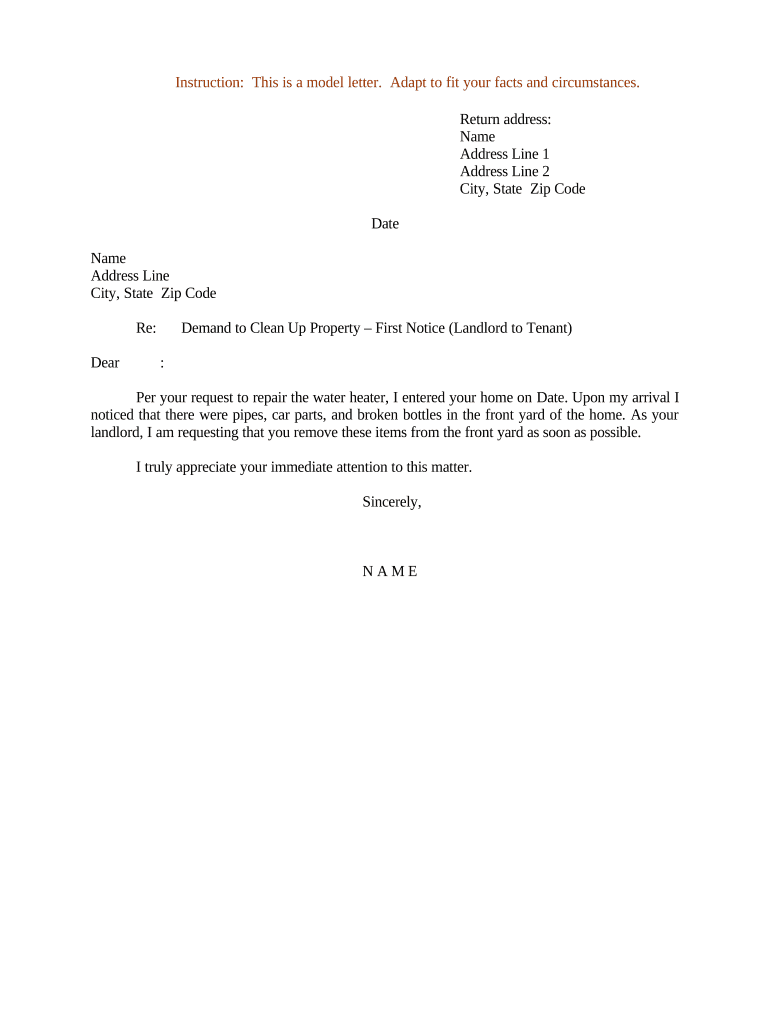
A correct Tenant Notice preserves landlord remedies, documents the tenant's obligations, and triggers statutory timelines for cure or eviction. It reduces ambiguity about dates and required actions, which lowers the risk of procedural dismissal in court.

Tenants and tenant advocates also rely on Notices to confirm obligations and exercise rights such as curing violations or disputing service methods.
Name the notice (e.g., Pay-or-Quit, Cure-or-Quit, Notice to Vacate) and reference the relevant lease section or statutory basis.
Include full legal name(s) of all tenants on the lease to avoid ambiguity and ensure the proper parties receive the obligations.
Provide full address, unit number, and any identifying lease or account number to tie the notice to the correct tenancy.
Explain the specific lease violation or reason for notice with dates and supporting facts rather than general assertions.
State the cure period or vacate date in calendar terms (MM/DD/YYYY) and describe acceptable remedies or payments.
Record how the notice was served (personal, certified mail, posted, email) and include the sender's signature, printed name, title, and date.
| Setting | Recommended configuration |
|---|---|
| Upload Template | Upload lease-based notice templates in PDF or DOCX. |
| Field Placement | Add signature, date, and tenant name fields. |
| Recipient Routing | Assign tenant email and property manager copies. |
| Authentication | Enable email or SMS code signer verification. |
Keep contemporaneous records of service and delivery receipts; for electronic methods, preserve audit trails that include timestamps and signer attribution.
Commonly 3–14 days to pay; many states use a 3-day period but statutory ranges vary.
Often 7–30 days to cure non-monetary lease violations depending on state law.
Month-to-month tenancy typically requires 30 or 60 days' notice depending on state and rental term.
Often 24–48 hours' advance notice for routine entry; emergency entries are immediate.
File in court only after the cure period expires and service proof is documented.
| signNow | DocuSign | Adobe Sign | PandaDoc | HelloSign | |
|---|---|---|---|---|---|
| Starting Price | $8/user/mo | $15/user/mo | $14/user/mo | $19/user/mo | $15/user/mo |
| Free Trial | 7-day free trial | Varies by plan | Varies by plan | Varies by plan | Varies by plan |
| Bulk Send | Yes | Yes | Yes | Yes | No |
| Audit Trail | Yes | Yes | Yes | Yes | Yes |
| HIPAA Compliant | Yes | Yes | Yes | No | No |
| Envelope Cap | No cap | 100 envelopes/user/year | Varies by plan | Varies by plan | Varies by plan |
Tim Martin used online notices to replace in-person signings and ensure compliance.
John Butler streamlined tenant communications for employee housing with signed, time-stamped notices.
Prepare the notice, confirm statutory basis, and obtain legal review if complex.
Deliver by the authorized method, record date, and retain proof of service.
Allow the tenant the stated time to remedy the breach; monitor and document any response.
If uncured, file in court or pursue agreed remedies; include proof of service and correspondence.