Date
State the date the notice is issued and the effective date of the rejection to establish timelines and any statutory deadlines.
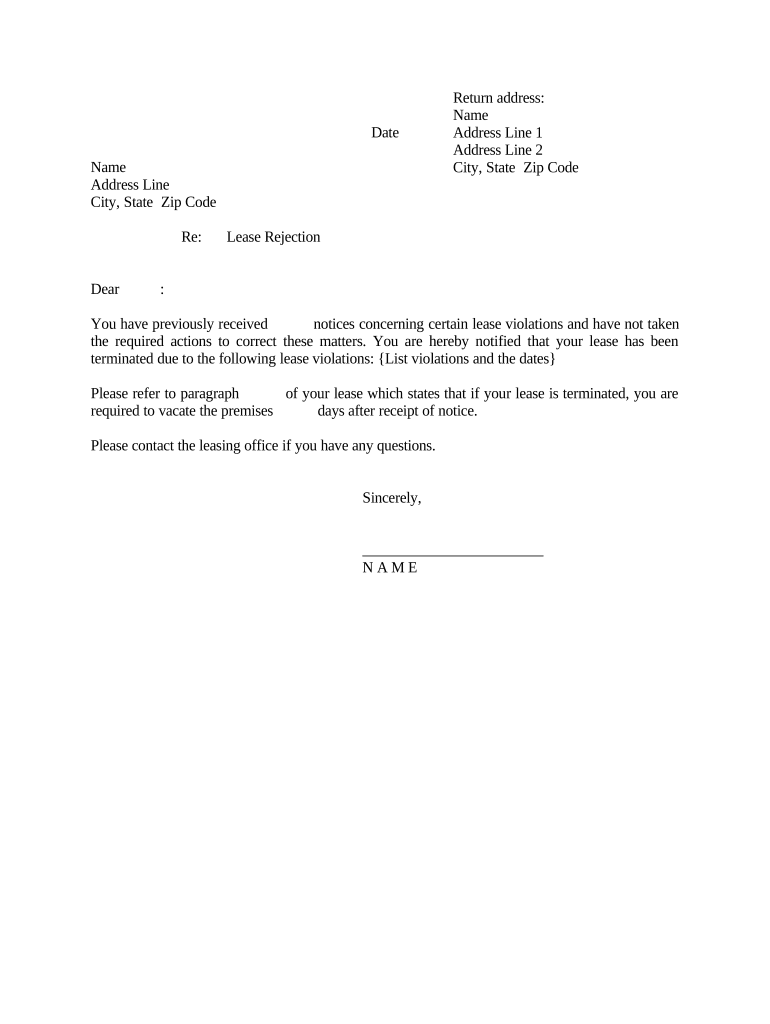
A concise Lease Rejection Notice protects both parties by documenting the decision, controlling expectations about deposits and next steps, and creating a retrievable record for compliance and dispute resolution.

The document is used by property owners and leasing professionals to communicate a formal refusal of an application or lease offer.
Recipients include applicants, co-applicants, guarantors, and sometimes listing brokers depending on the property’s process.
State the date the notice is issued and the effective date of the rejection to establish timelines and any statutory deadlines.
Identify the applicant(s) by full legal name and contact information so the notice is attributable and avoids identity confusion.
Include property name, address, and unit or application ID so the specific transaction is clearly referenced for records.
Provide a concise, non-discriminatory explanation or reference code for the rejection without revealing confidential screening details.
Explain whether a security deposit will be returned, withheld, or applied, and reference the timeline for disbursement per state law.
Describe appeal or reconsideration options, contact for questions, and how the recipient will receive the final signed copy.
| Workflow Configuration and Field Settings | Recommended configuration and brief setup guidance |
|---|---|
| Document Template, Naming, and Versioning | Create a standard template, include version date and template ID. |
| Signer Sequencing, Roles, and Order | Assign landlord as sender, applicant as recipient, set signing order. |
| Authentication and Identity | Require email plus SMS code or higher for sensitive notices. |
| Delivery Method and Retention Policy | Email delivery with audit trail; retain signed record per policy. |
Use tools that produce a tamper-evident signed PDF and capture an audit trail including timestamps, signer identity, and IP address.
Ensure the chosen platform supports secure storage (AES-256 at rest, TLS 1.2/1.3 in transit), audit trails for dispute defense, and any required HIPAA or state-level controls.
Issue notice within internal SLA, commonly 3–7 days from final review.
State rules often require return within 14–30 days after decision.
Specify any internal deadline for requesting reconsideration, typically 5–14 days.
Retention begins on notice date for statutory retention calculations.
Allow extra days for mailed notices and use proof of mailing.