Establishing secure connection…Loading editor…Preparing document…

Letter Regarding Conservatorship

This template is fully customizable. Edit the text, fill out the fields, and send it for signature. Give it a try!
Letter Regarding Conservatorship

What a Letter Regarding Conservatorship Is and when it’s used

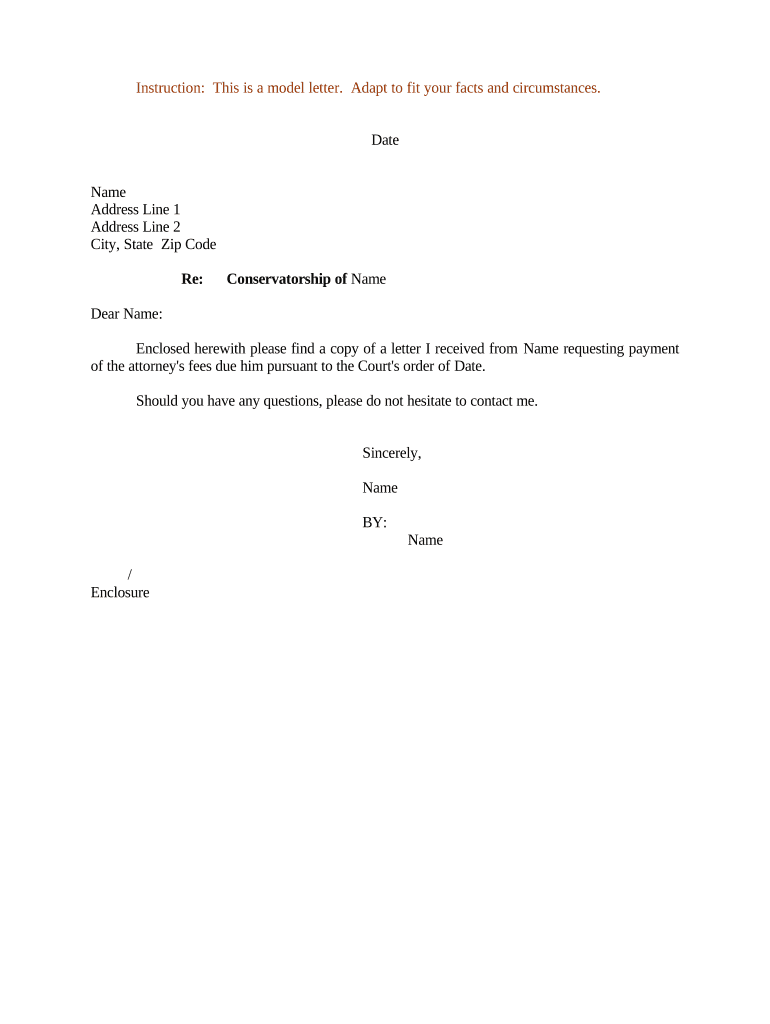
A Letter Regarding Conservatorship is a formal written statement used to notify third parties, institutions, or government agencies that a court has appointed a conservator to manage an individual’s personal or financial affairs. It typically identifies the conservatee, the appointed conservator, the scope of authority granted by the court, and case or docket information that proves the appointment. Organizations use the letter to accept decisions, release records, update accounts, or allow the conservator to act on behalf of the conservatee where the court order is not otherwise on file.

Why a clear conservatorship letter matters

A concise, well‑formatted letter reduces administrative delays, establishes authority for third parties, and minimizes requests for additional documentation when accessing records or managing accounts under a court order.

Why a clear conservatorship letter matters

Typical users and recipients of the conservatorship letter

The letter is prepared by or for the court-appointed conservator and shared with institutions that require proof of authority.

  • Financial institutions verifying account management authority and releasing funds or statements.
  • Healthcare providers granting access to medical records and making care decisions when authorized.
  • Government agencies and benefit providers accepting representation for payments, benefits, or records.

Who prepares and signs the letter

Conservator

A conservator (individual or corporate fiduciary) or their attorney typically prepares or requests the letter to present to third parties. The conservator must reference the probate court order, include identifying details, and sign or execute the letter consistent with local authentication rules.

Family Member

A family member acting as conservator or assisting the appointed conservator may draft the letter for institution use. When a third party requires legal proof, attach the certified court order or letters of conservatorship to avoid service delays.

Essential elements to include in a professional conservatorship letter

Ensure the letter clearly documents identity, court case details, and the exact scope of authority so recipients can process requests without additional follow-up.

Conservatee Identity

Full legal name, date of birth, and an identifying number (account or record number) to match institution files and reduce mismatches.
Court Reference

Probate court name, county, case or docket number, and date of the appointment to allow recipients to verify the order.

Conservator Details

Conservator's full legal name, contact information, mailing address, and relationship to the conservatee for communication and documentation.

Scope of Authority

Explicit description of powers (financial, medical, limited actions) and any statutory or court-imposed restrictions on the conservator’s authority.

Attachments

List and attach certified copies of the letters of conservatorship, court order, and any required releases or consent forms.

Execution Block

Signature line, printed name, date, and notarization or witness information if required by the recipient or jurisdiction.

Required factual data fields at a glance

Conservatee: Full legal name
Court Case: Court name & docket
Conservator: Name & contact
Authority: Scope description
Attachments: Certified documents
Execution: Signatures & date

Immediate risks of an incorrect or incomplete letter

Invalid Authority: Denied access
Incorrect Conservator: Legal disputes
Late Filing: Service delays
Missing Court Order: Request for certified copy
Wrong Notarization: Rejection by recipient
Privacy Breach: Unauthorized disclosure

Common preparation mistakes to avoid

  • Using informal names or nicknames without the conservatee’s full legal name causes mismatched records and delays.
  • Failing to include the probate court docket number forces institutions to request certified proof, extending processing time.
  • Omitting attachments such as the letters of conservatorship leads to denials or repeated requests for validation.
  • Not verifying recipient-specific notarization or witness expectations results in returned or unaccepted letters.

Step-by-step: prepare and deliver the letter

Follow a concise sequence to prepare, authenticate, and share a recipient-ready letter with minimal friction.

  • 01
    Gather Documents: Collect court order, letters of conservatorship, and IDs.
  • 02
    Draft Letter: Include identity, court details, scope, and attachments.
  • 03
    Authenticate: Notarize or attach certified court copy if required.
  • 04
    Distribute: Send to recipient with supporting attachments.

How the document is processed by typical recipients

Most institutions follow a verification flow on receipt; understanding their steps reduces back-and-forth.

  • Intake: Recipient logs request and cross-checks identity.
  • Verification: Staff confirms court case and conservator authority.
  • Acceptance: Records updated and actions authorized.
  • Follow-up: Recipient may request certified copies or extra forms.

How to set up an electronic workflow for this letter

Configure a simple digital workflow to collect signatures, attach certified documents, and maintain an audit trail.

Field Configuration
Signers Conservator and witness or notary fields as required
Authentication Email plus SMS code or ID verification
Attachments Attach certified court order PDF
Save Format PDF/A with embedded audit trail

Digital delivery and platform compatibility

Choose a platform that supports PDF, audit trails, and secure attachments for court or institution submissions.

  • File Formats: PDF, DOCX accepted
  • Integrations: Works with Google Workspace, Box
  • Security: TLS and AES-256 encryption

How this letter differs from similar legal documents

Compare the Letter Regarding Conservatorship to related documents to choose the correct form and authority evidence.

Document Letter Durable Power of Attorney
Primary Purpose notify institutions grant ongoing authority
Court Order Needed no (usually)
Typical Use verification only direct legal acts
Revocation Method court order principal action

Typical eSignature vendor comparison for letters and attachments

Basic vendor plan and capability comparison to help select an eSignature option for creating and sending conservatorship letters and attachments.

signNow DocuSign Adobe Sign PandaDoc HelloSign
Starting Price $8/user/mo $15/user/mo $14/user/mo $19/user/mo $15/user/mo
Free Trial 7-day free trial Varies Varies Varies Varies
Bulk Send Yes Yes Yes Yes No
Audit Trail Yes Yes Yes Yes Yes
HIPAA Compliant Yes Yes Yes No No

Frequently asked questions about conservatorship letters

Answers to common questions about format, signatures, electronic acceptance, notarization, corrections, and retention for Letter Regarding Conservatorship.


Need help? Contact support

be ready to get more
Join over 28 million airSlate SignNow users