Establishing secure connection…Loading editor…Preparing document…

Request for Extension on Leave of Absence

This template is fully customizable. Edit the text, fill out the fields, and send it for signature. Give it a try!
Request for Extension on Leave of Absence

What a Request for Extension on Leave of Absence Is

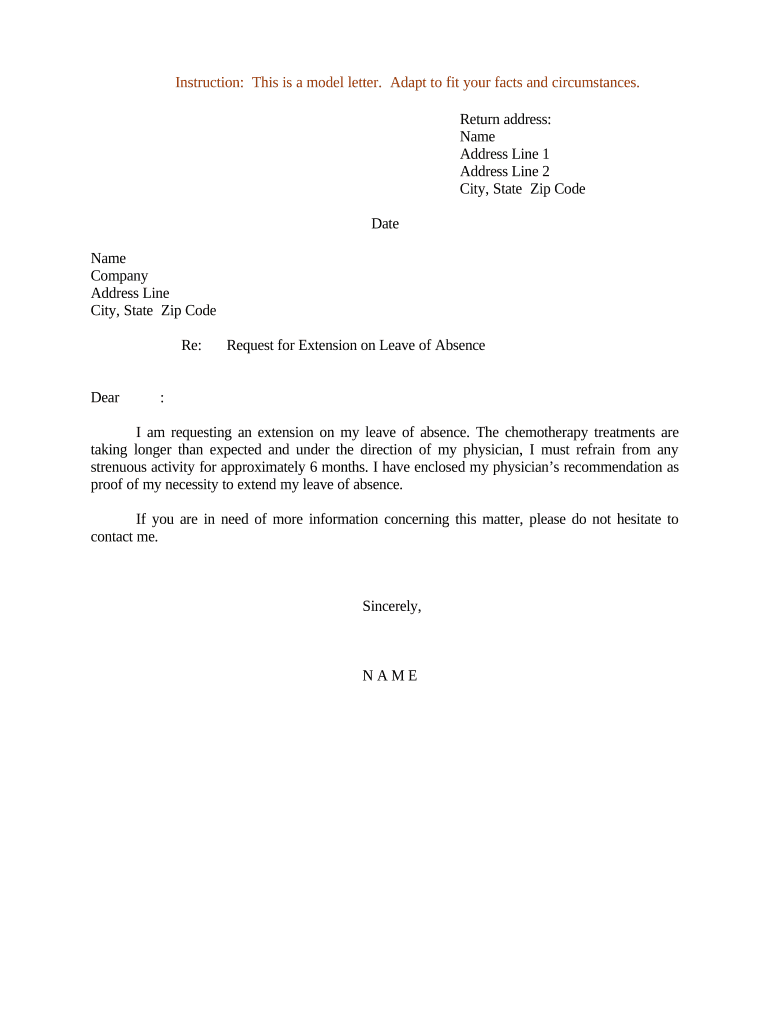
A Request for Extension on Leave of Absence is a written employee notice seeking additional time away from work beyond an approved leave period. It documents the expanded leave dates, reason for extension, and supporting information such as medical certification or administrative justification. Employers use the request to evaluate entitlement under FMLA, company leave policies, collective bargaining agreements, or statutory leave programs and to plan staffing, payroll, and benefits administration.

Why filing a clear extension request matters

A well-completed request protects both employee and employer by creating a dated record, clarifying expectations, and documenting supporting evidence for leave entitlement, benefits continuation, and return-to-work planning.

Why filing a clear extension request matters

Who typically prepares and reviews these requests

Employees and HR teams are the primary users; managers and benefits administrators review decisions and coordinate coverage.

  • Employees on approved leave needing more time to recover or resolve personal matters.
  • HR or benefits specialists who verify eligibility, documentation, and pay/benefits effects.
  • Supervisors or managers who assess operational impact and approve coverage plans.

Clear roles reduce delays and disputes by centralizing documentation and decision authority for the extension.

How to complete and submit the request

Follow these sequential steps to prepare a complete, properly formatted request that meets employer and legal requirements.

  • 01
    Prepare documentation: Collect required medical or legal paperwork before drafting the request.
  • 02
    Fill the form: Enter names, dates, and reasons precisely using MM/DD/YYYY for dates.
  • 03
    Attach evidence: Upload certificates, orders, or notes supporting the extension.
  • 04
    Submit to HR: Send to HR or your manager and request confirmation of receipt.

Typical processing flow for an extension request

This represents the common routing from employee submission to final decision and recordkeeping; your organization may add approval tiers.

  • Employee submission: Employee completes form and includes supporting documents.
  • HR intake: HR verifies eligibility, documentation, and policy applicability.
  • Manager review: Manager evaluates operational impact and recommends approval or denial.
  • Final decision: HR issues a dated decision, notifies employee, and updates records.

Essential elements to include in a professional request

A complete request combines identity details, clear date ranges, a concise reason, supporting proof, signature, and a statement on benefits or payroll implications.

Identification

Employee legal name and company identifier to match payroll and personnel records for reliable processing and auditability.
Dates

Original leave dates and the precise additional start and end dates requested in MM/DD/YYYY to avoid ambiguity.

Reason

Specific, factual reason such as 'medical recovery' or 'family care' rather than vague language to support eligibility checks.

Supporting proof

Medical certification, military orders, or other documentation required by policy or statute attached to the request.

Signatures

Employee signature and date; supervisor acknowledgment and HR final decision block for a complete decision trail.

Benefits note

Statement on whether benefits, paid leave, or job protection continues during the extension period.

Configuring an online extension workflow

Set up fields, attachments, approval routing, and notifications to standardize processing and reduce manual follow-up.

Field Configuration
Employee ID field Required, autofill from HRIS
Date fields MM/DD/YYYY validation
Attachment field Required for medical certification
Approval routing HR then manager sequential approval

Digital submission and signature considerations

Use a secure platform that supports audit trails, attachments, conditional fields, and regulated-data protections for medical information.

  • Authentication: Email link, SMS code, or stronger methods
  • File formats: Accept PDF, DOCX; preserve attachments
  • Integrations: Connect to HRIS and document storage

Platforms that log IP, timestamps, and provide encrypted storage and role-based access help satisfy ESIGN/UETA record retention and HIPAA requirements when medical data are involved.

Practical timelines and employer response expectations

Timelines vary by policy and applicable law; submit requests early and expect HR to confirm receipt and outcome within a defined period.

Advance notice:

Submit at least two weeks before the current leave ends when feasible.

Employer acknowledgment:

HR should confirm receipt within 3–5 business days under typical internal SLAs.

Certification deadlines:

Provide medical certification promptly; employers may set reasonable deadlines per FMLA rules (29 C.F.R. §825).

Decision period:

Employers commonly decide within 7–14 business days after receiving documentation.

Return-to-work planning:

Coordinate fitness-for-duty or accommodation steps before the extended return date.

Key processing milestones for a typical extension request

A sequential milestone view helps managers and employees track progress and required actions from submission to closure.

01

Submission logged

Form and attachments are uploaded and recorded in HR systems.

02

Documentation review

HR checks eligibility, medical forms, and benefits impacts.

03

Operational review

Manager assesses coverage and recommends approval or adjustment.

04

Final determination

HR issues an approved or denied decision with next-step instructions.

Common mistakes that delay or jeopardize an extension

  • Submitting incomplete or unsigned requests without required medical certification delays review and may result in denial.
  • Entering ambiguous dates (e.g., 'mid-June') instead of MM/DD/YYYY causes scheduling and payroll errors.
  • Failing to follow employer-specific routing or emailing HR directly instead of using the official form can lose the record.
  • Providing excessive protected health information without necessary redaction or authorization creates HIPAA exposure and compliance risk.

Risks and compliance issues to watch for

Leave denial: Extension may be refused without adequate documentation.
Payroll errors: Unapproved extensions can cause pay interruptions.
Benefit gaps: Insurance continuation may lapse without timely coordination.
Legal exposure: Wrongful denial can trigger FMLA or discrimination claims.
HIPAA breach: Improper handling of medical records risks penalties.
Recordkeeping failure: Missing documentation complicates audits or appeals.

eSignature vendor comparison for processing extension requests

Platform selection affects cost, compliance, and features; signNow is listed first for parity in comparison tables as required.

signNow DocuSign Adobe Sign PandaDoc HelloSign
Starting Price $8/user/mo $15/user/mo $14/user/mo $19/user/mo $15/user/mo
Free Trial 7-day trial Varies Varies Varies Varies
Bulk Send Yes Yes Yes Yes Yes
Audit Trail Yes Yes Yes Yes Yes
Envelope Cap No cap 100 envelopes/user/year Varies Varies Varies

Frequently asked questions about extension requests

These answers address common points of confusion about documentation, signatures, and employer obligations when requesting an extended leave.


Need help? Contact support

be ready to get more
Join over 28 million airSlate SignNow users