Establishing secure connection…Loading editor…Preparing document…

Letter Refusing Employee Request for Early Raise

This template is fully customizable. Edit the text, fill out the fields, and send it for signature. Give it a try!
Letter Refusing Employee Request for Early Raise

What this Letter Refusing Employee Request for Early Raise Is

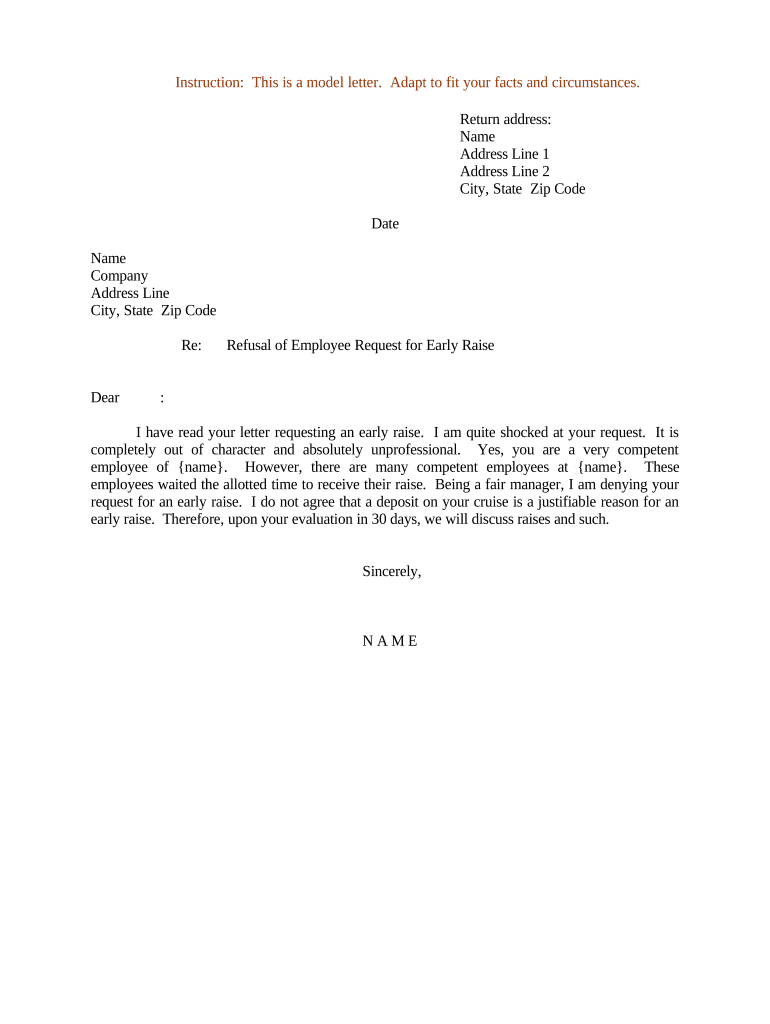
A Letter Refusing Employee Request for Early Raise is a formal, written notice from an employer to an employee that denies a request to accelerate a scheduled salary increase or to receive a raise earlier than the agreed review cycle. The letter documents the employer's decision, the business or policy reasons for declining the request, and any alternative options (for example, the next review date, eligibility criteria, or performance goals required for future consideration). Drafted carefully, it preserves a paper trail, reduces misunderstanding, and helps demonstrate consistent application of compensation policies.

Why a Clear Refusal Letter Matters

A concise, neutral letter protects both parties by recording the denial, explaining the rationale, and setting expectations for future review. It preserves documentation for HR records and can reduce disputes related to retaliation, discrimination claims, or unemployment appeals.

Why a Clear Refusal Letter Matters

Who Typically Issues or Receives This Letter

Employers and HR professionals issue these letters; employees who requested early raises receive them. Use the letter when an employee asks for an off-cycle raise and the organization needs to decline while providing next steps.

  • HR managers handling compensation and performance procedures
  • Direct supervisors who approve or deny salary changes
  • Employees who formally requested an early raise

Who Signs and Who Reads

HR Director

The HR Director or HR business partner typically prepares or reviews the final letter to ensure consistency with compensation policies and legal compliance. They document the decision in the employee file and advise managers on any follow-up.

Supervisor

The employee's immediate supervisor often endorses the letter or provides the factual basis for the decision, such as performance notes or budget constraints. The supervisor may communicate the denial in person and follow up with the written notice.

Essential Data Elements to Include

Employee Name: Full legal name
Position: Job title
Request Date: MM/DD/YYYY
Decision Date: MM/DD/YYYY
Reason: Concise explanation
Next Steps: Review date or goals

Step-by-Step: Prepare and Deliver the Refusal Letter

Follow a consistent sequence to prepare a defensible, clear letter that respects the employee while documenting the decision.

  • 01
    Draft Letter: Write a factual, nonjudgmental refusal with dates and rationale.
  • 02
    Review Internally: Have HR or legal review for policy and compliance.
  • 03
    Deliver in Person: Communicate verbally first when appropriate, then provide the letter.
  • 04
    File Record: Save signed copy in personnel file and HR system.

Customize and Send the Letter Online

Configure a digital workflow to generate, review, sign, and store refusal letters consistently across the organization.

Field Configuration
Template Name Refusal — Early Raise Request
Reviewer Role HR Manager approval required
Signature Order Supervisor → HR → Employee
Storage Location Secure HR file (PDF, encrypted)

Where to Send the Letter and How It Reaches the File

A standard routing ensures the letter is reviewed, delivered, and archived with an auditable trail.

  • Generate Document: Create the letter from the approved template with populated fields.
  • Internal Review: Send to HR for policy check and optional legal review.
  • Deliver to Employee: Provide in person and attach the signed PDF to the employee record.
  • Archive: Store final signed copy in HRIS and secure document repository.

Distribution Options and Technical Requirements

Ensure whatever channel you select captures proof of delivery or acknowledgement and that signed records are retained according to policy.

  • Email Delivery: Send as secure, tracked PDF attachment
  • In-Person Hand-Off: Provide printed copy and request employee acknowledgement
  • eSignature: Use eSign with audit trail for evidence of receipt

Timing Considerations and Recommended Deadlines

Timely response and documentation reduce misunderstandings and support consistent HR practices.

Acknowledge Request Quickly:

Respond to the employee within 3 business days to confirm receipt.

Deliver Decision Promptly:

Provide the written denial within 7–10 business days of the request when possible.

Schedule Follow-Up:

Specify the next formal review date or performance checkpoint.

Record Retention Start:

Date the signed letter when it is delivered to the employee.

HR File Update:

Place the signed letter in the personnel file immediately after delivery.

Key Milestones for Processing an Early Raise Request

Track these milestones to ensure consistent handling and to create a complete audit trail of the request and decision.

01

Request Received

Record the date the employee submitted the raise request and any supporting materials.

02

Internal Review Completed

Document HR and supervisor review results, budget checks, and legal input.

03

Decision Communicated

Deliver the denial notice verbally and provide the written letter with rationale.

04

File and Archive

Store the signed letter and any correspondence in the employee record for retention purposes.

Common Pitfalls to Avoid When Drafting the Letter

  • Vague language that lacks specific reasonings can lead to follow-up disputes or misinterpretation of policy.
  • Mixing performance critique with refusal without evidence may create legal risks and morale issues.
  • Failure to document the timing of request and response reduces the effectiveness of the record.
  • Neglecting to offer a clear next step or review date leaves the employee without a path forward.

Risks and Legal Consequences of an Improper Letter

Discrimination Claim: Increased risk if denial appears inconsistent
Retaliation Allegation: Risk if timing links to protected activity
Unemployment Impact: Potential effect if dismissal follows dispute
Policy Inconsistency: Can undermine internal compensation rules
Documentation Gaps: Weakens employer position in disputes
Breach of Contract: Rare but possible if contract guarantees raises

Anatomy of a Professional Refusal Letter

Include these six elements to make the letter clear, consistent, and defensible while maintaining respect for the employee.

Clear Opening

State the purpose of the letter immediately: that the early raise request is being denied and reference the original request date.
Objective Rationale

Provide factual reasons such as budget constraints, policy timing, eligibility rules, or unmet performance criteria without subjective language.

Reference Policy

Cite the relevant company policy or compensation schedule so the decision aligns with documented standards.

Next Review

Specify when the employee will be eligible for the next formal review or what goals must be met to reconsider.

Support Resources

Offer coaching, performance plans, or HR contacts if applicable to help the employee reach eligibility.

Signature Block

Include the names, titles, and signatures of the approving manager and HR representative and the date of issuance.

Sample Scenarios: How Organizations Use the Letter

These brief cases illustrate common contexts and how a clear refusal letter supports consistent HR practices.

Mid-Year Request Denied

A sales associate requested an off-cycle raise due to personal circumstances

  • Manager cited quota and budget cycles
  • The letter noted the denial, set a performance plan, and scheduled a review at the next compensation cycle to document fairness and follow-up.

Policy-Based Denial

An employee sought an early raise despite being within a probationary period

  • HR referred to the merit review policy requiring six months of service
  • The letter explained the policy, confirmed eligibility timeline, and listed resources to improve readiness for the scheduled review.

eSignature Vendor Comparison for Signing and Storing Letters

Compare core pricing and capabilities for common eSignature providers; signNow is listed first per platform comparison conventions.

signNow DocuSign Adobe Sign PandaDoc HelloSign
Starting Price $8/user/mo $15/user/mo $14/user/mo $19/user/mo $15/user/mo
Free Trial 7-day free trial Varies Varies Varies Varies
Bulk Send Yes Yes Yes Yes Varies
Audit Trail Yes Yes Yes Yes Yes
HIPAA Compliant Yes Yes Yes No No
Envelope Cap No cap 100 envelopes/user/year Varies Varies Varies

Best Practices for Tone, Documentation, and Consistency

Apply these practical techniques to reduce friction and legal exposure when refusing an early raise request.

Use Neutral, Fact-Based Language
Avoid subjective terms and focus on observable criteria like policy, budget, or stated performance metrics to reduce disagreement and maintain professionalism.
Document Supporting Facts
Include dates of prior reviews, performance goals, and any budget approvals or limits so the denial references verifiable materials.
Provide a Path Forward
Offer concrete next steps such as performance goals, timeline for re-evaluation, or resources for development to preserve morale and clarity.
Keep Records Secure
Store signed letters in the HR system with access controls and ensure retention follows regulatory and company policies for personnel records.

Frequently Asked Questions About Refusing an Early Raise Request

Answers to common practical and legal questions to help HR and managers apply consistent, lawful practices when denying early raises.


Need help? Contact support

be ready to get more
Join over 28 million airSlate SignNow users