Establishing secure connection…Loading editor…Preparing document…

Letter Requesting Academic Record

This template is fully customizable. Edit the text, fill out the fields, and send it for signature. Give it a try!
Letter Requesting Academic Record

What a Letter Requesting Academic Record Is

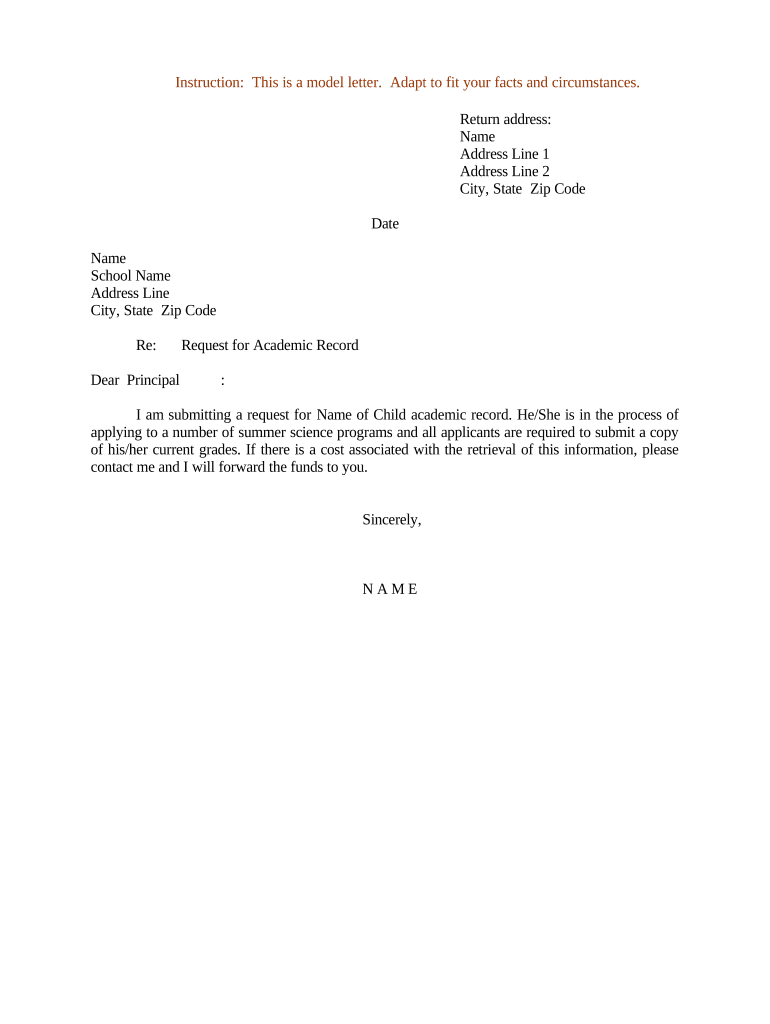
A Letter Requesting Academic Record is a formal written request sent to an educational institution asking for copies or certified copies of a student’s academic transcript, enrollment verification, or related records. The letter typically identifies the student, specifies which records are requested, explains the purpose, and provides any required consent or authorization to release protected information under FERPA or related privacy laws.

Why a Clear Request Matters

A concise, correctly completed request speeds processing, reduces the chance of denial, and documents consent when required by FERPA or institutional policy.

Why a Clear Request Matters

Who Prepares and Submits These Letters

Individuals and authorized representatives commonly use these letters when applying for transfer, employment, licensure, or benefits; institutions require clear authorization and identity proof.

  • Students requesting official transcripts for transfer or graduate admission.
  • Parents or guardians with documented authority or the student’s written consent.
  • Third parties (employers, licensing boards) when student-signed authorization is provided.

Use the institution’s published form or follow its instructions; many schools accept written letters, secure portals, or signed electronic requests that meet FERPA consent standards.

Step-by-Step: Filling the Letter Requesting Academic Record

Follow these steps to prepare a complete, institution-ready request that aligns with FERPA and common registrar procedures.

  • 01
    Identify Recipient: Address the registrar or records office with the correct department name.
  • 02
    Provide Student Details: Include full name, DOB, student ID, dates of attendance, and program of study.
  • 03
    State the Request: List exact records requested and whether certified copies are needed.
  • 04
    Authorize Release: Sign and date; attach ID copy if institution requires proof.

How Submission and Processing Typically Work

Most institutions follow an intake, verification, processing, and delivery flow — the options below outline common paths and expectations.

  • Email or Portal: Submit signed request via registrar portal or official school email for faster processing.
  • Mail or In-Person: Paper requests mailed or handed in may require original signature and ID.
  • Verification: Registrar verifies identity and authorization before releasing records.
  • Delivery: Records delivered electronically, by mail, or directly to third-party recipient.

Digital Workflow Settings to Configure

If you complete or accept requests electronically, configure authentication and delivery options to meet institutional and legal requirements.

Field Configuration
Request Type Official transcript | Electronic or paper delivery options
Authentication Email link, SMS code, or stronger KBA for identity verification
Delivery Method PDF via secure link, SFTP, or mailed hard copy per institution policy
Retention Policy Store signed request and audit trail for the institution’s retention period

Technical Considerations for eSubmission and Storage

Ensure your digital process supports secure file formats, required integrations, and accessible audit trails for compliance.

  • Supported Formats: PDF, DOCX accepted by most registrars
  • Integrations: Google Workspace, Microsoft 365, and Student Information Systems
  • Audit Trail: Timestamp, signer identity, and IP address recording

Align storage and access with FERPA rules and institutional IT policies; maintain retrievable records to demonstrate consent and chain of custody.

Essential Parts of a Professional Request Letter

A complete letter combines clear identification, explicit authorization, and delivery instructions to reduce back-and-forth with the registrar.

Purpose Statement

One to two sentences explaining why records are requested, for example transfer, employment verification, certification application, or personal copy; clarity reduces processing questions.
Student Identification

Full legal name, former names used while enrolled, date of birth, student ID, and dates of attendance; provide multiple identifiers when possible.

Records Requested

Specify transcript type (unofficial, official, certified), enrollment verification, or specific documents; list degree names and conferral dates if applicable.

Authorization Language

A clear signed statement authorizing release of education records to the named recipient; include printed name, signature, and date to meet FERPA consent expectations.

Recipient Details

Provide recipient name, institution or company, full mailing or secure email address, and any account or reference number required for delivery.

Supporting Documents

Attach government ID, proof of guardianship or power of attorney if requesting on behalf of another person, and any institutional release form.

Data and Security Considerations

Encryption: AES-256 at rest
In Transit: TLS 1.2/1.3
Certifications: SOC 2 Type II
HIPAA BAA: BAA available where needed
Audit Trail: Tamper-evident logs
Access Controls: Role-based authentication

Primary Risks and Legal Consequences

FERPA Violation: Unauthorized disclosure risks (34 CFR Part 99)
Identity Exposure: Sensitive data sent to wrong recipient
Invalid Authorization: Unsigned or incomplete consent may be rejected
Tampered Records: Alteration risks require tamper-evident controls
Delay Impact: Late submissions can miss admissions or licensure deadlines
Tax/Employment Penalties: Supporting tax/employment docs mishandled may trigger penalties

Common Mistakes to Avoid

  • Omitting a full legal name or prior names — institutions often need former names to find older records, which can add multiple business days to processing.
  • Failing to include a clear release or authorization — unsigned or vague consent is a frequent reason registrars refuse to release records to third parties.
  • Requesting the wrong document type or delivery method — specifying 'unofficial' versus 'official, sealed' copies or the wrong delivery address leads to rejected requests and reprocessing.
  • Not providing identity proof when required — many registrars require a government ID copy or in-person verification for security and FERPA compliance.

Timing and Processing Expectations

Plan ahead: processing times vary by institution, delivery method, and whether authentication is required.

Internal Processing Time:

Allow 2–4 weeks for many institutions, faster for electronic requests

Expedited Options:

Some registrars offer rush processing for a fee

Delivery Time:

Electronic delivery often < 5 business days; mail longer

Admission Deadlines:

Submit requests at least 4–6 weeks before deadlines

Third-Party Recipient:

Allow extra time when records go directly to licensing boards

Comparing eSignature Options for Submitting Requests

Common eSignature providers differ on pricing, trial availability, bulk send, and HIPAA support; signNow appears first for neutral comparison.

signNow DocuSign Adobe Sign PandaDoc HelloSign
Starting Price $8/user/mo $15/user/mo $14/user/mo $19/user/mo $15/user/mo
Free Trial Yes, 7-day free trial Varies by plan Varies by plan Varies by plan Varies by plan
Bulk Send Yes Yes Yes Yes Yes
Audit Trail Yes Yes Yes Yes Yes
HIPAA Compliant Yes Yes Yes No No

Real-World Examples of Request Use

These brief examples illustrate common scenarios where a clear, authorized request resolved a practical need.

Optica Ventures — COO

Intro: A hiring team needed rapid verification of applicant transcripts for several candidates.

  • Point: The registrar accepted an electronically signed authorization for each applicant.
  • Outro: Brian Fitzgibbons said the interface was simple and easy to use for their team and customers, reducing turnaround time for hiring decisions.

Fertility Centers — Founder

Intro: A medical clinic required certified academic credentials for new clinical staff.

  • Point: The clinic used a signed release directing the school to send sealed transcripts.
  • Outro: John Butler noted the platform’s compliance and API flexibility helped deliver documents in required formats to fulfill credentialing obligations.

Practical Tips for Accurate and Efficient Requests

Apply these best practices to reduce processing time, avoid rejections, and preserve a clear audit trail.

Confirm Registrar Requirements Ahead
Check the institution’s official transcript and records page before drafting your letter; follow any required template, fee procedure, identification, or notarization rules to avoid delays or denials.
Use Precise Recipient Details
Provide full recipient name, department, address, email, and any institution-specific account codes so records are delivered correctly and accepted without additional follow-up.
Provide Clear Authorization
Include explicit language authorizing the release of records, print name, sign, and date; attach proof of identity or power of attorney when requesting on behalf of someone else.
Keep Copies and Audit Trails
Retain the signed request, delivery confirmation, and any tracking or audit logs for the institution’s retention period to demonstrate consent and chain of custody if questions arise.

FAQs and Troubleshooting for Letter Requests

Answers to common questions about authorization, delivery, and legal validity when requesting academic records.


Need help? Contact support

be ready to get more
Join over 28 million airSlate SignNow users