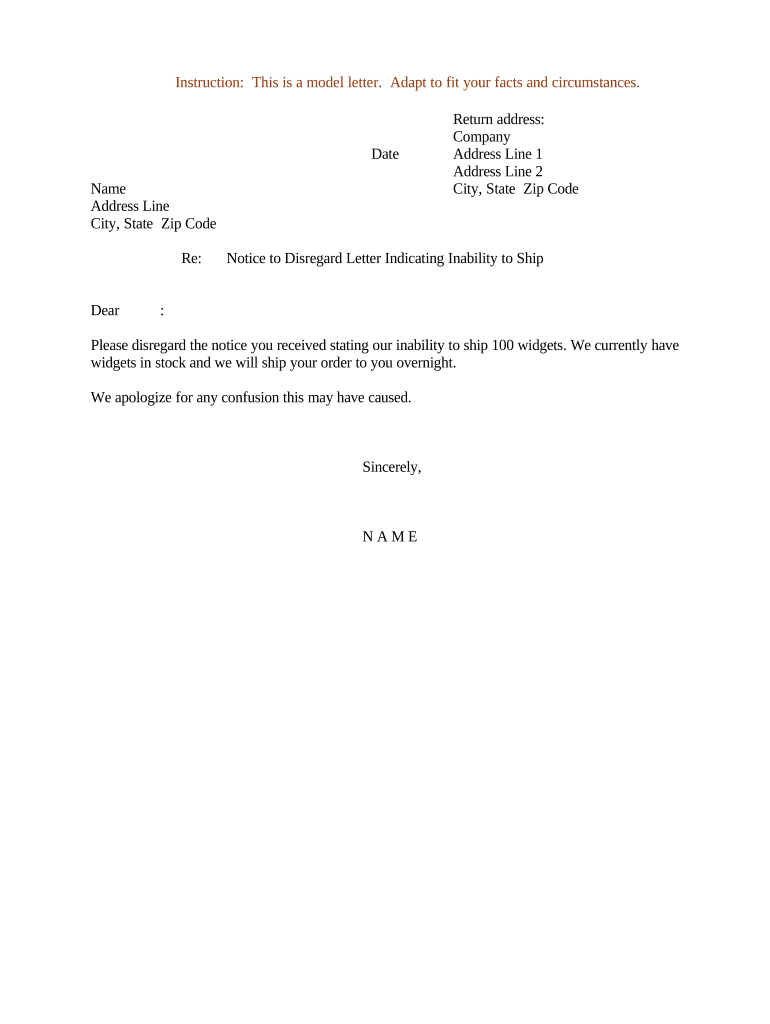
Letter to Disregard Shipping Inability Notice
What the Letter to Disregard Shipping Inability Notice Is
Why you might issue this letter
Use the Letter to Disregard Shipping Inability Notice to eliminate ambiguity after a previously issued inability-to-ship communication, protecting contractual timelines and reducing storage or demurrage costs.
Who typically prepares and receives this letter
Tailor the recipient list to contractual notice provisions and preserve a copy for internal records and dispute resolution.
- Logistics teams coordinating carrier updates and revised pickup or delivery schedules.
- Sales or customer service staff updating buyers about restored shipment capability.
- Third-party logistics (3PL) or freight forwarders notifying partners and carriers.
Typical sender and recipient profiles
Logistics Manager
A logistics manager or operations lead prepares the letter to document restored shipping capability, cites the original inability notice, and confirms new shipment dates to limit exposure to storage, demurrage, or contract penalties.
Small Business Owner
A small business owner or account manager uses the letter to reassure customers after supply-chain interruptions, provide updated delivery details, and record formal notice to avoid misunderstandings or claims for nonperformance.
Step-by-step: completing the letter
-
01Identify notice: Record the original inability notice date and reference number.
-
02Confirm status: Verify carrier availability, inventory, and new shipping date.
-
03Draft letter: State that the prior notice should be disregarded and provide updated details.
-
04Sign and send: Sign, date, and send via tracked delivery or electronic method.
How the letter moves through a workflow
-
Prepare Document: Populate template with reference, shipment details, and new dates.
-
Internal Approval: Obtain sign-off from operations or legal if required by policy.
-
Distribute: Send to recipient and relevant carriers using tracked delivery or e-sign.
-
Record: Store executed letter in contract and shipping records.
Delivery channels and technical requirements
Select the method best aligned with contractual notice clauses and retention policies; preserve both signed copy and delivery proof.
- Email with Read Receipt: Produces electronic timestamp
- Certified Mail or Courier: Provides physical proof of delivery
- eSignature Platform: Generates audit trail
Typical timelines and expectations
Immediate Notification:
Send as soon as shipping capability is restored, ideally within 24–72 hours.
Contractual Cure Period:
Observe any contract-specified cure or notice periods before resuming performance.
Carrier Lead Time:
Confirm carrier pickup windows to set realistic delivery dates.
Record Retention:
Retain the executed letter according to policy and legal retention periods.
Follow-up Window:
Request acknowledgement within a stated number of days, commonly 3–7 days.
Key milestones from notice to confirmation
Draft and Review
Complete the letter and obtain required internal approvals.
Transmit Letter
Send via chosen delivery channel with proof of sending.
Await Acknowledgement
Monitor for recipient confirmation within the stated follow-up window.
Confirm Shipment
Record carrier pickup and update tracking to all parties.
Common mistakes to avoid
- Failing to reference the original inability notice precisely, which can leave parties unclear about which communication to disregard.
- Sending the letter without internal approval when contract terms require prior authorization, risking noncompliance with notice provisions.
- Using informal language or vague timelines that fail to change contractual obligations or delivery expectations effectively.
- Not preserving delivery or signing evidence, leaving the sender unable to prove the recipient was notified of the change.
Potential consequences of an incorrect or late letter
Suggested digital workflow settings for eSubmission
| Field | Configuration |
|---|---|
| Authentication | Email link or SMS OTP for signer verification |
| Templates | Re-use standard template with required fields pre-populated |
| Retention | Enable audit trail storage and export as PDF/A |
| Integrations | Connect to ERP or contract repository for filing |
Representative eSignature vendor pricing and capabilities
| signNow | DocuSign | Adobe Sign | PandaDoc | HelloSign | |
|---|---|---|---|---|---|
| Starting Price | $8/user/mo | $15/user/mo | $14/user/mo | $19/user/mo | $15/user/mo |
| Free Trial | 7-day free trial | Varies by plan | Varies by plan | Varies by plan | Varies by plan |
| Bulk Send | Yes | Yes | Yes | Yes | No |
| Audit Trail | Yes | Yes | Yes | Yes | Yes |
| HIPAA Compliant | Yes | Yes | Yes | No | No |
Frequently asked questions about this letter
-
Is the letter legally effective?
Yes, when properly delivered and signed it can alter notice status; electronic signatures are legally recognized under the federal ESIGN Act (15 U.S.C. ch. 96) and UETA in most states, subject to limited statutory exceptions.
-
When should I send the letter?
Send as soon as the facts change and you can confirm the ability to ship; prompt notice reduces exposure to storage costs and demonstrates good-faith performance.
-
Do I need a notary or witness?
Not typically required for this type of commercial notice; check contract clauses and state rules—some states or contracts may require notarized acknowledgements for evidentiary uses.
-
Can the letter be signed electronically?
Yes; ESIGN and UETA generally permit eSignatures provided intent, consent, attribution, and reliable record retention are met. For health data include HIPAA considerations when required.
-
What if the recipient ignores it?
Document delivery attempts and follow up with certified mail or recorded eSignature evidence; preserve logs, timestamps, and acknowledgements to support dispute resolution.
-
How can I revoke or correct the letter?
Issue a subsequent dated communication that clearly states the correction or revocation; keep a copy of both documents and any acknowledgement from the recipient for the record.