Establishing secure connection…Loading editor…Preparing document…

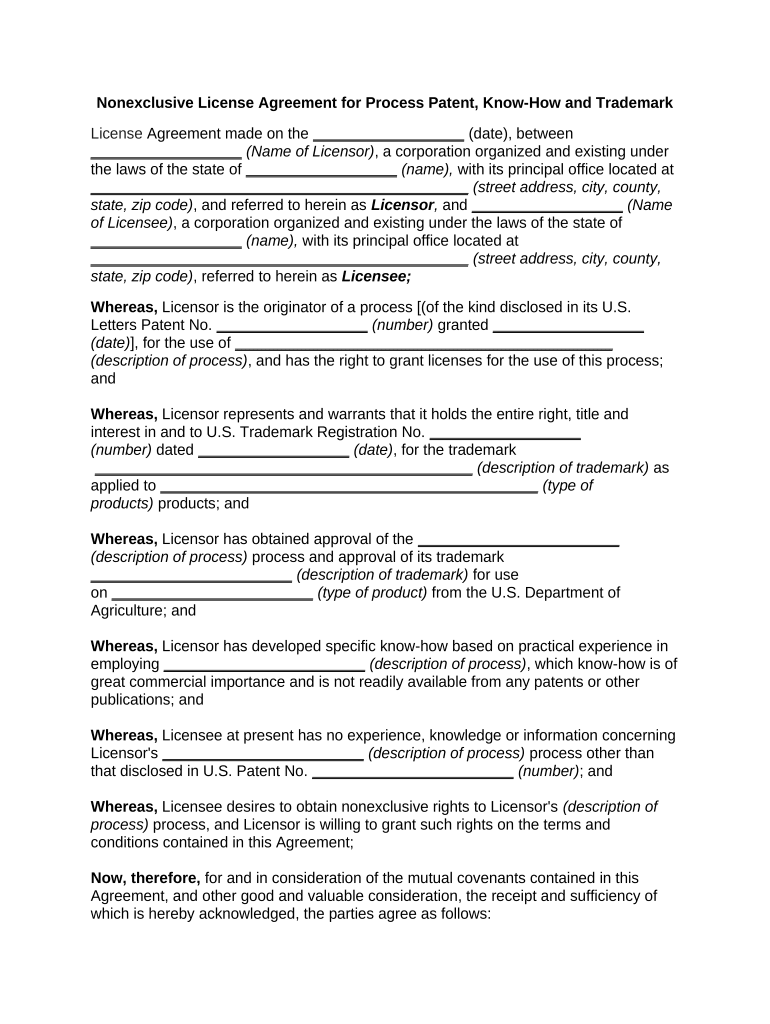
Nonexclusive License Agreement for Process Patent, Know-How and Trademark

This template is fully customizable. Edit the text, fill out the fields, and send it for signature. Give it a try!
Nonexclusive License Agreement for Process Patent, Know-How and Trademark

What this Nonexclusive License Agreement Covers

A Nonexclusive License Agreement for Process Patent, Know-How and Trademark grants one or more licensees the limited right to use patented processes, confidential technical know-how, and a trademark while the licensor retains ownership and may license others. This form typically defines the licensed scope, duration, territorial limits, permitted uses, confidentiality obligations for know-how, trademark quality controls, payment terms such as royalties or lump-sum fees, and processes for amendments, audits, or dispute resolution to clarify each party’s ongoing rights and responsibilities.

Why use a tailored nonexclusive license agreement

A clear nonexclusive license reduces ambiguity about permitted uses, preserves the licensor’s ability to exploit the same IP with other partners, and sets measurable obligations for compensation, quality control, and confidentiality to protect trade secrets and brand integrity.

Why use a tailored nonexclusive license agreement

Who typically prepares and signs this agreement

These agreements are used by licensors, licensees, counsel, and commercial teams to document rights for processes, know-how, and marks prior to commercial deployment.

  • Licensors and IP owners negotiating limited-use deals across multiple partners
  • Licensees seeking rights to use a process or brand without exclusivity
  • Legal and commercial teams coordinating technical and quality-control obligations

Who signs and why

Licensor — CEO

The licensor’s authorized executive or IP manager signs to grant rights while preserving ownership, defining permitted uses, and retaining the ability to license others. Their signature binds the company to monitoring, enforcement, and quality-control obligations.

Licensee — Ops Lead

A licensee’s operations or commercial officer signs to accept use restrictions, royalty terms, confidentiality requirements, and reporting duties that enable lawful commercial use of the process, know-how, and trademark.

Essential information and fields required

Party Names: Full legal entity names
Effective Date: MM/DD/YYYY format
Licensed IP: Patent/process/mark identifiers
Scope: Territory and field
Payment: Royalties or fees
Signatures: Name, title, date

Key risks and legal consequences of errors

Unenforceable Terms: Overbroad or vague scope may be invalid
IP Misuse: Unauthorized sublicensing or modification
Confidentiality Breach: Loss of trade-secret protection
Royalty Disputes: Underreported sales or missed payments
Termination Risk: Automatic defaults for noncompliance
Litigation Costs: Significant expense and injunction risk

Common preparation mistakes to avoid

  • Failing to precisely describe the patented process or know-how, which creates ambiguity about permitted uses and enforcement scope.
  • Using vague consideration language such as 'reasonable royalty' without formulae or reporting requirements that enable audit and enforcement.
  • Neglecting trademark quality-control provisions, allowing drift that weakens the mark and increases dilution risk.
  • Omitting data-handling and confidentiality measures for know-how, which can jeopardize trade-secret protection under state law.

Step-by-step: complete and execute the agreement

Follow these sequential actions to prepare, review, sign, and store a compliant nonexclusive license agreement.

  • 01
    Draft Terms: Define scope, duration, payments, and confidentiality
  • 02
    Legal Review: Have counsel check enforceability and IP language
  • 03
    Signatures: Collect authorized signatures and dates
  • 04
    Recordkeeping: Store executed copy with audit trail

Configuring a secure online signing workflow

Set up fields, signer order, and authentication to create a defensible electronic signature process.

Field Configuration
Signature Field Required; place for each authorized signer
Date Field MM/DD/YYYY auto-fill option
Attachment Field For exhibits, technical specs, or registrations
Authentication Email OTP or stronger KBA as needed

Technical considerations for e-execution and recordkeeping

Maintain archival copies with immutable audit logs, export signed PDFs for retention, and ensure BAA or 21 CFR Part 11 support where applicable for regulated data.

  • Integrations: CRM and cloud storage
  • File Types: PDF, DOCX compatibility
  • Authentication: Email OTP, SMS, or SSO

Key clauses to include for a professional agreement

A robust nonexclusive license balances commercial flexibility with legal protections; include precise clauses that prevent ambiguity and enable enforcement.

Grant

Specify the nonexclusive grant, listed patent numbers or process descriptions, permitted activities, and any field-of-use or duration limitations to prevent overreach and preserve licensor rights.
Consideration

Set clear royalty rates, minimums, reporting timelines, payment methods, late fees, and audit rights so both parties understand financial obligations and compliance checks.

Confidentiality

Define know-how protections, permitted disclosures, return or destruction obligations on termination, and remedies for misappropriation to preserve trade-secret treatment.

Trademark Use

Include brand guidelines, quality-control obligations, and revocation triggers to protect mark integrity and maintain consistent consumer experience.

Warranties & Indemnities

Limit liability where appropriate, include IP infringement warranties, and allocate indemnification responsibilities for third-party claims and enforcement costs.

Termination

Describe breach remedies, cure periods, post-termination use restrictions, and surviving provisions like confidentiality and indemnity to ensure orderly wind-down.

Typical execution path for online completion

An online signing sequence reduces friction while creating verifiable metadata to support enforceability under U.S. e-signature law.

  • Upload: Sender uploads final agreement
  • Place Fields: Add signature, date, and initial fields
  • Authenticate: Signers verify identity and consent
  • Finalize: System issues signed PDF and audit trail

Common timing and deadline considerations

Track effective dates, notice periods, payment schedules, and audit windows to meet contractual and regulatory timing obligations.

Effective Date Entry:

Specify exact start date in MM/DD/YYYY format

Payment Schedule:

Set dates for initial payment and recurring royalties

Audit Notice:

Require reasonable notice period, e.g., 30 days

Cure Period:

Typical 30–60 day cure before termination

Trademark Review:

Annual quality-control reviews recommended

Real-world examples of digital agreement use

These customer stories illustrate practical benefits when executing licensing or IP-related agreements online with auditable records.

Optica Ventures LLC — COO

The team used online execution to streamline partner licensing negotiations and reduce turnaround time.

  • Platform supported mobile and desktop signing by distributed partners.
  • This reduced administrative delays and produced a complete audit trail for each executed license, aiding compliance and future audits.

Fertility Centers of Illinois — Founder

Clinic operators executed service and IP-related agreements remotely while maintaining documented consent and confidentiality.

  • Mobile signing enabled patient-facing affiliates to comply quickly.
  • Resulting records included tamper-evident PDFs and timestamps that supported regulatory reviews and internal governance.

Frequently asked questions about execution and validity

Answers to common questions about enforceability, signatures, notarization, and recordkeeping for nonexclusive license agreements.


Need help? Contact support

be ready to get more
Join over 28 million airSlate SignNow users