Establishing secure connection…Loading editor…Preparing document…

Notice of Charging Lien on a Judgment

This template is fully customizable. Edit the text, fill out the fields, and send it for signature. Give it a try!
Notice of Charging Lien on a Judgment

What a Notice of Charging Lien on a Judgment Is

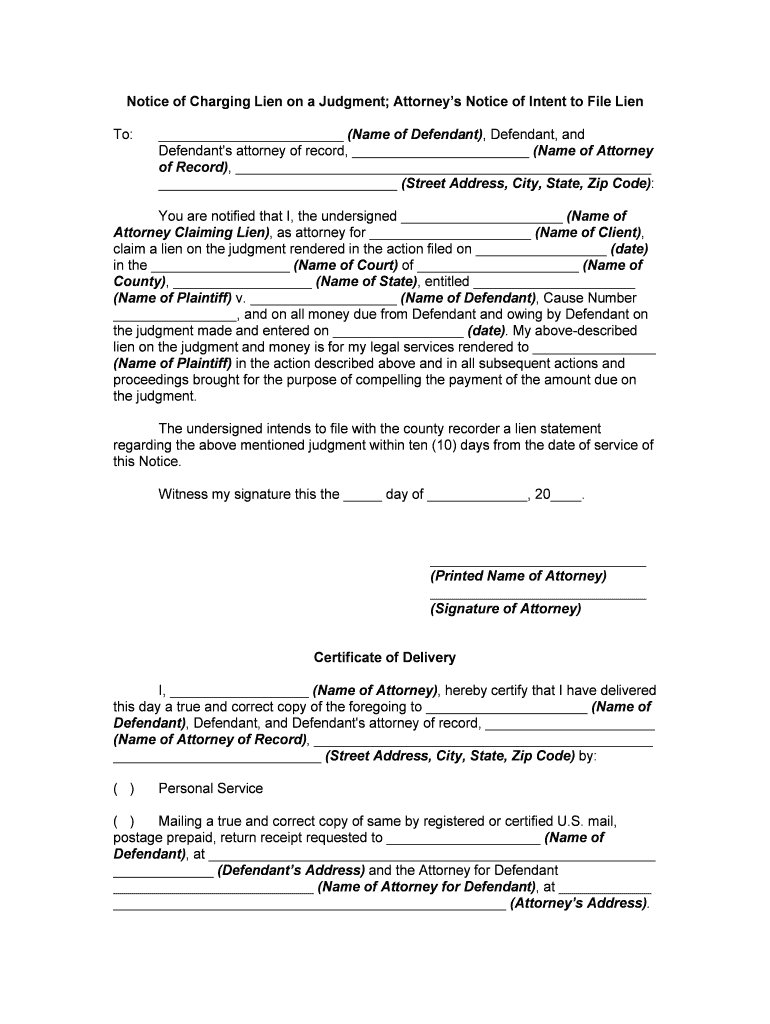
A Notice of Charging Lien on a Judgment is a formal written notice filed by an attorney or law firm asserting a charging lien against a court judgment to secure attorney fees and costs. It identifies the judgment, the client, amounts claimed, and the legal basis for the lien, and provides notice to the judgment debtor and other interested parties. The document preserves the attorney's right to payment from funds collected on the judgment and establishes priority over remaining proceeds under applicable state lien statutes.

Why This Notice Matters for Fee Protection

Used to protect legal fees, this Notice of Charging Lien on a Judgment formally notifies creditors and the court of an attorney's claim against judgment proceeds, helps secure payment priority, and creates a public record that supports enforcement or distribution objections during collection or settlement.

Why This Notice Matters for Fee Protection

Who Prepares and Responds to This Notice

Typical users who prepare or receive a Notice of Charging Lien on a Judgment include attorneys, judgment creditors, and courts handling collections.

  • Private practice attorneys representing judgment creditors and firms protecting fee recovery.
  • Judgment creditors, assignees, or lienholders seeking priority over judgment proceeds during distribution.
  • Clerks, receivers, and bankruptcy practitioners monitoring claims against collected judgments.

Core Elements to Include in the Notice

Core parts of a professional Notice of Charging Lien on a Judgment establish the claim, supporting details, and procedural steps for enforcement and priority.

Caption

Include court name, case number, parties, and judgment date so the notice unambiguously references the specific judgment and links the charging lien to the recorded case before the clerk.
Judgment Details

Describe judgment amount, interest accrual rate, enforcement date, and any post-judgment adjustments so recipients can confirm the lien attaches to current judgment value.

Claim Amount

State the attorney fees, costs, and computed totals claimed under the lien; itemize fees where possible to support the amount and reduce disputes during distribution.

Legal Basis

Cite statutory or common-law authority for charging liens in the relevant jurisdiction and reference any retainer or fee agreement supporting the attorney's right to charge the judgment.

Service Details

Identify how and when notice was served on judgment debtor, opposing counsel, and the court; include proof of service method to meet procedural requirements.

Signature Block

Provide attorney name, firm, bar number, contact information, and signature; include notarization or verification if state rules or court require it for filing acceptance.

Required Case and Contact Information

Client Name: Full legal name as on pleadings.
Case Number: Exact docket or case number.
Judgment Date: MM/DD/YYYY or court date.
Amount Claimed: Fees and costs itemized in dollars.
Service Method: Certified mail, personal service, or e-file.
Attorney Info: Name, firm, bar number, and contact.

Step-by-Step: Prepare, Serve, and File

Follow these steps to complete, serve, and file a Notice of Charging Lien on a Judgment in proper form and sequence.

  • 01
    Prepare Notice: Draft with judgment details and fee calculations.
  • 02
    Attach Evidence: Include retainer, billing records, and judgment copy.
  • 03
    Serve Parties: Serve debtor, counsel, and file proof with court clerk.
  • 04
    File & Record: File with court and record lien where required.

Setting Up an Online Workflow for Filing

Configure an online workflow to populate, sign, and submit the Notice of Charging Lien on a Judgment with secure fields and routing.

Field Configuration
Auto-fill Populate case, party, and judgment fields from dockets
Signature Field Require attorney typed or drawn signature with timestamp
Authentication Email link plus SMS code for signer verification
Attachments Attach retainer, bills, judgment PDF, proof of service

Where to File and How the Process Flows

Typical routing for a Notice of Charging Lien on a Judgment follows preparation, attachment of evidence, service on parties, and filing with the court clerk.

  • Upload Document: Upload final notice and supporting exhibits.
  • Assign Signer: Assign attorney to sign and date.
  • Serve Recipients: Send certified mail or e-service link.
  • File Record: File with court and retain stamped copy.

Digital Signing and eFiling Technical Requirements

Use a secure eSignature platform that supports PDF, audit trail, and exportable signed copies for court filing or records.

  • Formats: PDF and DOCX file formats supported
  • Security: TLS 1.2/1.3 and AES-256 encryption
  • Integrations: Connectors for NetSuite, Salesforce, and Google Workspace

Timing Considerations and Critical Deadlines

Deadlines vary by jurisdiction; prompt filing and timely service preserve lien priority and avoid procedural rejection.

Filing Deadline:

File as soon as possible after judgment entry.

Service Timelines:

Serve debtor per state service rules; proof required.

Statute of Limitations:

Lien duration and enforcement windows vary by state.

Clerk Processing:

Allow time for clerk to docket and stamp.

Contests and Objections:

Opposing parties typically have set period to object.

Key Milestones from Judgment to Enforcement

Key milestones from judgment entry to lien enforcement outline the actions that preserve priority and prepare for distribution disputes.

01

Judgment Entry

Record entry date which triggers lien opportunities.

02

Notice Preparation

Draft notice and assemble supporting billing records.

03

Service & Filing

Serve required parties and file proof with clerk.

04

Enforcement

Move to enforce or claim share at distribution.

Common Mistakes to Avoid

  • Failing to file a Notice of Charging Lien on a Judgment promptly can forfeit priority and allow other creditors to exhaust available proceeds before the lien attaches.
  • Serving the notice using incorrect methods or on the wrong parties can render the filing ineffective and lead to dismissal of the lien claim.
  • Vague or unitemized fee claims invite challenges; detailed billing records reduce disputes and support the lien amount in contested distributions.
  • Omitting statutory or contractual authority for the lien weakens enforceability and complicates court review during distribution or settlement motions.

Consequences of an Incorrect or Late Notice

Priority Loss: Lien subordinated by late filing.
Fee Forfeiture: Claim denied if procedural defects.
Court Sanctions: Possible sanctions for improper filings.
Increased Costs: Additional litigation and attorney fees.
Reputation Risk: Professional conduct inquiries possible.
Client Disputes: Heightened malpractice exposure.

Examples: How Notices Affect Distribution and Settlement

Two short scenarios illustrate how a Notice of Charging Lien on a Judgment can preserve fee recovery and influence distribution outcomes.

Law Firm Recovery

A mid-sized law firm filed a Notice of Charging Lien on a Judgment after securing a default judgment to protect unpaid hourly fees before proceeds were distributed.

  • Notice preserved the firm's priority for fee recovery.
  • When the judgment debtor sought settlement, the lien required the settling party to recognize the firm's claim; the firm used billing records and the recorded notice to negotiate direct payment from settlement proceeds.

Judgment Distribution Dispute

After enforcement, multiple creditors claimed proceeds; a judgment creditor filed a charging lien to ensure the attorney fee portion was allocated before distribution.

  • Lien supported contested distribution hearing.
  • The court reviewed the recorded notice, fee itemization, and service proof; the attorney's prioritized claim reduced litigation over allocations and facilitated an orderly disbursement to satisfy fees first.

Frequently Asked Questions About Charging Liens on Judgments

Common questions about preparing, filing, and enforcing a Notice of Charging Lien on a Judgment, with practical answers for typical procedural issues.


Need help? Contact support

Pricing and Feature Snapshot for eSignature Platforms

Baseline vendor pricing and capability snapshot for executing electronically signed Notices of Charging Lien on a Judgment, with signNow listed first for comparison.

signNow DocuSign Adobe Sign PandaDoc HelloSign
Starting Price $8/user/mo $15/user/mo $14/user/mo $19/user/mo $15/user/mo
Free Trial 7-day free trial, no credit card required Varies by vendor; check provider site Varies by vendor; check provider site Varies by vendor; check provider site Varies by vendor; check provider site
Bulk Send Yes Yes Yes Yes No
Audit Trail Yes Yes Yes Yes Yes
HIPAA Compliant Yes Yes Yes No No
Envelope Cap No envelope cap 100 envelopes/user/year limit Varies by plan Varies by plan Varies by plan
be ready to get more
Join over 28 million airSlate SignNow users