Establishing secure connection…Loading editor…Preparing document…

Life Estate Deed

This template is fully customizable. Edit the text, fill out the fields, and send it for signature. Give it a try!
Life Estate Deed

What a Life Estate Deed Is and when it’s used

A Life Estate Deed is a conveyance that gives one person (the life tenant) the right to use and occupy real property for the duration of that person’s life, with ownership passing to a named remainder beneficiary on the life tenant’s death. It preserves lifetime use while avoiding probate for the remainder interest; the deed itself typically includes a clear description of the property, identification of the life tenant and remainderman, and the effective date and signing blocks needed to record the transfer.

Why people choose a Life Estate Deed

A Life Estate Deed keeps the grantor or another person in possession during their lifetime, transfers the remainder interest to named beneficiaries, and generally avoids probate for the transferred interest. It can simplify post-mortem transfer, preserve homestead or tax benefits in some states, and allow the life tenant to sell or encumber only their life interest if the deed permits.

Why people choose a Life Estate Deed

Common user profiles for a Life Estate Deed

This deed is often used by property owners planning for succession, by advisors preparing estate plans, and by family members coordinating ownership transitions.

  • Seniors planning succession without probate — preserve lifetime residence while naming remainder beneficiaries.
  • Adult children acting with or for aging parents — secure future ownership while enabling current occupancy.
  • Estate and real estate attorneys — draft tailored language to match client tax and asset-protection goals.

Users should consult counsel about tax, Medicaid, and creditor implications before recording a Life Estate Deed in their state.

Authorized signers and typical roles

Grantor / Owner

The person who conveys the present life estate; must sign the deed to transfer the life interest. If the grantor is an entity, use the entity’s authorized signer and include capacity language.

Remainderman / Beneficiary

The person or persons who receive the remainder interest at the life tenant’s death. Remaindermen do not sign to create the life estate but may sign acknowledgements or acceptances when required by state law.

Essential sections to include in a professional Life Estate Deed

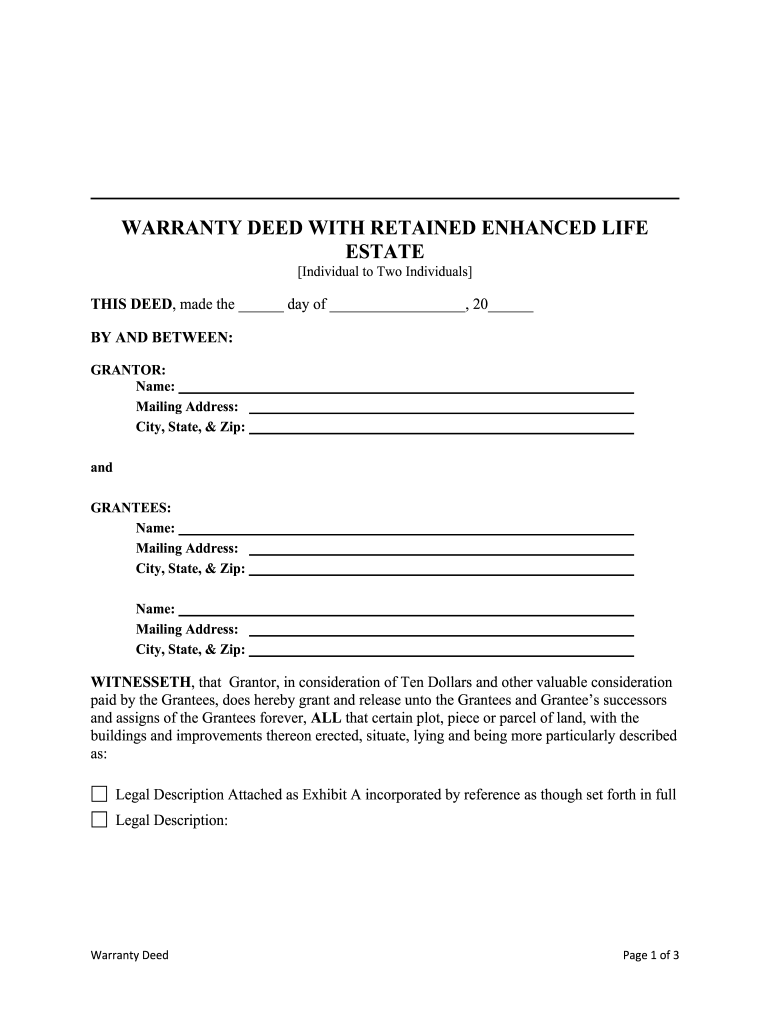
A complete deed includes clauses that identify parties, precisely describe the property, state the life tenant interest, name remaindermen, note reservations or powers, and provide signature, notary and witness blocks for recordation.

Parties

Full legal names and capacities of grantor(s), life tenant(s), and remainderman(s) to avoid ambiguity in title records and future conveyances.
Property Description

Metes-and-bounds or recorded plat reference and parcel number as used in the county recorder to ensure the deed indexes correctly.

Granting Language

Clear statement that grantor conveys a life estate to X for life, with remainder to Y, plus any limitations or reserved powers.

Reservations and Liens

Specify any reserved rights, easements, existing mortgages, or taxes to clarify encumbrance effects on the life and remainder interests.

Signature and Acknowledgement

Grantor signature block, witness lines if required by state law, and a notary acknowledgement formatted for the recording county.

Recording Instructions

Include county recorder name, return-to address, and any transfer tax or documentary stamp language needed for filing.

Step-by-step: completing a Life Estate Deed

Follow this sequence to prepare, sign, notarize, and record a Life Estate Deed correctly.

  • 01
    Prepare draft: Assemble names, full legal description, and desired reservation or powers.
  • 02
    Review legal effects: Confirm tax, Medicaid, and creditor consequences with counsel.
  • 03
    Sign in presence: Grantor signs before a notary; add witnesses where state law requires.
  • 04
    Record deed: Submit to county recorder with required recording fee and return address.

The typical workflow for preparing and recording

This sequence describes the practical flow from drafting to recorded title.

  • Drafting: Create deed text and legal description for review.
  • Execution: Grantor signs with notary and required witnesses.
  • Delivery: Deliver executed deed to recorder with fees.
  • Indexing: Recorder assigns book/page or instrument number and returns copy.

Digital setup for completing the deed online

If using an eSignature platform, configure authentication, field placement, and notarization options before sending for signatures.

Field Configuration
Signature Block Place grantor signature and date fields; enable signer's name auto-fill.
Notary Block Add a notary acknowledgement formatted for the recording county.
Witness Fields Include witness signature and printed-name fields when state law requires two witnesses.
Authentication Require email verification and consider SMS/KBA for stronger signer identity proof.

Electronic signing and notarization: platform considerations

Choose a platform that supports secure signatures, notarization workflows, and produces a record suitable for recording where permitted.

  • Document formats: PDF and DOCX support are standard for recorder systems.
  • Notarization: Remote Online Notarization (RON) may be allowed depending on state rules and recorder acceptance.
  • Audit Trail: Retain timestamp, IP, and signer authentication details for evidentiary support.

Confirm the county recorder accepts e-recorded deeds and the chosen platform’s RON or in-person notary output before relying on an electronic workflow.

Typical eSignature vendor pricing and basic capabilities

Compare common vendor starting prices and basic feature availability relevant to Life Estate Deed workflows; signNow is listed first for parity in evaluation.

signNow DocuSign Adobe Sign PandaDoc HelloSign
Starting Price $8/user/mo $15/user/mo $14/user/mo $19/user/mo $15/user/mo
Free Trial Yes, 7-day trial No No No Yes, limited
Bulk Send Yes Yes Yes Yes No
Audit Trail Yes Yes Yes Yes Yes
HIPAA Compliant Yes Yes Yes No No

Security and compliance considerations when using digital tools

Encryption: TLS 1.2/1.3 in transit, AES-256 at rest
Audit Logs: Detailed timestamped audit trails show actions and IP addresses
Authentication: Email, SMS, KBA, or advanced multi-factor options available
Regulatory Compliance: Platforms may support ESIGN, UETA, and optional HIPAA BAA
Access Controls: Role-based permissions and SSO for enterprise accounts
Document Integrity: Tamper-evident PDFs and digital certificates supported

Common legal risks and consequences of errors

Recording Rejection: Missing or incorrect notary/witness blocks can result in recorder rejection
Title Defect: Incorrect legal description may create clouds on title requiring corrective deeds
Tax Liability: Improper transfer language can trigger reassessment or transfer tax
Medicaid Risk: Property transfers may affect Medicaid eligibility depending on timing and state rules
Creditor Claims: Life estate does not always protect against preexisting creditor claims
Revocation Issues: Inadequate revocation language can complicate later ownership changes

Avoidable preparation mistakes

  • Using a street address instead of the recorded legal description causes recording delays.
  • Failing to confirm state witness rules before signing leads to rejection by the recorder.
  • Not updating mortgage or lienholder notices can create unintended encumbrance gaps.
  • Overlooking tax or Medicaid look-back periods may produce unintended eligibility consequences.

Real-world examples of Life Estate Deed use

These examples illustrate typical scenarios where a Life Estate Deed is applied.

Family Succession

An aging homeowner conveys a life estate to herself

  • names her two children as remaindermen
  • the deed avoids probate for the remainder interest and ensures the home passes directly to the children on her death while she retains occupancy.

Asset Simplification

A widow adds a life estate for her adult child

  • retains the right to live in the property for life
  • the arrangement simplifies title transfer at death and reduces the time and cost of probate administration for the estate.

Practical tips for accurate and efficient completion

Follow these practices to reduce recording delays and legal uncertainty.

Verify names and title
Confirm current title owner names and any entity capacities before preparing the deed to prevent mismatches that delay indexing.
Use recorded legal description
Pull the exact legal description from the county recorder or prior deed; avoid free-form addresses.
Confirm witness and notary rules
Check county and state requirements for witness count and whether RON or in-person notarization is acceptable for deeds.
Record promptly
Record executed deeds quickly to protect priority and avoid intervening liens or transfers.

Timing and processing expectations for recording

Recordation timing varies by county; plan for local processing and possible courier or mailing lead times.

Prepare and sign:

Same-day to 1 week depending on scheduling notary and witnesses

Local recording processing:

1–10 business days typical; some counties offer same-day e-recording

Return of recorded deed:

2–14 days by mail or immediate for in-person pickup

Corrections or rejects:

Expect additional 1–30 days if clerk requests re-execution or correction

Priority protection:

Record as soon as possible to preserve priority against subsequent encumbrances

Key milestones from execution to title update

Below are the numbered stages commonly involved in completing and recording a Life Estate Deed.

01

Stage 1: Drafting

Prepare deed text, legal description, and recording instructions.

02

Stage 2: Execution

Grantor signs in front of notary and required witnesses.

03

Stage 3: Submission

Deliver deed to county recorder with payment of fees.

04

Stage 4: Indexing and return

Recorder indexes deed; recorded copy returned to designated address.

Frequently asked questions about Life Estate Deeds

Common questions and brief answers about drafting, signing, and recording Life Estate Deeds in the United States.


Need help? Contact support

be ready to get more
Join over 28 million airSlate SignNow users