Establishing secure connection…Loading editor…Preparing document…

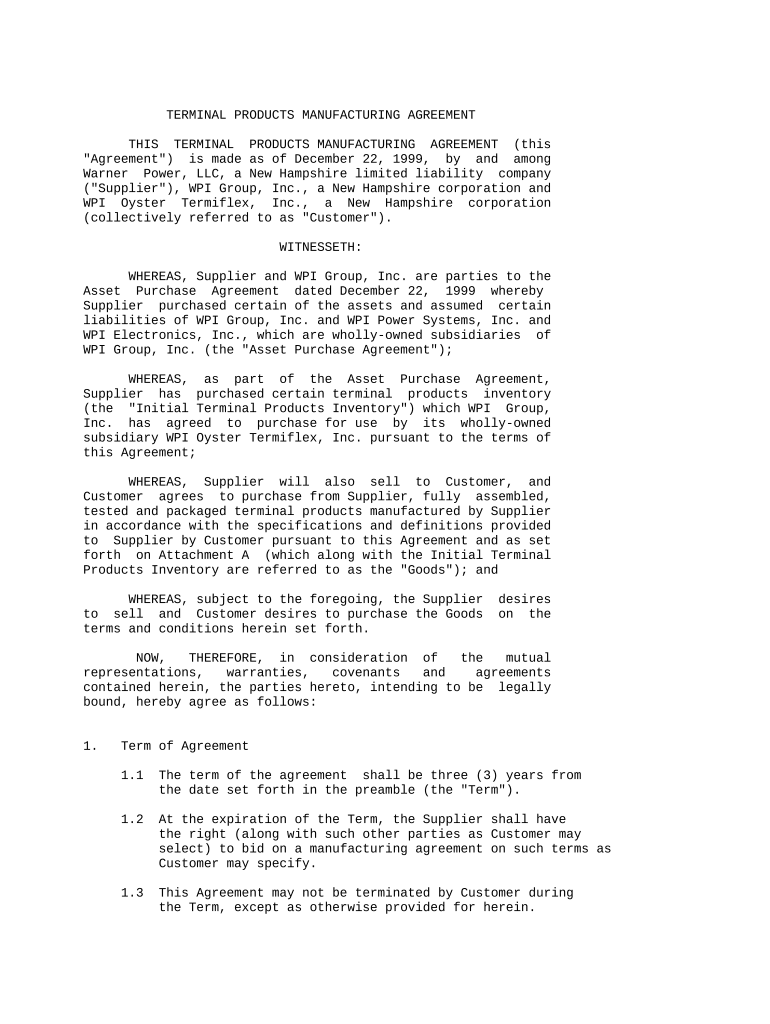
Terminal Products Manufacturing Agreement

This template is fully customizable. Edit the text, fill out the fields, and send it for signature. Give it a try!
Terminal Products Manufacturing Agreement

What a Terminal Products Manufacturing Agreement Is

A Terminal Products Manufacturing Agreement is a contract that governs the manufacture, testing, delivery, and acceptance of finished terminal products supplied to a buyer by a manufacturer or contract assembler. It defines product specifications, production schedules, minimum order quantities, unit pricing, inspection and testing procedures, intellectual property ownership, confidentiality obligations, payment terms, warranty and indemnity provisions, change-order processes, and remedies for defects or late delivery. The agreement allocates responsibilities between design, tooling, and production, and typically includes attachment exhibits for drawings, bill of materials, and quality-control checklists used to verify compliance before shipment.

Why this Agreement Matters for Product Manufacturers and Buyers

A clear, well-drafted Terminal Products Manufacturing Agreement reduces operational risk by setting precise specs, delivery milestones, inspection criteria, and liability limits. It protects IP, clarifies acceptance processes, and defines remedies for defective goods or missed schedules.

Why this Agreement Matters for Product Manufacturers and Buyers

Who Typically Uses This Agreement

Common users include OEMs, contract manufacturers, procurement teams, and legal counsel involved in product supply and assembly.

  • Original equipment manufacturers and product owners who outsource final assembly and require control over specifications and IP.
  • Contract manufacturers and CMOs that need clear production scope, testing obligations, and acceptance criteria.
  • Procurement and supply chain teams that manage forecasts, lead times, and logistics for finished goods.

Use this agreement when the relationship includes recurring production runs, tooling investments, or when the buyer requires contractually defined quality and acceptance procedures.

Key people who sign or manage the agreement

Manufacturing Manager

Typically responsible for operational performance, production scheduling, and quality acceptance. Reviews technical exhibits and approves inspection criteria to ensure purchased goods meet specifications and delivery windows.

Legal Counsel

Drafts and negotiates contract terms including IP assignment, warranty scope, indemnities, and limitation of liability. Advises on regulatory or jurisdictional issues affecting enforceability.

Core Clauses to Include in a Professional Agreement

A strong Terminal Products Manufacturing Agreement organizes obligations clearly and protects both parties with measurable standards.

Product Specifications

Detailed drawings, BOM, tolerances, approved vendors, and change control procedures that define acceptable product attributes and revision management.
Production Schedules

Forecasting, lead times, order confirmation, and penalties or remedies for missed milestones that align expectations across teams.

Inspection and Acceptance

Sampling plans, inspection protocols, acceptance tests, and remedies for nonconforming goods, including rework and rejection procedures.

Intellectual Property

Ownership of tooling, design rights, license grants, and assignment provisions addressing preexisting and created IP.

Warranty & Indemnity

Duration and scope of warranties, limitations of liability, and indemnification for third-party claims, including product liability allocation.

Payment & Pricing

Unit pricing, volume discounts, currency, invoicing schedule, payment terms, and remedies for late payment or short-payments.

Step-by-Step: How to Complete the Agreement

Follow this order to reduce negotiation cycles and operational misalignment.

  • 01
    Gather Exhibits: Collect drawings, BOM, test plans, and tooling lists before drafting.
  • 02
    Define Scope: Agree product specs, quantities, and delivery cadence in writing.
  • 03
    Set Acceptance: Insert inspection methods, sample sizes, and rejection remedies.
  • 04
    Sign and Record: Obtain authorized signatures and store executed copies securely.

Digital Workflow Options for Managing the Agreement

Configure a repeatable e‑workflow to route drafts, collect signatures, and archive final documents.

Field Configuration
Signing Order Specify sequential or parallel signers, and set mandatory fields per signer.
Authentication Choose email link, SMS code, or knowledge-based authentication for higher risk transactions.
Templates Save standard clauses and exhibits as templates to speed future orders.
Notifications Enable reminders for pending signatures and send completed copies automatically.

Typical eSigning and Routing Flow for Terminal Agreements

A standard electronic routing reduces turnaround time and captures an audit trail for each signature event.

  • Upload Document: Sender uploads the agreement and attached exhibits to the signing platform.
  • Place Fields: Sender inserts signature, initial, and date fields and assigns recipients.
  • Signer Authentication: Signer verifies identity via email link, SMS, or stronger ID check if required.
  • Completion & Archive: Signed copies and audit reports are captured and stored for compliance.

Technical and Integration Considerations

Choose a platform that supports PDF and DOCX uploads, API access for automation, and secure storage.

  • File Types: PDF, DOCX, and XLSX compatibility.
  • Integrations: Connectors for ERP and CRM such as NetSuite and Salesforce.
  • Authentication: Supports email, SMS, and advanced signer verification.

Verify the provider offers audit trails, retention controls, and enterprise-grade security before transmitting proprietary designs or specs.

eSignature Vendor Pricing and Feature Snapshot

Comparison of typical starting prices and select features across leading eSignature providers. signNow appears first in the table per vendor ordering rules.

signNow DocuSign Adobe Sign PandaDoc HelloSign
Starting Price $8/user/mo $15/user/mo $14/user/mo $19/user/mo $15/user/mo
Free Trial 7-day free trial Varies by plan Varies by plan Varies by plan Varies by plan
Bulk Send Yes Yes Yes Yes No
Audit Trail Yes Yes Yes Yes Yes
HIPAA Compliant Yes Yes Yes No No
Envelope Cap No cap 100 envelopes/user/year Varies by plan Varies by plan Varies by plan

Security and Compliance Controls to Confirm

Encryption: TLS 1.2/1.3 in transit; AES-256 at rest
Audit Trail: Detailed timestamp, IP, and action history
Certifications: SOC 2 Type II and ISO 27001 compliance
HIPAA Support: BAA required for protected health information
Regulatory: ESIGN and UETA legal framework compliance
Accessibility: WCAG 2.0 Level AA support

Key Risks and Legal Consequences to Watch For

Late Delivery: Liquidated damages or lost revenue
Defective Goods: Rework costs and potential breach claims
IP Misassignment: Loss of rights or ownership disputes
Payment Default: Interest, collection costs, and suspension
Noncompliance: Regulatory fines or contract termination
Data Breach: Notification, remediation costs, potential liability

Common Drafting and Execution Mistakes to Avoid

  • Vague specifications that reference informal drawings rather than controlled exhibits create disputes over acceptability.
  • Failing to state inspection windows and acceptance criteria leaves cadence and rejection remedies undefined and risky.
  • Not clarifying tooling ownership and amortization often causes disagreements when orders change or tooling is obsolete.
  • Using ambiguous change-order language can permit unilateral price increases or delays without defined approval processes.

How This Agreement Differs from a Standard Manufacturing Services Agreement

The table contrasts the terminal-products focus with broader manufacturing services agreements that may lack product-specific controls.

Criteria Terminal Products Agreement Standard MSA
Scope Specificity sku-level detail broad service descriptions
IP Assignment explicit transfer often limited or absent
Quality Controls detailed testing plan general quality obligation
Accept/Reject Process formal acceptance steps informal or ad hoc

Typical Timelines and Processing Expectations

These timelines reflect typical production and contractual milestones you should plan around when executing the agreement.

Sample Approval Window:

7–21 days for prototype verification and authorization to proceed

Production Lead Time:

30–90 days depending on complexity and tooling requirements

Delivery Window:

Carrier lead times plus 7–14 days for customs or inspections

Warranty Period:

Commonly 12 months from date of acceptance

Change Order Response:

Buyer response and price revision within 10–21 days

Key Milestones from Contract Signing to First Shipment

A sequential milestone view helps project managers track progress from execution to fulfillment.

01

Contract Execution

Agreement signed and effective; enables tooling payments and production scheduling

02

Tooling & Setup

Tooling manufactured and validated prior to pilot production runs

03

Pilot Run

First batch produced and inspected; buyer approves for volume manufacture

04

Mass Production

Full-scale manufacturing begins and scheduled deliveries commence

Example Use Cases from Real-World Scenarios

Two anonymized examples illustrate how parties structure agreements for production and IP protection.

Case Study 1

An electronics OEM contracted a CMO to assemble finished terminals using buyer-supplied tooling and components.

  • The contract required a first article inspection and 1% sampling at acceptance.
  • The explicit acceptance criteria and warranty clause reduced disputes and ensured timely replacement of defective lots without interrupting the supply chain.

Case Study 2

A medical device developer licensed its design to a manufacturer under a terminal-products agreement with strict quality-attestation exhibits.

  • The agreement also required HIPAA-compliant handling of patient-relevant data.
  • Clear IP assignment and documentation obligations allowed confident scaling while maintaining regulatory traceability for audits.

Frequently Asked Questions About Terminal Products Manufacturing Agreements

Answers to common questions about eSigning, enforceability, IP, inspection, and dispute resolution in these agreements.


Need help? Contact support

be ready to get more
Join over 28 million airSlate SignNow users