Establishing secure connection…Loading editor…Preparing document…

Washington Owner's Demand for Release

This template is fully customizable. Edit the text, fill out the fields, and send it for signature. Give it a try!
Washington Owner's Demand for Release

What the Washington Owner's Demand for Release Is

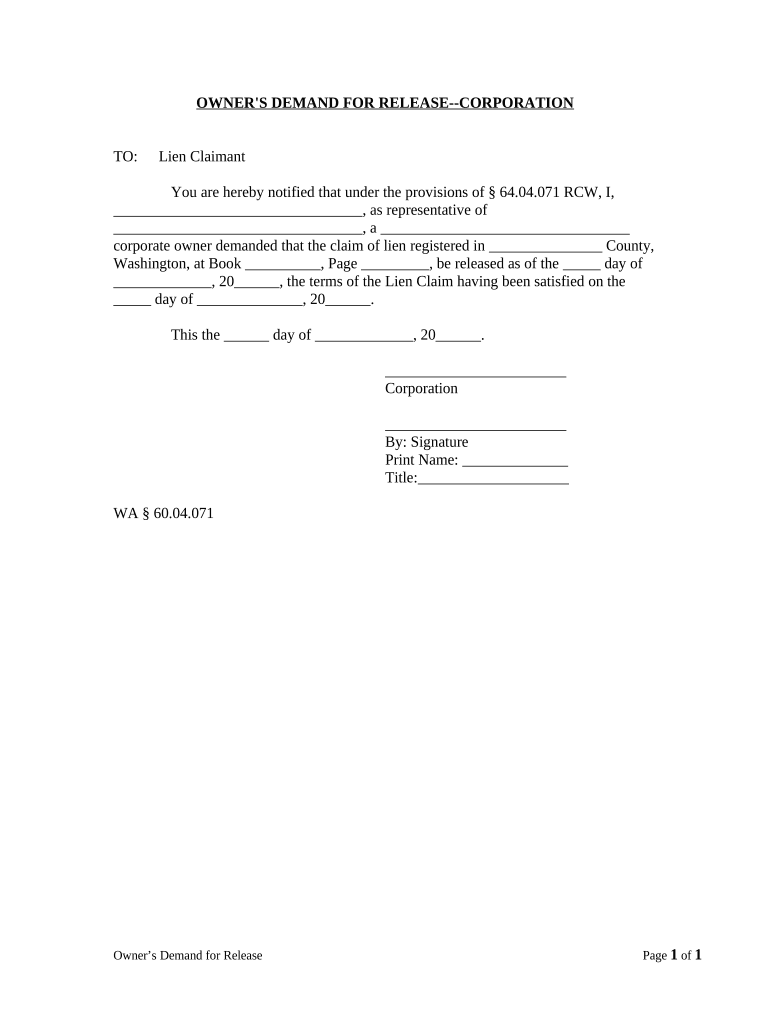
The Washington Owner's Demand for Release is a written notice used by a property owner or lienholder in Washington state to demand the release of a lien, holdback, or claim against real or personal property. It identifies the parties, describes the property and the encumbrance, states the factual and legal basis for release, and records the relief requested with a dated signature. When properly completed it creates a clear record for title officers, recorders, and disputing parties, and it can be submitted in paper or electronic form where permitted.

Why a Formal Demand for Release Matters

Use the Washington Owner's Demand for Release to clearly record a property owner’s request that a lien or claim be removed. It creates a dated written demand useful for negotiations, administrative filings, and as evidence in later disputes under applicable state law.

Why a Formal Demand for Release Matters

Who Typically Prepares or Receives This Demand

Typical users include property owners, title companies, contractors, and attorneys preparing to clear liens or seek administrative resolution.

  • Property owners and investors asserting wrongful liens or requesting releases after payment.
  • Title companies clearing chain-of-title issues prior to closing or recording.
  • Contractors or subcontractors confirming lien releases following dispute resolution or payment.

Representative Signers and Their Roles

Owner / Claimant

An individual or corporate owner asserting entitlement to a release after satisfying an obligation or disputing a recorded claim. Signatory should attach proof of payment, contract references, and any prior correspondence to support prompt processing and potential filing with the county recorder.

Title Officer

A title company representative verifies release language and supporting evidence before closing; they may request recorded instrument numbers, proof of satisfaction, and a notarized or electronically signed demand to confirm the lien removal for chain-of-title clearance.

Essential Elements to Include in a Professional Demand

A professional demand includes identifiable parties, precise property details, clear legal basis, supporting evidence, correct authentication, and proper routing for recording or title review.

Identified Parties

List full legal names and contact information for owner, lienholder, and any agent. For corporations, include the registered business name and the signer's title or authority to bind the entity.
Property Details

Provide address, legal description, parcel or tax ID, recorded instrument references, and include vicinity information and lot numbers where applicable to accurately link the demand to the encumbrance.

Legal Basis

Cite the contract clause, payment date, settlement agreement, or court order that justifies release. Reference exhibit numbers and attached supporting documents to assist title review and reduce disputes.

Supporting Evidence

Attach receipts, canceled checks, lien releases, satisfaction letters, or escrow statements. Clearly label exhibits and cross-reference them within the demand to expedite recorder or title officer processing.

Authentication

Include signature blocks with printed names, titles, and dates. Complete notary acknowledgments or use compliant e-signature authentication methods consistent with ESIGN and state rules, and retain audit trail information for evidentiary support.

Routing & Filing

Specify delivery instructions for lienholder, title company, and county recorder. Use tracked delivery or e-recording options and retain proof of transmission for chain-of-custody to support title insurance underwriting and dispute resolution.

Step-by-Step: Prepare and Deliver the Demand

Follow these steps to prepare, sign, and deliver the Washington Owner's Demand for Release correctly.

  • 01
    Gather Evidence: Collect payment receipts, contract references, and recorded instrument numbers.
  • 02
    Draft Demand: State owner, property, basis, and requested release clearly.
  • 03
    Sign & Notarize: Signatures and notary acknowledgment as required by state law.
  • 04
    Submit: File with county recorder or send to lienholder and title officer.

Recommended Digital Workflow Settings

Set up a digital workflow to collect signatures, attach exhibits, and route the Washington Owner's Demand for Release to required parties.

Field Configuration
Signer Order Sequential or parallel, select per workflow needs
Authentication Email, SMS code, or KBA for higher risk
Notary Field Include notary block or RON option
Attachments Upload PDFs, invoices, and title reports

Delivery Formats and Integration Considerations

Platforms and delivery methods influence acceptance and processing for recorder offices and title companies.

  • Formats: PDF and Word (DOCX) formats supported
  • Integrations: Salesforce, NetSuite, Google Workspace compatible
  • eRecording: Check county e-recording vendors

How Electronic Submission Typically Works

This flow shows how to deliver, sign, and record the demand, whether using paper, in-person notarization, or e-signature platforms.

  • Upload Document: Prepare PDF or DOCX and attach supporting evidence.
  • Place Fields: Add signature, date, and notarization placeholders.
  • Authenticate Signer: Use email, SMS, or advanced authentication per risk.
  • Deliver & Record: Send to signers, obtain signatures, then file with recorder.

How This Demand Compares to Related Instruments

Compare related instruments to determine when to use a Washington Owner's Demand for Release versus other lien release documents.

Document Type Best Use Notarization Required
Owner's Demand formal request varies
Satisfaction of Lien filed by lienholder typically yes
Lien Release recorded release instrument
Partial Release parcel-specific release

eSignature Vendor Pricing and Feature Snapshot

Compare entry pricing and essential feature availability for common eSignature vendors relevant to completing and distributing this form.

signNow DocuSign Adobe Sign PandaDoc HelloSign
Starting Price $8/user/mo $15/user/mo $14/user/mo $19/user/mo $15/user/mo
Free Trial 7-day trial Varies Varies Varies Varies
Bulk Send Yes Yes Yes Yes No
Audit Trail Yes Yes Yes Yes Yes
HIPAA Compliant Yes Yes Yes No No
Envelope Cap No envelope cap 100 envelopes/user/year Varies by plan Varies by plan Varies by plan

Key Milestones from Draft to Recording

Key milestones for a demand filing include preparation, authentication, delivery, and recording; plan timelines accordingly.

01

Preparation

Gather evidence, prepare demand, and attach exhibits.

02

Authentication

Signatures and notary acknowledgment or e-sign authentication completed.

03

Delivery

Send to lienholder and title company with proof of service.

04

Recording

File with county recorder or e-recording provider; retain receipt.

Timing Expectations and Processing Notes

Typical timelines for responses and recording can vary; use conservative windows and verify county processing times before relying on recording dates.

Typical response window:

Provide a 30-day deadline for reply to a demand.

County recording time:

Processing varies from same-day to several weeks.

Notary and RON retention:

Notary journals and RON recordings are often retained 5–10 years.

Submission buffer:

Allow extra time for RON, mailed, or courier submissions.

Statute of limitations impact:

Effective date may affect filing or quiet title timing.

Security and Compliance Considerations

Encryption in transit: TLS 1.2 / TLS 1.3
Encryption at rest: AES-256 encryption for stored data
Certifications: SOC 2 Type II, ISO 27001
HIPAA readiness: BAA available for covered entities
Legal compliance: ESIGN and UETA standards
Accessibility: WCAG 2.0 Level AA

Risks and Consequences of Errors

Incorrect party name: May invalidate release
Missing supporting proof: Record rejection or dispute
Failure to notarize: May delay recording
Improper eSign: Not accepted in exceptions
Tax withholding risk: Backup withholding possible
Fraudulent claims: Civil liability exposure

Common Preparation Mistakes to Avoid

  • Leaving dates blank or using inconsistent effective dates creates ambiguity that can delay acceptance by title companies or recorders.
  • Omitting recorded instrument references or account numbers makes it difficult to match the demand to the encumbrance being released.
  • Submitting unsigned or improperly notarized demands will be rejected for recording or considered unenforceable in disputes.
  • Relying on informal email confirmations without a signed demand increases risk and may not satisfy record retention or legal admissibility standards.

Real-world Examples of Electronic Demands in Use

Selected examples show how electronic signing accelerates resolution and supports title processes and filings across organizations.

Optica Ventures

Optica Ventures adopted e-signing to remove paper bottlenecks and ensure customers could complete releases without in-person steps.

  • Interface simple and easy-to-use for customers.
  • They reported faster turnaround and fewer processing errors when sharing signed release documents with title officers, allowing quicker closings and reduced follow-up with a clear audit trail to resolve timing and signer questions.

Martin Properties

Martin Properties used electronic demands to process releases remotely, enabling agents to close transactions without waiting for mailed documents or return trips.

  • Online processing with full compliance.
  • This reduced in-person coordination, shortened settlement timelines, and produced a clear audit trail for title companies and lenders; agents reported consistent compliance across mobile and desktop workflows.

Frequently Asked Questions About Completion and Submission

[INTRO] Answers to frequent questions about completing, signing, and submitting the Washington Owner's Demand for Release to avoid common rejections.


Need help? Contact support

Practical Tips to Reduce Rejection Risk and Speed Processing

Best practices reduce rejection risk and speed acceptance by title companies and recorders when submitting a demand for release.

Verify recorded references and identifiers match
Cross-check the recorded instrument number, book and page or document ID against county records and title reports. Mismatches are a leading cause of processing delays and can require supplemental affidavits or corrected instruments to complete release.
Use clear exhibit labeling and indexing
Label attachments as Exhibit A, B, etc., and reference them in the demand text. Provide a cover index listing each document name, date, and a brief description so reviewers can rapidly confirm evidence and accept the release.
Confirm signer authority and corporate proof
Obtain a corporate resolution, power of attorney, or officer certification when a business signs. Attach proof of authorization to bind the entity; title companies often require such documentation before accepting releases affecting corporate-held property.
Retain and distribute audit trail copies
Keep signed copies, notary acknowledgments, and e-sign audit trails in your records. Provide certified copies to title companies and lenders; maintain originals or verified electronic records for the retention period applicable to your jurisdiction.
be ready to get more
Join over 28 million airSlate SignNow users