Establishing secure connection…Loading editor…Preparing document…

Louisiana Act Donation Form

This template is fully customizable. Edit the text, fill out the fields, and send it for signature. Give it a try!
Louisiana Act Donation Form

What the Louisiana Act Donation Form Is and When It’s Used

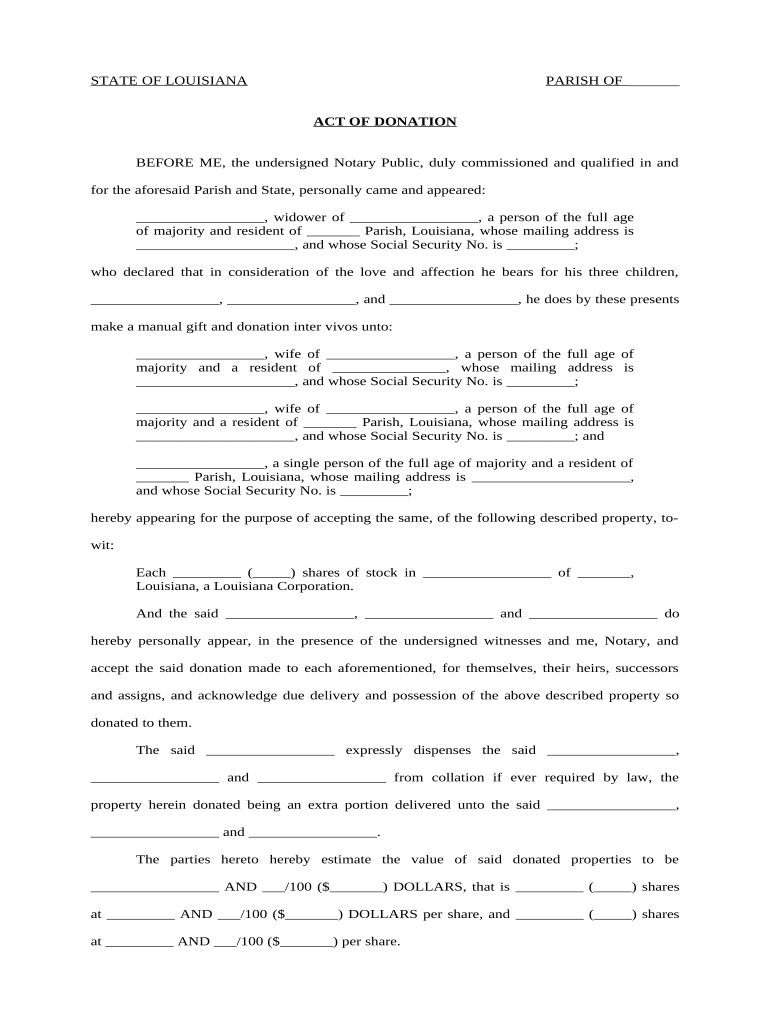
The Louisiana Act Donation Form documents a voluntary transfer of property, funds, or rights under Louisiana law and records donor intent, description of the donated item, and any conditions. Organizations use it to create a clear, signed record for audit, acceptance, and tax substantiation. The form can apply to monetary gifts, tangible property, or transfers requiring a written record for organizational governance or compliance. Where allowed, the form may be completed electronically and retained as a reproducible record consistent with federal ESIGN (15 U.S.C. ch. 96) and applicable state electronic transaction law.

Why a Proper Louisiana Act Donation Form Matters

A complete, signed donation form protects donor intent, supports tax substantiation, and creates a clear acceptance record for the recipient organization. Proper documentation reduces disputes and improves audit readiness.

Why a Proper Louisiana Act Donation Form Matters

Who Typically Prepares and Signs This Form

Common users include nonprofit development staff, legal counsel, and individual donors preparing a documented gift.

  • Nonprofit development teams preparing donor acknowledgments and gift tracking records.
  • Donors or donor representatives documenting intent, conditions, or restrictions on a donation.
  • Counsel or compliance officers reviewing language for tax, title, or transfer conditions.

Step-by-step: Completing the Louisiana Act Donation Form

Follow these steps in order to create a clear, enforceable donation record and avoid common procedural errors.

  • 01
    Collect donor details: Enter full legal name, address, and contact information.
  • 02
    Describe donation: State item, quantity, condition, and fair market value if known.
  • 03
    Specify terms: Note restrictions, intended use, or time limits clearly.
  • 04
    Sign and retain: Obtain signatures, date, and store the executed record securely.

How to set up an online completion workflow

Configure the document and signing flow so signers see required fields, receive authentication prompts, and copies are stored centrally.

Field Configuration
Authentication Method Email link, SMS code, or KBA depending on risk
Signer Roles Donor, recipient acceptance officer, witness, notary
Field Logic Show conditional fields for restricted donations
Storage Location Secure cloud repository with access controls

Where to send and how to route completed forms

Typical routing flows ensure proper acceptance, acknowledgement, and secure storage after signatures are captured.

  • Upload document: Place the form into your eSignature platform.
  • Assign signers: Add donor and organizational signers in order.
  • Authenticate signers: Use chosen verification method before signing.
  • Store final copy: Save signed PDF with audit trail in records system.

Technical considerations for electronic completion and submission

Choose a platform that supports secure eSigning, audit trails, and the authentication level your organization requires.

  • Integrations: Salesforce, NetSuite, Microsoft 365, Google Workspace
  • Document formats: PDF, DOCX, HTML supported for upload and export
  • Security features: TLS in transit; AES-256 at rest

Typical timelines and processing expectations

Processing timelines depend on organization workflow but set clear expectations for acknowledgement, verification, and record retention.

Acknowledgment timing:

Many organizations issue a written receipt within 5–14 business days.

Verification window:

Title or valuation checks typically complete within 7–30 days.

Tax substantiation:

Donor receipts should be provided promptly for year-end filing needs.

Notary scheduling:

Allow additional days for in-person or RON appointments.

Record archival:

Execute secure archival immediately after final signatures are captured.

Key milestones from submission to archival

A clear milestone timeline helps track signoff, acceptance, and storage for compliance and donor stewardship.

01

Submission Received

Organization logs the incoming donation form for tracking.

02

Acknowledgment Issued

Send donor a receipt and any IRS-required acknowledgement.

03

Verification Complete

Confirm title, valuation, or any restrictions attached to the gift.

04

Final Archival

Store the executed form and audit trail in secure records.

Required information and essential fields at a glance

Donor Identity: Full legal name
Contact Details: Address and email
Donation Details: Item description
Value Disclosure: FMV or estimate
Effective Date: MM/DD/YYYY
Signatures: Donor and recipient

Penalties and common legal risks to avoid

Incorrect valuation: IRS penalties possible (IRC §6662)
Missing receipt: Donor cannot claim deduction
Improper signature: Form may be invalid under ESIGN/UETA
I-9 / employment risk: Recordkeeping fines possible
Notarization errors: State rejection or title issues
Tax reporting mistakes: Penalties under IRC §6721

Key components to include for a professional form

A comprehensive donation form reduces legal ambiguity and supports acceptance, valuation, and stewardship processes.

Donor Information

Complete legal name, contact details, and taxpayer identification when required for tax receipts.
Recipient Details

Organization name, acceptance officer, address, and authorized signature block for official acceptance.

Donation Description

Precise description, serial numbers, condition, and any attached exhibits for tangible or intangible property.

Restrictions or Conditions

Clear statement of donor-imposed restrictions, term limits, or designated purposes for use.

Consideration Statement

If required, describe any goods or services provided in return to meet disclosure obligations.

Notary / Witness

Notary block or witness lines when state law or organizational policy requires authentication.

Practical examples of effective form use

These examples illustrate how clear documentation and eSigning improve acceptance, stewardship, and audit readiness.

Optica Ventures example

Small business donor engagement improved documentation accuracy

  • The interface is simple and easy-to-use for our team; more importantly, it is just as easy for our customers.
  • Clear, signed donation forms let development teams issue timely acknowledgements and maintain consistent valuation records for audits and donor relations.

Martin Properties example

Real estate gift processing made consistent and compliant

  • I can process and execute all of these documents online with 100% compliance and built-in security.
  • Using standardized, signed forms reduces title and transfer delays and creates an auditable chain when property is donated to an organization.

Who typically signs and accepts the form

Donor — Individual

The donor signs to show intent and transfer ownership. The narrative should include the donor's legal name, contact details, and any representation that they have authority to convey the donated property or funds.

Authorized Officer — Organization

An authorized officer signs on behalf of the recipient organization to accept the gift. The record should list name, title, and proof of signing authority, and may require board approval language depending on organizational policy.

Common mistakes to avoid when preparing the form

  • Leaving donation description vague or incomplete, which complicates valuation and acceptance decisions and can delay processing.
  • Failing to collect full donor identification, leading to verification delays or tax substantiation problems at year end.
  • Not specifying restrictions or conditions clearly, producing ambiguity about permitted uses and legal obligations for the recipient.
  • Using unsigned or image-only signatures without an audit trail, reducing evidentiary weight in disputes or audits.

eSignature vendor comparison for executing donation forms

Comparison focuses on starting price, trial availability, bulk send, audit trail, HIPAA compliance, and envelope-cap considerations to inform vendor selection for form execution.

signNow DocuSign Adobe Sign PandaDoc HelloSign
Starting Price $8/user/mo $15/user/mo $14/user/mo $19/user/mo $15/user/mo
Free Trial 7-day trial Varies Varies Varies Varies
Bulk Send Yes Yes Yes Yes No
Audit Trail Yes Yes Yes Yes Yes
HIPAA Compliant Yes Yes Yes No No

Frequently asked questions about execution and validity

Answers below cover legal validity, notarization, corrections, signer authority, retention, and revocation specific to donation records.


Need help? Contact support

be ready to get more
Join over 28 million airSlate SignNow users