Parties
Names and contact details for depositor and all known claimants, plus counsel information for each side.
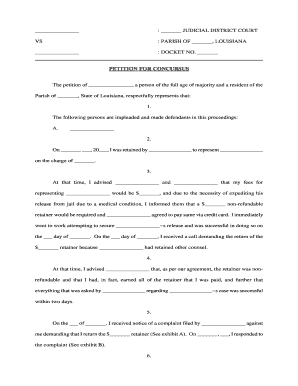
A concursus centralizes disputed assets with the court to prevent duplicate claims and limit the depositor’s exposure. It clarifies competing rights through judicial determination and can stop multiple lawsuits over the same asset.

Several professional roles commonly handle concursus filings; each has distinct responsibilities before and after deposit.
Where liability exposure exists, depositors and their counsel should follow court rules carefully and preserve proof of good-faith deposit and notice to claimants.
Names and contact details for depositor and all known claimants, plus counsel information for each side.
Clear description of deposited funds or property, including account numbers, amounts, and any identifying tags or serial numbers.
Concise statement of each claimant’s asserted legal basis for entitlement and any supporting documents referenced.
How and where the funds are deposited, who holds them, and proposed escrow or registry instructions for the court.
Citation to the court’s authority to accept the deposit and a statement of procedural posture or case number if related litigation exists.
Specific request for judicial determination, discharge from liability, and any proposed distribution or preservation order.
| Field | Configuration |
|---|---|
| Upload document | Use PDF/A or DOCX; retain original formatting |
| Signature placement | Assign signer roles and required date fields |
| Authentication | Email plus SMS code or ID verification |
| Routing order | Sequential signing with required attestations |
Use tools that produce tamper-evident PDFs and capture an audit trail with signer attribution and timestamps.
Confirm the court accepts electronic filings and preserve signed originals and audit logs in secure storage for future proof.
Varies by parish; allow administrative review time before judicial action.
Serve known claimants promptly per the court’s rules to preserve rights.
Claimants may have a court-specified period to assert claims after notice.
Timing depends on case complexity and court docket availability.
Registry holds assets until the court issues discharge or distribution order.
Assemble deposit details, claimant list, and supporting documentation for filing.
Submit petition to clerk and place funds or items with the designated registry.
Provide timely notice to all known claimants and file proof of service.
Court issues determination and directs distribution or discharge of the deposit.
| Procedure | Concursus | Escrow | Interpleader |
|---|---|---|---|
| Purpose | court-held dispute | private holding | court resolution |
| Third-party role | court registry | escrow agent | neutral stakeholder |
| Liability shield | contractual only | ||
| Typical use | multiple legal claimants | commercial closings | competing creditors |
| signNow | DocuSign | Adobe Sign | PandaDoc | HelloSign | |
|---|---|---|---|---|---|
| Starting Price | $8/user/mo | $15/user/mo | $14/user/mo | $19/user/mo | $15/user/mo |
| Free Trial | 7-day trial | Varies | Varies | Varies | Varies |
| Bulk Send | Yes (Premium) | Yes | Yes | Yes | No |
| Audit Trail | Yes | Yes | Yes | Yes | Yes |
| HIPAA Compliant | Yes | Yes | Yes | No | No |
A bank holds disputed escrow funds from a real estate closing and files a concursus to avoid paying two claimants.
An executor encounters competing beneficiary claims over a cash bequest and files a concursus before distribution.