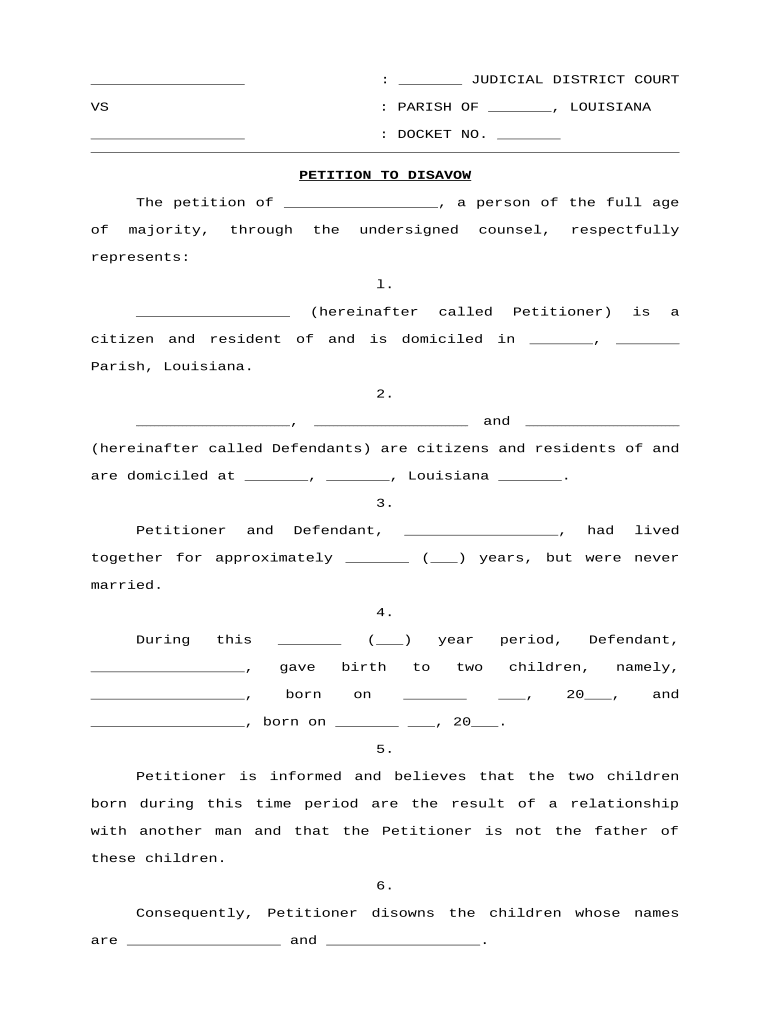
Louisiana Petition to Disavow Paternity
What the Louisiana Petition to Disavow Paternity Is
Why This Petition Matters for Parents and Children
Filing a petition can clarify legal responsibility, correct the birth record, and potentially end or modify child support and parental rights when genetic evidence shows a different biological parent.
Who Typically Files or Responds to a Disavowal Petition
Common parties and stakeholders who engage the petition process include those directly affected and the agencies that enforce support orders.
- Alleged father seeking to disprove paternity and remove legal responsibilities for support and custody.
- Mother or legal guardian responding to challenges or filing to correct an inaccurate legal finding of paternity.
- Child support or social services agencies when public benefits or enforcement actions are affected by a paternity determination.
Courts weigh the petition against statutory rules, evidentiary standards, and any prior orders when deciding whether to grant disavowal.
Step-by-Step: Filing a Petition in Louisiana
-
01Prepare Petition: Draft or use the court form with accurate facts and requested relief.
-
02Attach Evidence: Include any supporting documents and request DNA testing if available.
-
03File with Court: Submit to the parish family court clerk and pay the applicable filing fee.
-
04Serve Parties: Provide proper notice to the other parent and any agencies involved.
Digital Workflow Settings for an Online Petition
| Field | Configuration |
|---|---|
| Signature Authentication | Email link with optional SMS code |
| Document Format | PDF with embedded fields |
| Evidence Attachments | Accept PDF, JPG, DOCX |
| Notarization Support | Enable RON or in-person acknowledgment |
How Filing and Court Review Typically Flow
-
Draft: Assemble petition, evidence, and relief requests.
-
File: File with parish family court clerk and pay fees.
-
Hearing: Court schedules a hearing and may order DNA testing.
-
Order: Judge issues a ruling and updates records if disavowal granted.
Technical and Platform Requirements for eFiling and eSigning
Confirm the court and clerk accept electronic filings and which eSignature methods meet local rules before relying on digital submission.
- Supported Formats: PDF, DOCX accepted
- Authentication: Email or SMS code options
- Integrations: Court eFile portals supported
If remote notarization (RON) is used, ensure identity-proofing and audio-video recording meet state requirements and that the court recognizes RON-signed affidavits before filing.
Key Risks and Legal Consequences to Consider
Common Mistakes That Delay or Undermine Petitions
- Incomplete names, dates, or mismatched IDs that prevent proper service or identity verification and trigger court rejection.
- Failing to attach or request timely genetic testing evidence when biological parentage is contested, which can weaken the petition.
- Missing required notarization or incorrect witness counts according to parish rules, causing re-filing or continuance.
- Not checking whether the clerk or judge accepts electronic signatures or RON, leading to filing refusals or delays.
Typical Timelines and Court Scheduling Expectations
Initial Filing:
File as soon as facts are known to avoid statute issues; clerk will docket your case.
Service Deadline:
Provide service according to local rules, usually within weeks after filing.
Genetic Test Orders:
Court may order testing within 30–90 days depending on scheduling.
Hearing Date:
Hearing often scheduled 30–90 days after filing, court calendar dependent.
Final Order:
Judge issues rulings after hearing; entry timing depends on evidence and objections.
eSignature Vendor Comparison for Filing and Signing
| signNow | DocuSign | Adobe Sign | PandaDoc | HelloSign | |
|---|---|---|---|---|---|
| Starting Price | $8/user/mo | $15/user/mo | $14/user/mo | $19/user/mo | $15/user/mo |
| Free Trial | 7-day free trial, no credit card required | No | No | Yes, limited | Yes, limited |
| Bulk Send | Yes | Yes | Yes | Yes | No |
| Audit Trail | Yes | Yes | Yes | Yes | Yes |
| HIPAA Compliant | Yes | Yes | Yes | No | No |
Practical Examples of How Petitions Are Used
Case Study 1
A father filed to disavow after learning of non-paternity evidence and requested genetic testing
- DNA testing ordered by the court
- After testing established non-paternity, the court amended the support order and directed birth record correction, subject to appeal timelines.
Case Study 2
A mother sought correction of an incorrect paternity entry on a birth record
- Court required sworn statements and medical records
- The judge ordered an amended birth certificate and stayed support enforcement while records were updated.
Practical Tips for Accurate, Efficient Petition Processing
Frequently Asked Questions About the Louisiana Petition to Disavow Paternity
-
Who can file this petition?
An alleged father typically files to disavow paternity; in limited circumstances a mother or the child's guardian may petition. Agencies may also intervene when public benefits or enforcement actions are affected.
-
Is DNA testing required?
Courts often order genetic testing if biological parentage is contested and testing is relevant. The judge decides whether testing is necessary based on pleadings and circumstances.
-
Does an electronic signature work for this petition?
Electronic signatures can be valid under ESIGN and UETA if the court and local rules accept them and required disclosures are provided; verify acceptance with the clerk beforehand.
-
What happens to child support during the process?
Existing support orders typically remain in effect until the court modifies or vacates them; parties may request temporary relief, but courts evaluate based on evidence and statutory standards.
-
How long does the court process take?
Timelines vary; hearings are commonly scheduled within 30–90 days, but delays can occur due to service issues, testing turnaround, or court backlog.
-
Can a petition be withdrawn or revised?
A petitioner may seek to withdraw or amend a petition before final order, subject to court approval and any objections by other parties or agencies.