Establishing secure connection…Loading editor…Preparing document…

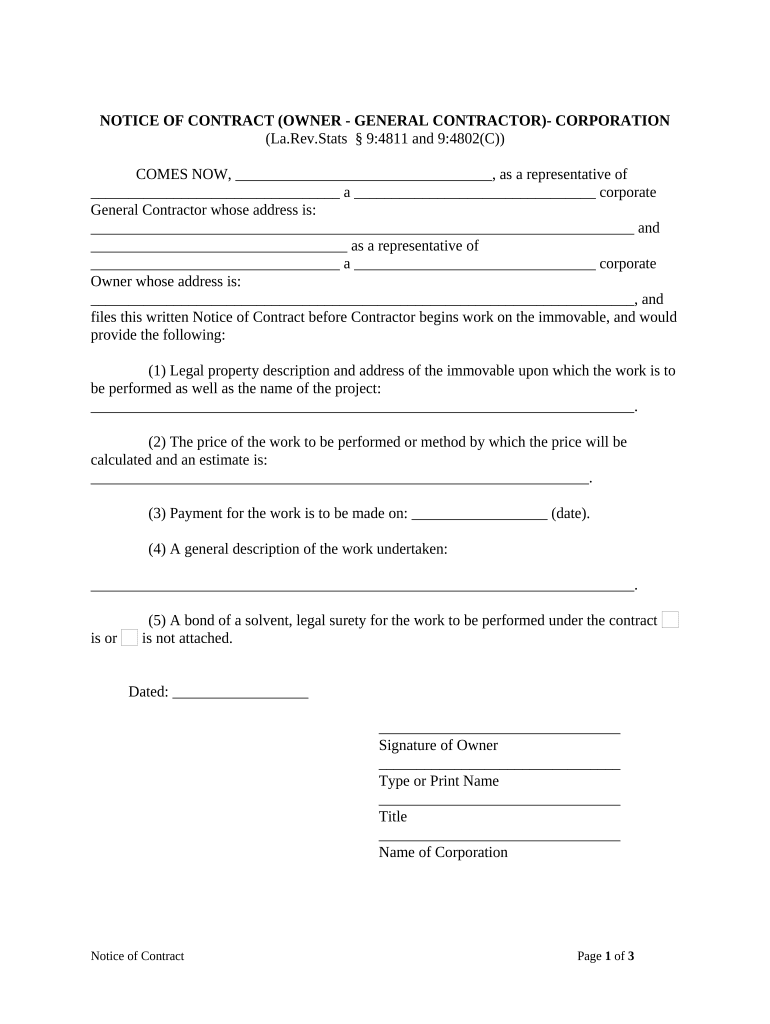
Louisiana Notice of Contract

This template is fully customizable. Edit the text, fill out the fields, and send it for signature. Give it a try!
Louisiana Notice of Contract

What the Louisiana Notice of Contract Is and When It’s Used

A Louisiana Notice of Contract is a formal written statement used to inform parties, contractors, subcontractors, or public agencies about the existence, terms, or award of a contract. It typically summarizes the parties, scope, effective date, and key obligations, and is used in procurement, construction, professional services, and vendor onboarding to create an auditable record of notice and tendering. The notice may be required by contract clauses, state procurement rules, or for triggering statutory rights such as payment, cure, or lien timelines.

Why a Clear Notice of Contract Matters

A precise notice reduces disputes about timing and obligations, ensures contract clauses that require written notice are satisfied, and creates a record that supports enforcement or remedies.

Why a Clear Notice of Contract Matters

Who Prepares and Receives a Notice of Contract

Typical preparers include contract managers, procurement officers, general contractors, and in-house counsel.

  • Contract Managers and Procurement — Draft notices, set deadlines, and monitor responses within procurement lifecycles.
  • General Contractors and Subcontractors — Use notices to trigger payment, change order, or lien-related procedures.
  • Legal and Compliance Teams — Retain notices for audit trails, dispute resolution, and regulatory compliance.

Core Elements of a Professional Louisiana Notice of Contract

A professional notice is concise, identifies the governing contract, specifies dates and delivery methods, and names authorized signers. It should include remedies, relevant exhibits, and clear routing instructions for responses.

Parties

Full legal names and contact details for all contracting parties, including billing and legal representatives, to avoid ambiguity and ensure correct service.
Contract Reference

Cite the original contract number, effective date, and a short description of scope so the notice is unambiguously tied to the correct agreement.

Effective Date

Specify the date the notice is issued and the date any clocked periods begin, such as cure periods or deadlines to respond.

Action Requested

Describe required response or remedy (e.g., cure, invoice submission), with clear deliverables and how to submit them.

Delivery Method

State accepted service methods (email, certified mail, hand delivery, e-service portal) and designate addresses or inboxes.

Signature & Attestation

Name and title of the authorized signer, signature block, and whether notarization or witness is required under applicable law.

Step-by-Step: Prepare and Issue the Notice

Follow a consistent sequence to reduce error and create an auditable trail for compliance and dispute prevention.

  • 01
    Identify Contract: Confirm contract number, governing law, and notice clause before drafting.
  • 02
    Draft Notice: Populate required fields, include attachments, and specify remedy or requested action.
  • 03
    Authorize Signer: Ensure the signatory has authority; add signature, date, and notarization if required.
  • 04
    Deliver & Record: Send via stated method, keep proof of delivery, and log in contract records.

Where to Send or File the Notice

Choose the service channel required by the contract or governing procurement rules and preserve proof of delivery for audits and disputes.

  • Contracting Officer: Deliver notices to the official point of contact named in the contract or procurement documents.
  • Procurement Portal: Upload to the agency or vendor portal when contract terms require electronic submission.
  • Legal Counsel: Send copies to in-house or external counsel to preserve litigation and compliance records.
  • Records/Compliance: File the executed notice in the contract repository and retention system.

Configuring an Online Workflow for the Notice

Set up a digital template and routing to capture signatures, attachments, and proof of delivery automatically.

Template Fields Pre-fill contract number, party names, and dates to reduce manual entry errors.
Signer Authentication Require email verification or SMS code, or stronger KBA for high-risk contracts.
Attachments Allow PDF exhibits and evidence files; require file size limits and accepted formats.
Notary / Witness Enable remote or in-person notarization options where the jurisdiction or contract requires it.
Audit Trail Capture timestamps, IP addresses, and delivery receipts for compliance and evidence.

Technical Considerations for Digital Delivery and Signing

Verify that the e-signature and document platform supports required authentication, audit logs, and exportable records before use.

  • Integrations: Salesforce, NetSuite, Microsoft 365, Google Workspace and cloud storage hooks.
  • File Formats: PDF and DOCX inputs with signed PDF output and audit metadata.
  • Authentication: Email, SMS, KBA, and stronger signer verification options.

Key Risks and Consequences of an Incorrect Notice

Enforceability Risk: Late or malformed notice can forfeit contractual remedies
Service Failure: Using an unauthorized delivery method may be ineffective
Retention Gaps: Missing proof of delivery undermines dispute evidence
Notarization Defect: Improper notarization may invalidate acknowledgements
Regulatory Exposure: Incorrect process may violate procurement rules
Tax or Audit Risk: Incomplete records can complicate tax or audit reviews

Common Mistakes When Preparing a Notice

  • Using incomplete party names or PO boxes that prevent validated service and later raise disputes about whether notice was properly given.
  • Failing to follow the contract's specified delivery method, such as sending email when certified mail was contractually required for notice.
  • Neglecting to include effective dates or cure deadlines, which can result in missed windows for remedies and escalation.
  • Relying on unsigned or unnotarized copies when the contract or jurisdiction requires a notarized acknowledgement for proof.

Practical Tips for Accurate and Efficient Notices

Adopt consistent templates, designate authorized signers, and automate routing to reduce errors and speed processing.

Use a Standard Template
Create a single, reviewed template with mandatory fields, which reduces omissions and ensures every notice meets contract requirements.
Authorize Signers in Advance
Maintain a roster of individuals with signing authority and documented delegation to prevent rejections and ensure validity.
Preserve Proof of Delivery
Retain certified mail receipts, email headers, portal timestamps, or platform audit trails to document service and timing.
Leverage Conditional Fields
When using digital forms, require attachments or notarization options conditionally for notices that trigger those requirements.

Real-World Examples of Digital Notice Workflows

These examples show how organizations use online signing and records to issue notices and preserve compliance-ready evidence.

Optica Ventures LLC

Optica standardized notices and templates to reduce back-and-forth approvals.

  • They used online forms to collect signatures remotely.
  • The interface is simple and easy-to-use for our team; more importantly, it is just as easy for our customers.

Martin Properties

A property services firm replaced paper notices with e-signed templates to accelerate vendor onboarding.

  • They captured signatures and timestamps automatically.
  • I can process and execute all of these documents online with 100% compliance and built-in security, whether on mobile or working offline.

Who Can Legally Sign a Notice of Contract

Company Officer — CEO

A chief executive or other officer with delegated authority may sign on behalf of the legal entity; record the delegation and title to demonstrate authority.

Authorized Representative — Contract Manager

A named contract manager or authorized agent can sign when explicit delegation exists in corporate records or the contract; evidence of delegation should accompany the notice.

Typical Timing and Deadlines to Track

Track both contractual deadlines and statutory timeframes; missing a deadline can forfeit remedies or create compliance exposure.

Notice Issuance:

Issue by the date required in the contract; this often triggers cure or response periods.

Cure Period Deadline:

Allow the contract-stated cure period for remediation; document responses and attempts to cure.

Filing/Recording:

If the notice must be recorded (e.g., related to property), file within the period specified by statute or contract.

Audit Retention Start:

Begin retention from the notice date to ensure records meet IRS and audit standards.

Dispute Window:

Track statute of limitations and contractual claim windows that may be affected by notice timing.

Comparing eSignature Vendors for Issuing Notices

Vendor choice affects authentication, audit trails, and cost. The table shows basic cost and capability differences relevant to contract notices.

signNow DocuSign Adobe Sign PandaDoc HelloSign
Starting Price $8/user/mo $15/user/mo $14/user/mo $19/user/mo $15/user/mo
Free Trial 7-day free trial, no credit card required Varies by plan Varies by plan Varies by plan Varies by plan
Bulk Send Yes (Business Premium) Yes Yes Yes No
Audit Trail Yes Yes Yes Yes Yes
HIPAA Compliant Yes (BAA available) Yes Yes No No

Frequently Asked Questions and Troubleshooting

Answers to common questions about validity, notarization, signature methods, and recordkeeping for a Louisiana Notice of Contract.


Need help? Contact support

be ready to get more
Join over 28 million airSlate SignNow users