Establishing secure connection…Loading editor…Preparing document…

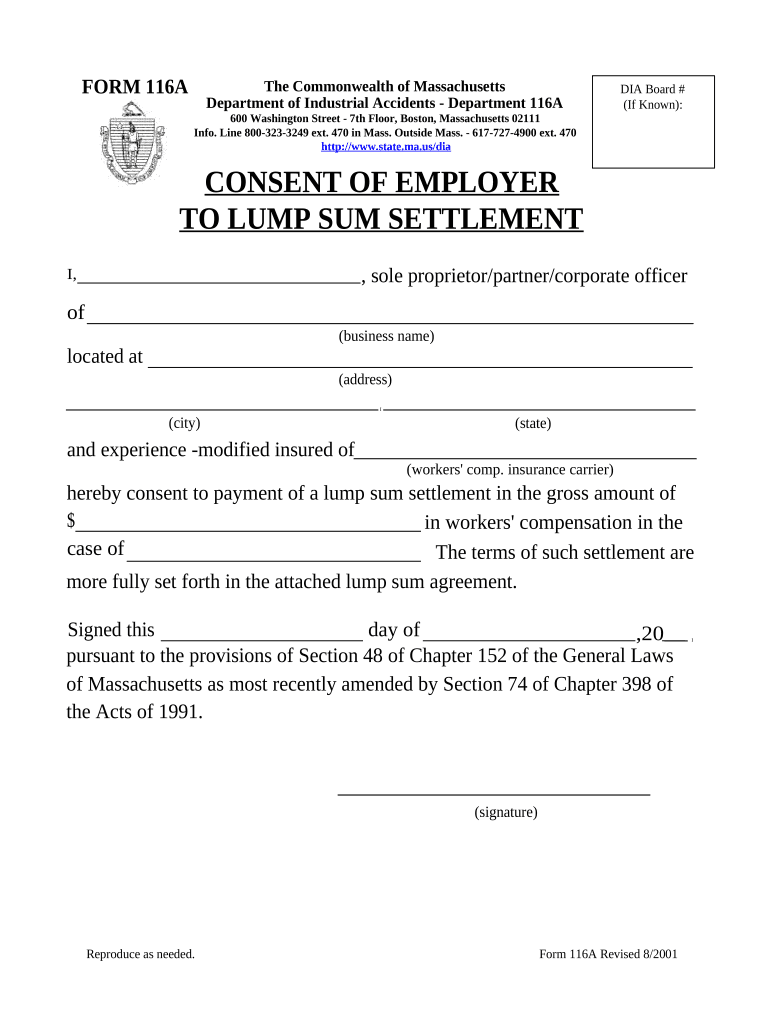
Massachusetts Workers' Compensation Form

This template is fully customizable. Edit the text, fill out the fields, and send it for signature. Give it a try!
Massachusetts Workers' Compensation Form

What the Massachusetts Workers' Compensation Form Is

The Massachusetts Workers' Compensation Form is the written document used to report a work-related injury or occupational disease and to initiate a claim for benefits under Massachusetts law. Employers, employees, and medical providers use the form to capture incident details, medical treatment, wage information, and employer insurance data so claims administrators can evaluate eligibility and begin benefit payments and return-to-work planning. Accurate completion supports timely medical care, wage replacement, and employer compliance with state reporting obligations.

Step-by-Step: Submitting a Massachusetts Workers' Compensation Claim

Complete and submit the form in the sequence below to ensure the claim is accepted and routed correctly.

  • 01
    1. Collect Details: Record injury facts and witness names immediately.
  • 02
    2. Obtain Medical Info: Get initial treatment record and provider contact.
  • 03
    3. Complete Form: Fill all required fields and sign.
  • 04
    4. Send to Insurer: Submit to employer and insurer per instructions.

Why Accurate Completion Matters for Workers and Employers

A complete Massachusetts Workers' Compensation Form protects employee rights and helps employers meet statutory obligations. Accurate data shortens claim adjudication, reduces unnecessary disputes, and preserves medical and wage documentation needed for benefits determination under state law and insurance policy terms.

Why Accurate Completion Matters for Workers and Employers

Who Regularly Uses This Form

Coordination among these users ensures timely medical care and correct benefit calculation.

  • Employers and HR teams who report incidents and notify the insurer and state agency.
  • Injured employees or claimants submitting their account and authorizing medical release.
  • Claims adjusters and medical providers who evaluate treatment, liability, and benefits.

Typical Signatory Roles

Employer Representative

An HR manager or designated company representative signs affirming factual employer information, policy details, and confirmation that the incident was reported internally; they must be authorized to act on behalf of the company.

Injured Worker

The claimant provides a signed account of the injury, attests to medical treatments and lost wages, and consents to release of medical information to the insurer for claims processing.

Key Data and Security Elements on the Form

Employee Identifiers: Name, DOB, SSN
Incident Details: Date, location, witnesses
Medical Information: Provider, diagnosis, treatment
Employer Data: Policy, employer name
Signature Evidence: Signed and dated consent
Audit Trail: Timestamp, IP address

Consequences of Incomplete or Incorrect Forms

Delayed Benefits: May postpone medical and wage payments
Claim Denial: Insurer may deny for insufficient evidence
Administrative Fines: Employer penalties for reporting failures
Legal Exposure: Increased risk of litigation
Reputational Risk: Workplace trust and morale impacts
Recordkeeping Violations: Noncompliance with retention laws

Common Pitfalls to Avoid

  • Missing or incorrect date of injury that creates disputes over coverage or statute of limitations.
  • Incomplete employer or insurer policy information that delays routing to the correct claims unit.
  • Insufficient medical detail or provider contact information that prevents timely benefit authorization.
  • Unsigned or undated forms, including failure to capture claimant consent for medical release.

What a Professional Workers' Compensation Form Includes

A complete form balances factual accuracy, medical detail, and administrative data to support evaluation and payment of benefits.

Incident Summary

Clear, concise description of how the injury occurred, body part affected, and whether the injury was a single event or cumulative exposure; this drives initial compensability assessment.
Medical Treatment

Name and contact of treating provider, diagnosis codes where available, date(s) of treatment, and recommended work restrictions; these details affect temporary disability and return-to-work planning.

Wage Information

Recent earnings, work schedule, and pay frequency used to calculate average weekly wage and benefit amounts under state formulae.

Employer Data

Company legal name, mailing address, policy number, and contact person for claims correspondence to ensure correct insurer routing.

Authorization and Consent

Claimant signature or electronic equivalent authorizing release of medical records and attesting to the truthfulness of the report.

Supporting Attachments

Space to list and attach medical notes, diagnostic reports, witness statements, and any employer incident reports to substantiate the claim.

Typical Submission Flow for the Form

A standard processing sequence moves the form from claimant to payer and recordkeeping systems.

  • Prepare Form: Complete fields and attach documents
  • Authorize Release: Claimant signs consent
  • Submit to Insurer: Send via employer or direct
  • Claims Intake: Adjuster evaluates and documents

Configuring an Efficient Digital Workflow

Map fields to responsible parties and automate routing to reduce errors and cycle time.

Auto-fill Employer Fields Prepopulate employer and policy data for repeat submissions
Conditional Medical Fields Show provider fields only when treatment reported
Claims Notification Auto-notify adjuster on submission
Attachment Rules Require medical report upload for lost-time claims
Retention Settings Archive signed form with metadata for compliance

Digital Submission and Integration Considerations

Ensure the platform meets regulatory needs such as ESIGN and state record retention before use.

  • File Formats: Accept PDF, DOCX for records
  • Authentication: Email, SMS, or stronger MFA
  • Integrations: Connect to HR and claims systems

Timelines and Typical Processing Expectations

Timing varies by insurer and state; report promptly and keep records of submission dates and receipts.

Initial Reporting:

Notify employer as soon as injury is known; prompt notice preserves rights

Insurer Notification:

Employers typically report to insurer per policy deadlines

Medical Authorization:

Provider reports should accompany lost-time claims where required

Claim Adjudication:

Adjuster review and initial decision timelines vary by caseload

Appeals Window:

Deadlines to appeal determinations are statutory; check state guidance

How the Massachusetts Form Differs from Other Injury Records

Compare core attributes to related workplace records to choose the correct form for reporting and compliance.

Criteria Massachusetts Workers' Compensation Form OSHA Form 300
Purpose initiate claim recordkeeping
Filed to insurer / state agency employer internal files
Required for benefits claim injury logs
Electronic Acceptance varies by insurer typically internal systems

Comparing eSignature Vendors for Filing and Managing the Form

Select an eSignature vendor that supports secure recordkeeping, audit trails, and any required compliance such as HIPAA or 21 CFR Part 11.

signNow DocuSign Adobe Sign PandaDoc HelloSign
Starting Price $8/user/mo $15/user/mo $14/user/mo $19/user/mo $15/user/mo
Free Trial 7-day free trial Varies by plan Varies by plan Varies by plan Varies by plan
Bulk Send Yes Yes Yes Yes No
Audit Trail Yes Yes Yes Yes Yes
HIPAA Compliant Yes Yes Yes No No
Envelope Cap No cap 100 envs/user/yr Varies Varies Varies

Practical Tips for Accurate and Efficient Completion

Adopt standard procedures to reduce errors and accelerate claims handling.

Document Immediately
Capture incident details, witness names, and photographs as soon as possible after the event; contemporaneous records reduce disputes and provide clearer evidence for adjudicators.
Standardize Attachments
Require a defined set of attachments for lost-time claims (initial medical report, employer incident report, payroll excerpt) to streamline adjuster review and reduce back-and-forth requests.
Use Secure eSignature
Adopt an ESIGN- and HIPAA-compliant eSignature solution where PHI is present, maintain audit trails, and keep electronic copies in a secure, access-controlled repository to meet legal retention obligations.
Train Process Owners
Provide clear internal guidance to HR, supervisors, and medical personnel on what to collect and how to submit forms to avoid misrouting and processing delays.

Example Scenarios Illustrating Typical Use

Realistic scenarios show how proper completion affects outcomes for claimants and employers.

Offsite Slip-and-Fall

A field technician slips on wet pavement and reports arm injury immediately

  • Employer attaches incident photos and witness statements
  • Comprehensive initial documentation led to timely medical authorization and expedited wage-replacement payments, reducing dispute duration and administrative overhead.

Repetitive Strain

An assembly-line worker reports cumulative wrist pain after months of repetitive work

  • Medical provider documents diagnosis and work restrictions
  • Early submission with ergonomic reports enabled accommodation planning and a coordinated return-to-work, minimizing lost-time duration.

FAQs and Troubleshooting for the Massachusetts Workers' Compensation Form

Answers to common questions about filing, e-signatures, corrections, and submission practices.


Need help? Contact support

be ready to get more
Join over 28 million airSlate SignNow users