Establishing secure connection…Loading editor…Preparing document…

Waiver of Notice of Special Meeting

This template is fully customizable. Edit the text, fill out the fields, and send it for signature. Give it a try!
Waiver of Notice of Special Meeting

What a Waiver of Notice of Special Meeting Is and When It Applies

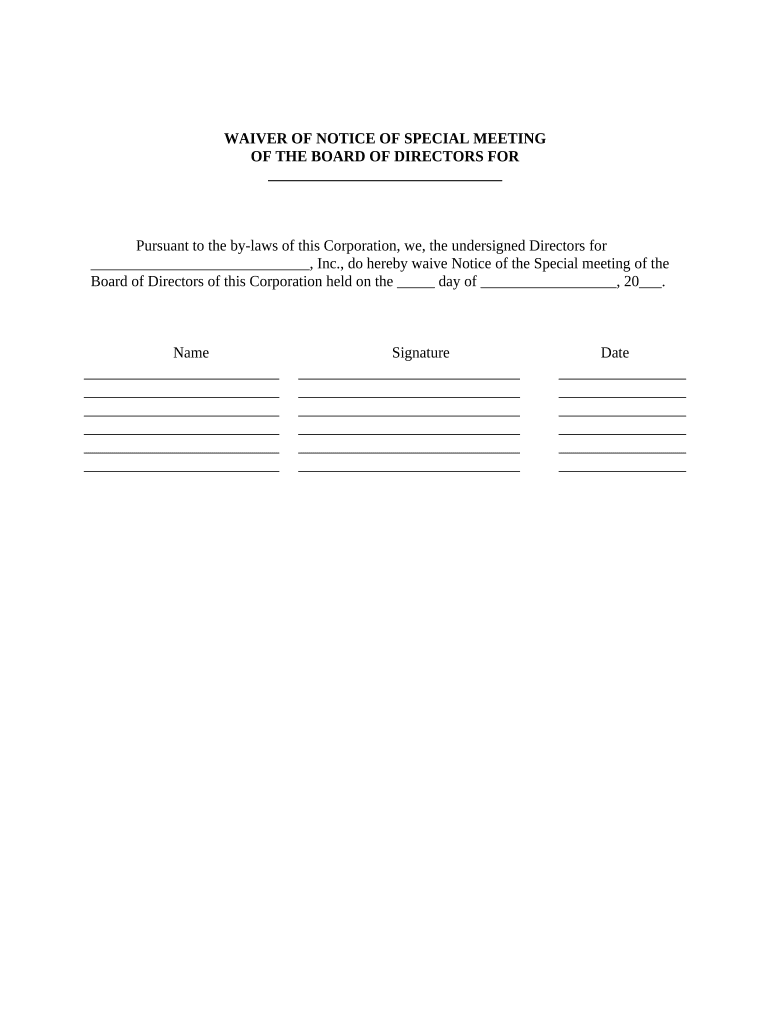
A Waiver of Notice of Special Meeting is a written document in which a shareholder, director, or member acknowledges receipt of notice (or waives the requirement for notice) for a specially called meeting and agrees that the meeting may proceed. The waiver records consent to hold the meeting at a specified date, time, and place or to validate actions taken without prior formal notice. Corporations, LLCs, and non‑profits use waivers to satisfy statutory notice requirements and to prevent later challenges to meeting validity.

Why a Proper Waiver Matters for Meeting Validity

A correctly executed waiver prevents procedural disputes, preserves corporate actions from being voided, and documents informed consent of interested parties under ESIGN and state electronic transaction laws. It provides a clear record that notice requirements were accepted or intentionally waived, reducing litigation risk.

Why a Proper Waiver Matters for Meeting Validity

Who Typically Signs a Waiver of Notice

Typical signers include board members, shareholders, LLC members, and corporate officers who have voting or notice rights under bylaws or operating agreements.

  • Individual shareholders or members who hold voting rights and can accept notice on behalf of an entity.
  • Directors or managers who are required by bylaws or statute to receive notice of meetings.
  • Corporate officers or authorized agents who sign on behalf of the entity under delegated authority.

Ensure the signer has the authority to waive notice under the governing documents; unauthorized waivers may be challengeable in court.

Core Elements to Include in a Professional Waiver of Notice

A complete waiver is concise but specific: it identifies parties, references the meeting, records the waiver or acknowledgment, and contains signature, date, and governing law language.

Parties

Full legal names of the person or entity waiving notice and, where applicable, the capacity in which they sign (e.g., director, shareholder, member, authorized agent).
Meeting Details

Clear identification of the special meeting by date, time, and location or statement that the waiver applies to any reconvened meeting with the same agenda.

Waiver Language

Explicit statement that the signer waives the right to receive advance notice or acknowledges receipt of notice for the specified special meeting.

Signature Block

Signature, printed name, title or capacity, and signature date. If an entity signs, include signer authority (e.g., by resolution).

Acknowledgment

Optional notary acknowledgment or witness lines if required by bylaws, charter, or state law for added evidentiary weight.

Governing Law

Choice of governing state law or reference to the corporation’s charter/bylaws to clarify interpretive rules and dispute resolution.

Required Data Elements at a Glance

Signer Name: Full legal name
Signer Capacity: Director, shareholder, member
Meeting Date: MM/DD/YYYY
Meeting Location: Physical or virtual location
Signature Date: MM/DD/YYYY
Notary / Witness: If required by bylaws or state law

Step-by-Step: Complete a Waiver of Notice Quickly and Accurately

Follow this simple sequence to prepare, sign, and record a valid waiver consistent with corporate formalities and ESIGN/UETA standards.

  • 01
    Identify Signers: Confirm who may validly waive notice under bylaws or operating agreement.
  • 02
    Specify Meeting: Enter the exact meeting date, time, and location or describe the reconvened session.
  • 03
    Draft Waiver: Use clear waiver language and add governing law or charter reference.
  • 04
    Execute & Record: Sign, date, and file the signed waiver with minutes or corporate records.

Setting Up an Online Waiver Workflow

Configure a consistent digital workflow to collect waivers, maintain evidence of consent, and attach signed waivers to corporate minute books.

Field Configuration
Signer Name Required text field; auto-validate against directory
Capacity / Title Dropdown of roles; include 'Authorized Agent' option
Meeting Details Group field with date, time, and location entries
Signature eSignature field with timestamp and audit trail

Typical eSigning Flow for a Waiver of Notice

Digital waivers follow a standard sequence that preserves intent, attribution, and an auditable trail accepted under ESIGN and UETA.

  • Upload Document: Sender uploads the waiver template to the eSignature platform.
  • Assign Fields: Place name, capacity, date, and signature fields for each signer.
  • Authenticate Signer: Use email, SMS code, or stronger verification as required.
  • Complete & Store: Signed waiver is timestamped, archived, and linked to meeting minutes.

Technology and File Requirements for Electronic Waivers

Use a platform that supports PDF and DOCX uploads, durable audit trails, and exportable signed copies in common formats.

  • File Formats: PDF, DOCX, or locked PDF/A
  • Integrity: Tamper-evident audit trail
  • Integrations: Connects to document storage

Ensure the chosen provider supports ESIGN/UETA compliance, secure storage (AES‑256), and the ability to produce a certificate of completion for corporate records.

Timing Considerations and Typical Deadlines

Time the waiver to align with bylaws and any statutory notice periods; the effective timing affects meeting validity and the corporate record.

Execution Before Meeting:

Ideally signed before the meeting date to eliminate notice objections.

Execution At Meeting:

Signing at the start of the meeting can also ratify actions if bylaws permit.

Post-Meeting Ratification:

Some jurisdictions allow ratification after the fact; check governing documents and state law.

Record Filing:

Attach the signed waiver to minutes immediately after execution.

Retention Start Date:

Retention period generally begins from the date of signature or meeting resolution.

Common Preparation Errors to Avoid

  • Using vague waiver language that fails to identify the specific meeting or actions taken.
  • Having an unauthorized individual sign on behalf of an entity without documented delegation.
  • Failing to attach the signed waiver to minutes or corporate records, creating an evidentiary gap.
  • Missing the signer’s capacity or title, which can undermine claims of authority to waive notice.

Risks When a Waiver Is Invalid or Missing

Voidable Acts: Corporate actions may be voidable
Shareholder Claims: Increased litigation risk
Statutory Noncompliance: Challenge under state law
Board Liability: Potential personal exposure
Transaction Delays: Deals or approvals may be postponed
Recordkeeping Gaps: Audit and compliance issues

eSignature Provider Comparison for Executing Waivers of Notice

Compare per-user pricing, trial availability, bulk send, audit trail, HIPAA support, and envelope limits when selecting an eSignature provider for corporate waivers.

signNow DocuSign Adobe Sign PandaDoc HelloSign
Starting Price $8/user/mo $15/user/mo $14/user/mo $19/user/mo $15/user/mo
Free Trial 7-day free trial Varies by offer Varies by offer Varies by offer Varies by offer
Bulk Send Yes Yes Yes Yes No
Audit Trail Yes Yes Yes Yes Yes
HIPAA Compliant Yes Yes Yes No No

Frequently Asked Questions About Waivers of Notice of Special Meeting

Answers to common questions about execution, electronic signing, authority, and recordkeeping for waivers of notice.


Need help? Contact support

be ready to get more
Join over 28 million airSlate SignNow users