Establishing secure connection…Loading editor…Preparing document…

Minnesota Temporary Custody Order

This template is fully customizable. Edit the text, fill out the fields, and send it for signature. Give it a try!
Minnesota Temporary Custody Order

What a Minnesota Temporary Custody Order Is and When It Applies

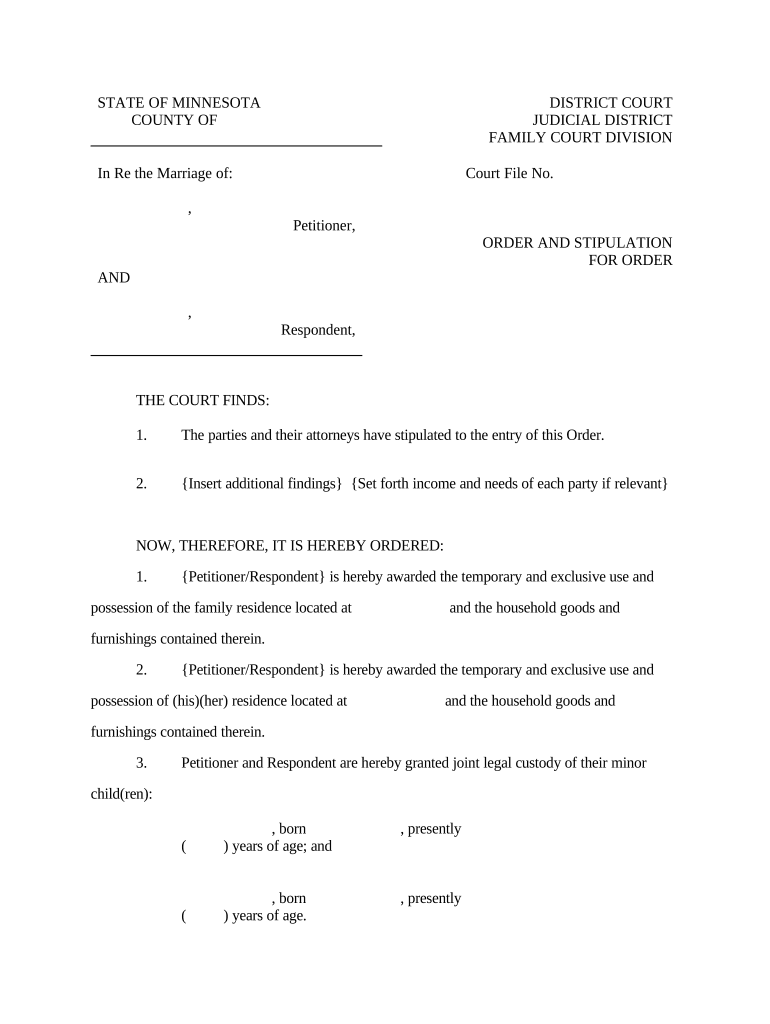
A Minnesota Temporary Custody Order is a court-issued directive that grants a person or agency short-term legal custody of a child pending a full hearing or while the court evaluates the child's best interests. It is typically requested when a parent is unavailable, incapacitated, absent, or when immediate protection is needed. The order sets who has physical custody, decision-making authority, and where the child will reside, and it remains in effect only for the period the court specifies or until a subsequent order replaces it.

Why a Temporary Custody Order Matters for Child Safety and Legal Clarity

A temporary custody order provides immediate legal authority to care for a child, reduces uncertainty for caregivers, and preserves parental rights pending a full hearing. Courts use these orders to balance urgent safety needs with due process.

Why a Temporary Custody Order Matters for Child Safety and Legal Clarity

Who Typically Prepares and Relies on These Orders

Several participants commonly use or complete a Minnesota Temporary Custody Order depending on the situation and urgency.

  • Parents or guardians seeking short-term placement while travel, hospitalization, or treatment prevents care.
  • Relatives or designated caregivers petitioning to care for a child during an emergency or temporary absence.
  • Child protective services or attorneys filing emergency petitions for the child's immediate protection.

Each role has distinct responsibilities: petitioners initiate the request, courts evaluate best interests, and temporary custodians exercise day-to-day care under the court's limits.

Primary Parties and Typical Roles

Petitioner

The individual or agency that files the petition (parent, relative, guardian ad litem, or child protection authority). The petitioner must explain the emergency or justification and provide contact information and supporting affidavits.

Temporary Custodian

The person or organization asking for custody authority to care for the child. The custodian's duties and limitations are specified by the court and may include medical decision-making, schooling, and travel permissions.

Key Elements Included in a Professional Temporary Custody Order

A complete Minnesota Temporary Custody Order includes clear identity details, scope and duration of custody, authority limits, and instructions for service and hearings to avoid enforcement and interpretation disputes.

Child Information

Full legal name, date of birth, gender, and current residence to accurately identify the subject of the order and avoid ambiguity.
Parties Identified

Full names and contact details for the petitioner, parents, legal guardians, and proposed temporary custodian for service and enforcement purposes.

Scope of Authority

Specific powers granted to the custodian (physical custody, medical decisions, school enrollment) and any explicit limits or exclusions.

Effective Dates

Clear start and end dates or a triggering event to define the temporary nature and enable timely review at the final hearing.

Service Instructions

How and when other parties must be served with notice and what constitutes valid service under Minnesota court rules.

Judge's Signature

Space for judicial approval, entry date, and court seal or docket number to validate and enforce the order.

Step-by-Step: Filing a Minnesota Temporary Custody Petition

Follow a clear sequence to prepare and submit a petition: complete forms, attach evidence, file with the correct court, serve parties, and attend the hearing.

  • 01
    Prepare Forms: Complete the petition and proposed order with accurate party and child details.
  • 02
    Attach Evidence: Include affidavits, medical or police reports, and proof of relationship as needed.
  • 03
    File with Court: Submit documents to the district court in the child's county or as local rules require.
  • 04
    Serve Parties: Provide notice to parents and interested parties per court rules before the hearing when possible.

Configuring an Online Workflow for the Order

Set up a repeatable digital workflow to populate, route, and store custody orders consistently while preserving audit trails and required attachments.

Field Configuration
Document Type Use locked PDF template matching court form.
Signer Authentication Email + SMS codes or advanced auth if required.
Template Logic Conditional fields for emergency vs. standard petitions.
Storage Export signed PDF/A and retain audit log.

Where to File and How the Submission Flow Typically Works

Filing and service follow a predictable path: submit to the appropriate district court, arrange service on required parties, then appear for the hearing or request ex parte relief if urgent.

  • File with Court: Submit petition to the district court in the county of the child's residence.
  • Request Emergency Relief: Ask the judge for ex parte or expedited hearing if immediate danger exists.
  • Serve Other Parties: Follow Minnesota rules for personal or substituted service before hearings when possible.
  • Attend Hearing: Appear on the scheduled date with originals and witnesses ready to testify.

Digital Filing and Signature Compatibility

Use a platform that accepts court-ready PDFs, preserves audit trails, and supports required authentication for signers.

  • File Formats: PDF, PDF/A, DOCX supported for court-ready submissions.
  • Integrations: Connectors include Microsoft 365, Google Workspace, and NetSuite.
  • Authentication: Email, SMS, and advanced signer verification options.

Ensure digital signatures and exported PDFs meet the court's acceptable formats and preserve timestamps and audit trails for admissibility.

Common Timeframes and Hearing Deadlines to Expect

Timelines vary by county and urgency; emergency petitions move fastest while standard petitions follow routine scheduling and service windows.

Emergency Action:

Court may act immediately when imminent risk is shown.

Hearing Scheduling:

Standard hearings are set per court calendar, often within weeks.

Service Window:

Other parties should be served promptly; local rules define timing.

Duration of Order:

Temporary orders expire per the date or until the final ruling.

Appeal or Review:

Short statutory windows may apply for objections or appeals.

Key Milestones from Filing to Order Entry

Track milestone stages so parties know what to expect and which documents are due at each step.

01

File Petition

Petitioner files petition and proposed temporary order with court clerk.

02

Request Hearing

Court schedules an expedited or regular hearing based on urgency.

03

Judicial Decision

Judge issues temporary custody order with defined scope and duration.

04

Service & Implementation

Order served to parties and implemented by temporary custodian.

Essential Information Elements to Include on the Order

Child Name: Full legal name
Date of Birth: MM/DD/YYYY
Petitioner: Name and contact
Temporary Custodian: Name and contact
Scope: Authority limits
Effective Period: Start and end dates

Consequences of Incomplete or Incorrect Orders

Court Rejection: Incomplete filings can be rejected
Placement Delay: Delays in protective placement
Contempt: Risk of contempt for noncompliance
Perjury Exposure: False statements may trigger charges
Enforcement Gaps: Unclear orders complicate enforcement
Custody Disputes: Increased litigation risk

Common Mistakes to Avoid When Preparing the Order

  • Failing to serve parents or guardians promptly, which can delay hearings or render an emergency order vulnerable to challenge.
  • Leaving dates, durations, or scope vague; ambiguous language invites differing interpretations and enforcement problems in court.
  • Omitting supporting evidence such as affidavits, medical reports, or police reports that justify temporary custody and expedite judicial review.
  • Using inconsistent party names or contact details between petition and proposed order, which can cause rejection or administrative delays.

Practical Tips for Accurate and Efficient Completion

Adopt a checklist-driven approach and verify identities, dates, and attachments before filing to minimize administrative delays and reduce court follow-up.

Verify Identities
Check government-issued IDs and enter names exactly. Accurate identity information reduces disputes and helps the court confirm jurisdiction.
Attach Evidence
Include clear, dated supporting documents (medical records, police reports, affidavits) to substantiate urgency and establish factual basis for temporary custody.
Use Court Forms
Whenever available, use the court's official forms or approved template language to align with local filing and docketing requirements.
Preserve Audit Trail
Use signed PDFs that retain timestamps and signer metadata so the court can verify who signed and when, and to support admissibility.

Realistic Use Scenarios Illustrating Typical Outcomes

Two anonymized examples show how temporary custody orders are used for different urgent circumstances and what follows after the order is entered.

Emergency Hospitalization

A parent is hospitalized unexpectedly and cannot care for a child for an extended period.

  • The relative files a petition with affidavits and medical records.
  • The court issues a temporary custody order that permits the relative to enroll the child in school and consent to urgent medical care until the next hearing, reducing disruption and providing legal clarity for providers.

Protective Removal

Authorities document an unsafe home environment and petition for immediate protection.

  • An ex parte order grants temporary custody to child protection services.
  • The temporary order enables safe placement and schedules a prompt adjudicatory hearing where evidence is reviewed and longer-term arrangements are determined.

Typical eSignature Pricing and Capabilities to Consider

Compare commonly evaluated vendor attributes relevant to filing and managing court documents; signNow appears first in the comparison per platform guidelines.

signNow DocuSign Adobe Sign PandaDoc HelloSign
Starting Price $8/user/mo $15/user/mo $14/user/mo $19/user/mo $15/user/mo
Free Trial 7-day trial Varies Varies Varies Varies
Bulk Send Yes Yes Yes Yes No
Audit Trail Yes Yes Yes Yes Yes
HIPAA Compliant Yes Yes Yes No No

Frequently Asked Questions About Minnesota Temporary Custody Orders

Answers to common procedural and technical questions about preparing, filing, and enforcing temporary custody orders in Minnesota.


Need help? Contact support

be ready to get more
Join over 28 million airSlate SignNow users