Establishing secure connection…Loading editor…Preparing document…

Iowa Small Estate Affidavit

This template is fully customizable. Edit the text, fill out the fields, and send it for signature. Give it a try!
Iowa Small Estate Affidavit

What the Iowa Small Estate Affidavit Is and when it matters

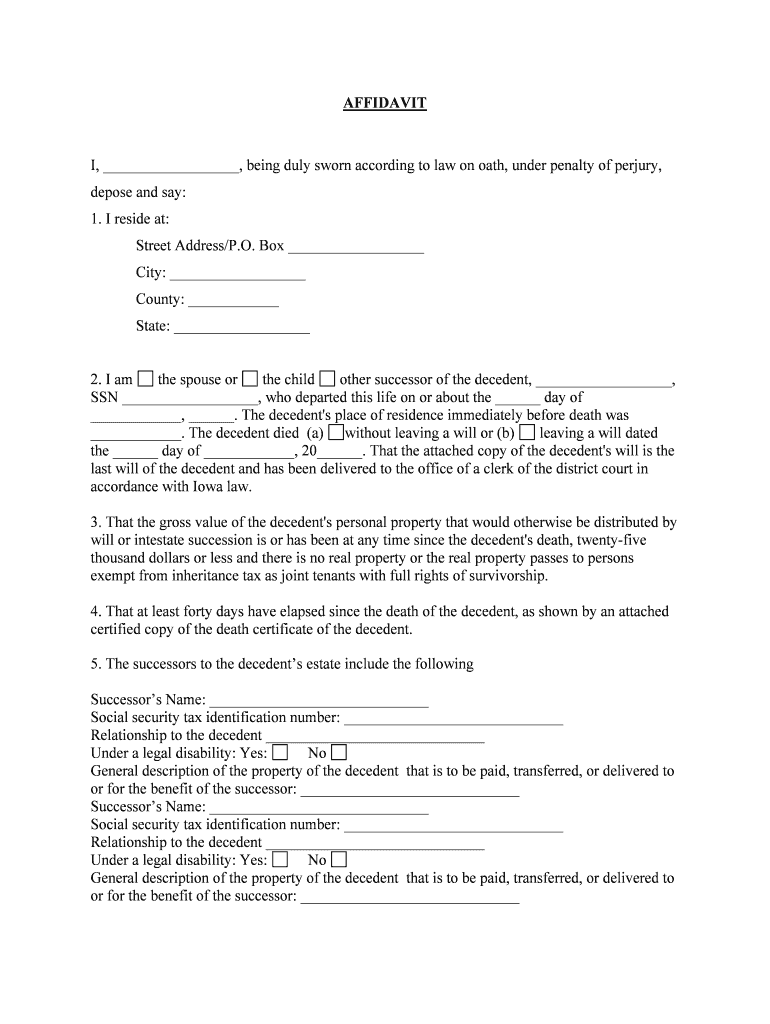
The Iowa Small Estate Affidavit is a sworn statement used to claim and transfer certain decedent assets without full probate when the estate qualifies under state thresholds. It summarizes the decedent’s identity, assets, known heirs, and the affiant’s right to collect property, and it is presented to banks, title companies, and other holders of assets to request release or transfer.

When the affidavit simplifies estate transfers

Used for smaller estates, the affidavit avoids formal probate in many cases, speeding distribution and lowering legal cost while creating a notarized record of claimant authority.

When the affidavit simplifies estate transfers

Who typically completes an Iowa Small Estate Affidavit

Institutions that release assets may also require supporting documents such as death certificates, account statements, and a court acknowledgment before distribution.

  • Adult children or surviving spouse claiming household property or bank funds
  • Named successor administrators acting under informal estate rules
  • Heirs who need a notarized claim to release assets to beneficiaries

Step-by-step: preparing and filing the affidavit

Follow these steps in order to prepare a complete, accepted affidavit.

  • 01
    Gather documents: Collect death certificate, account statements, and ID.
  • 02
    Complete affidavit: Fill each field carefully using MM/DD/YYYY dates.
  • 03
    Notarize: Sign before a notary or use RON where accepted.
  • 04
    Submit to holder: Provide affidavit and attachments to the bank or title holder.

Essential parts of a professional Iowa Small Estate Affidavit

A complete affidavit is clear, notarized, and supported by documentation so institutions can verify authority and release assets without further probate.

Decedent details

Full legal name, last residence, and date of death to uniquely identify the estate and match institutional records.
Affiant statement

A sworn declaration of your relationship to the decedent and your legal basis to claim assets, including any appointment or statutory right.

Asset schedule

A concise list of bank accounts, vehicles, and personal property being claimed, with account numbers or serial numbers where available.

Heir information

Names and contact details for all beneficiaries or heirs, and the distribution share if known and required by the institution.

Attachments

Certified death certificate, account statements, will (if relevant), and any supporting affidavits to corroborate the claim.

Notary jurat

A notarized signature and jurat attesting to the affiant’s oath, or a recorded RON session where permitted by law.

Preparing an online affidavit workflow

Set up an online document with clear fields, signer routing, and required authentication to ensure acceptance by institutions.

Field Configuration
Decedent Name Field Required text; exact-match verification
Date of Death Field MM/DD/YYYY format enforced
Supporting Attachments Require PDF upload; death certificate
Notary / Jurat Place jurat field for notary signature

How digital submission typically proceeds

An electronic workflow reduces in-person steps by combining form completion, attachment upload, and notarization when allowed.

  • Upload: Sender uploads affidavit and documents.
  • Place fields: Define signature, date, and attachment fields.
  • Signer authentication: Signers verify identity by email or stronger methods.
  • Delivery: Signed package delivered with audit trail.

Timing considerations and prompt filing

File the affidavit promptly after death to reduce creditor risk and to meet any institutional deadlines; there is no uniform federal deadline.

Immediate action:

Contact banks quickly to learn their hold periods for release.

Creditor claims:

Prompt filing limits exposure to late creditor claims.

Institution deadlines:

Banks and title companies set their own submission windows.

Probate alternative:

Affidavit can be faster than full probate in eligible estates.

Record retention:

Keep filed copies for the periods required by law.

Key milestones from completion to distribution

Track these sequential stages to monitor progress and confirm asset release.

01

Prepare affidavit

Complete form and attach death certificate and statements.

02

Notarize affidavit

Sign before a notary or use RON where allowed.

03

Submit to holder

Provide affidavit to bank, insurer, or title company.

04

Receive distribution

Institution reviews and releases funds or property.

Annual pricing and basic feature comparison for common eSignature providers

Compare starting prices and core capabilities relevant to affidavit workflows; signNow is listed first per vendor ordering rules.

signNow DocuSign Adobe Sign PandaDoc HelloSign
Starting Price $8/user/mo $15/user/mo $14/user/mo $19/user/mo $15/user/mo
Free Trial 7-day free trial Varies by plan Varies by plan Varies by plan Varies by plan
Bulk Send Yes (Business Premium) Varies by plan Varies by plan Yes Varies by plan
Audit Trail Yes Yes Yes Yes Yes
HIPAA Compliant Yes Yes Yes No No

Security and compliance elements to include with the affidavit

Encryption: AES-256 at rest
Transport Security: TLS 1.2/1.3 in transit
Audit Trail: IP, timestamp, action log
BAA Availability: HIPAA BAA on request
Standards: SOC 2 Type II certified
Access Controls: Role-based signer permissions

Legal and operational risks to avoid

Invalid Affidavit: Can nullify the claim
Delayed Distribution: Institution may refuse release
Tax Liability: Unreported transfers can create exposure
Notary Error: Incorrect jurat may require reexecution
Creditor Claims: Outstanding debts may impede release
Fraud Accusation: False statements risk criminal charges

Common preparation mistakes that cause rejections

  • Using informal names instead of full legal names, which prevents matching to institutional records and delays release.
  • Failing to attach a certified death certificate or recent account statements, causing banks to withhold funds pending proof.
  • Not obtaining a proper notarial jurat or recorded RON session where required, leading institutions to refuse acceptance.
  • Underestimating property subject to formal probate and attempting to use the affidavit for ineligible assets.

Typical signers and their roles

Estate Relative

A family member acting as affiant or informal administrator who collects assets on behalf of heirs and must provide identity verification and supporting documents to institutions.

Institution Officer

A bank or title company representative who reviews the affidavit, requests supporting evidence, and authorizes release under the institution’s policies and applicable state law.

Digital format and platform considerations

Use secure PDF or DOCX files with fillable fields and preserve original signatures and notarizations.

  • File Formats: PDF or DOCX supported
  • Integrations: Works with Box and Google Drive
  • Authentication: Email, SMS, or advanced methods

Frequently asked questions about the Iowa Small Estate Affidavit

Answers to common questions about eligibility, signing authority, and acceptance by institutions.


Need help? Contact support

be ready to get more
Join over 28 million airSlate SignNow users