Establishing secure connection…Loading editor…Preparing document…

Mississippi Letters of Guardianship

This template is fully customizable. Edit the text, fill out the fields, and send it for signature. Give it a try!
Mississippi Letters of Guardianship

What Mississippi Letters of Guardianship are and how they function

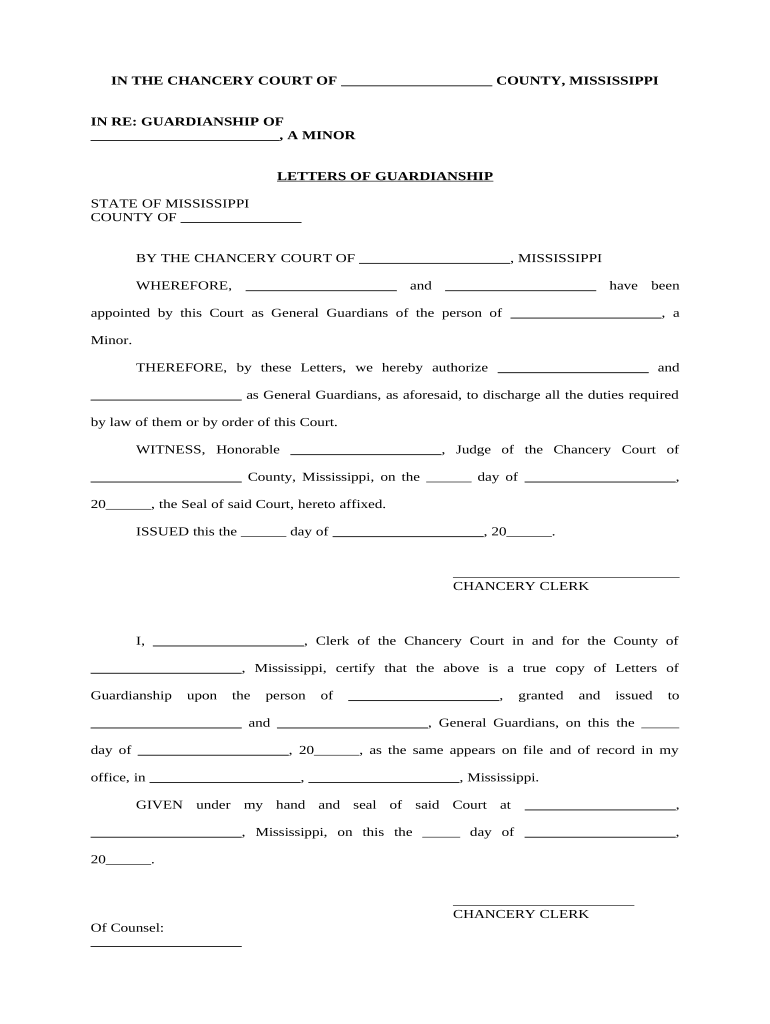
Mississippi Letters of Guardianship are court-issued documents that confirm a court has appointed an individual or entity to act as guardian for a minor or an incapacitated adult. The letters identify the guardian and the protected person, summarize the authority granted by the court, include the court case number and issuance date, and serve as the official proof third parties use to accept the guardian’s decisions for medical care, financial transactions, and custodial duties.

Why these letters matter for guardians and third parties

Letters of Guardianship provide legally recognized proof of authority, reduce delays when dealing with banks and care providers, and clarify the scope and duration of the guardian’s powers.

Why these letters matter for guardians and third parties

Who commonly needs or receives Mississippi Letters of Guardianship

These letters are used by the appointed guardian, entities that must accept the guardian’s authority, and legal professionals managing the case.

  • Appointed guardians who must prove authority to make decisions on behalf of the ward — for healthcare, finance, or custody.
  • Banks, title companies and financial institutions that require court proof before allowing account access or financial transactions on behalf of the ward.
  • Healthcare providers and insurers that need lawful authorization to make medical decisions or access protected health information.

Keep copies accessible for routine interactions and provide certified or notarized copies when institutions request formal proof.

Key elements included in professional Letters of Guardianship

A complete letter clearly identifies parties, cites the court order, enumerates granted powers, notes limits or expiration, and carries the clerk’s seal and signature.

Court Heading

Full court name, county, and official case number for unambiguous identification of the issuing court and docket.
Guardian Identity

Guardian’s full legal name, address, and contact information; include business name if a corporate guardian is appointed.

Ward Identity

Protected person’s full legal name, date of birth, and any identifying details used by the court to avoid mistaken identity.

Scope of Authority

Clear list of powers granted (healthcare, financial, custody), including any restrictions or required court approvals.

Effective Dates

Date the guardianship began and any expiration, review, or renewal dates imposed by the court order.

Authentication

Signature or clerk certification, court seal, and any notarization or recording details needed for acceptance by third parties.

Required factual details to include on the letter

Guardian Name: Full legal name
Ward Name: Full legal name
Case Number: Court docket number
Issuing Court: County and court name
Date Issued: MM/DD/YYYY
Scope: Summary of powers

Risks and consequences of improper letters

Acting Beyond Authority: Civil liability risk
Forgery or Fraud: Criminal exposure possible
Unaccepted Documentation: Refusal by banks/providers
Delayed Care or Access: Interruption in services
Financial Loss: Unauthorized transactions risk
Court Sanctions: Potential guardianship review

Common pitfalls when preparing letters

  • Using an unofficial or uncertified copy that institutions will not accept, leading to delays or repeated requests for verification.
  • Mismatched names or dates between the court order and the letter, which can invalidate the document for specific transactions.
  • Failing to include the court seal or clerk signature when required, resulting in refusal by third parties.
  • Not accounting for limits in authority in the letter text, causing disputes over what the guardian may legally do.

Step-by-step: obtain and use Letters of Guardianship

Follow a clear sequence from petition to issuance and distribution to ensure the letter is valid and accepted.

  • 01
    File Petition: Submit guardianship petition in the appropriate county court.
  • 02
    Court Hearing: Attend hearing; court reviews capacity and necessity.
  • 03
    Order Issued: Judge signs order appointing guardian.
  • 04
    Letters Issued: Clerk prepares certified letters for the guardian.

How a letter moves from court to real‑world use

After issuance, the guardian uses certified copies to interact with institutions that require proof of authority.

  • Obtain Certified Copies: Request clerk-certified copies immediately after issuance.
  • Share with Institutions: Provide copies to banks, healthcare providers, and agencies.
  • Retain Originals: Keep the original or certified copy in a secure location.
  • Update as Needed: Return to court for amendments or renewals when circumstances change.

Preparing an electronic workflow for guardianship letters

Set up a digital process that preserves legal authenticity and makes distribution consistent and auditable.

Field Configuration
Document Type PDF/A scanned certified letter
Authentication Email and optional SMS code
Retention Store for case life plus retention period
Distribution Secure email or authorized portal

Technical considerations for electronic copies and e-submission

Use formats and integrations that preserve the certified appearance and audit trail needed by third parties.

  • Supported Formats: PDF/A or high-resolution PDF preferred
  • Integrations: CRM, cloud storage, and case-management systems
  • Authentication: Email link with optional multifactor

Ensure system logs an immutable audit trail, stores copies per retention rules, and supports secure sharing with banks, insurers, and healthcare providers.

Typical timing and processing expectations

Timing varies by county; plan for court scheduling and allow time to obtain certified copies and notify key institutions.

Filing to Hearing:

Often 4–8 weeks depending on court calendar

Issuance of Letters:

Letters may be issued same day or within 7 days

Institution Acceptance:

Banks/health systems may require additional verification

Renewals or Reports:

Periodic accounting deadlines vary by jurisdiction

Emergency Appointments:

Expedited hearings available in urgent situations

Key milestones from petition to acceptance

A simple sequence helps track case progress and required actions after each milestone.

01

Petition Filed

Clerk accepts petition and assigns case number.

02

Notice Served

Required parties are served per court rules.

03

Hearing Held

Court determines need and appoints guardian.

04

Letters Issued

Certified letters are produced for distribution.

eSignature vendor comparison for preparing and distributing guardianship letters

When digitizing certified letters, compare eSignature vendors on price, bulk send, HIPAA support, and envelope caps for high-volume workflows.

signNow DocuSign Adobe Sign PandaDoc HelloSign
Starting Price $8/user/mo $15/user/mo $14/user/mo $19/user/mo $15/user/mo
Free Trial 7-day free trial Varies by plan Varies by plan Varies by plan Varies by plan
Bulk Send Yes (Business Premium) Yes Yes Yes No
HIPAA Compliant Yes Yes Yes No No
Envelope Cap No cap 100 envelopes/user/year No cap No cap No cap

Frequently asked questions about Letters of Guardianship

Answers to common issues about validity, notarization, digital copies, and acceptance by banks or healthcare providers.


Need help? Contact support

be ready to get more
Join over 28 million airSlate SignNow users