Establishing secure connection…Loading editor…Preparing document…

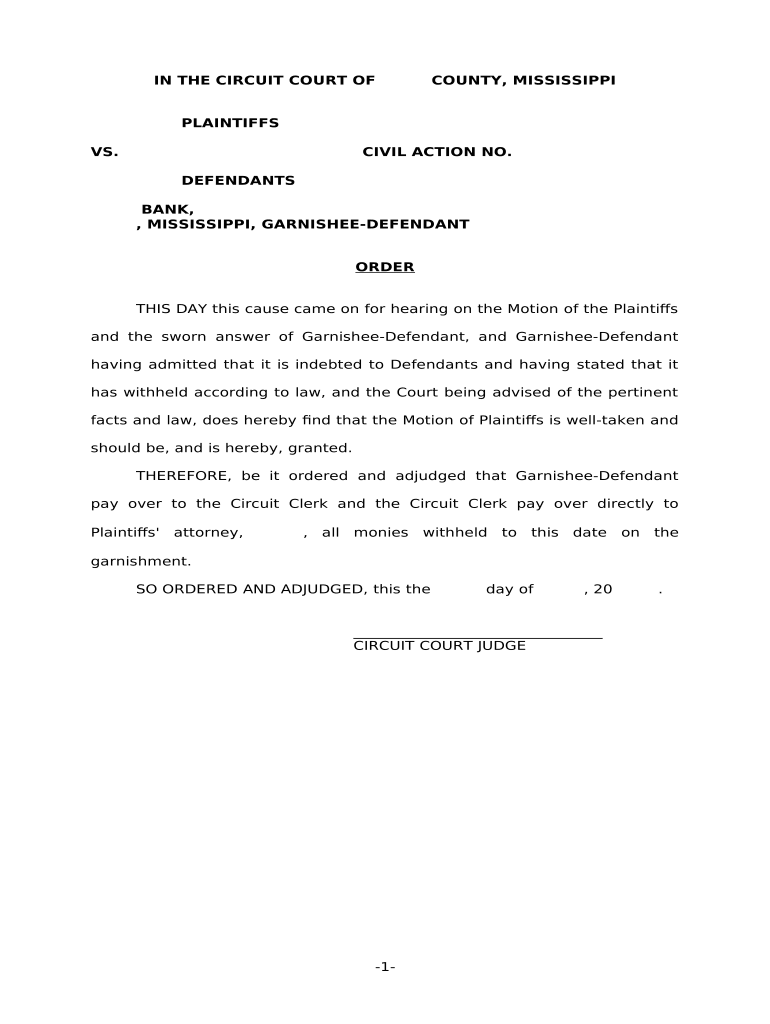
Mississippi Garnishment

This template is fully customizable. Edit the text, fill out the fields, and send it for signature. Give it a try!
Mississippi Garnishment

What the Mississippi Garnishment Is and When It Applies

A Mississippi Garnishment is a legal process by which a creditor seeks to collect a judgment by directing a third party — typically an employer or financial institution — to withhold funds from a debtor and remit them to the judgment creditor. Garnishment can apply to wages, bank accounts, or other tangible funds after a court issues a judgment or allowable statutory order. Procedures, exemptions, and required forms vary by jurisdiction; parties should confirm local court rules and statutory caps before initiating garnishment.

Why Use a Garnishment and the Primary Benefits

Garnishment provides an enforceable, court-backed method to collect unpaid judgments or debts without repeated litigation. It channels third-party withholding to preserve cash flow and reduce debtor evasion, while statutory procedures and notice requirements protect debtor rights and ensure predictable, documented recovery.

Why Use a Garnishment and the Primary Benefits

Which Parties Typically Prepare or Receive a Garnishment

Different stakeholders prepare or respond to garnishment actions depending on role and responsibility.

  • Creditors and collection counsel who hold a judgment and need a court-directed withholding method to recover money owed.
  • Employers and payroll administrators who receive garnishment orders and must withhold and remit amounts according to law.
  • Courts and clerks who issue writs of garnishment, manage filings, and record proof of service for enforcement.

Each party has specific duties — creditors file and serve the order, garnishees respond or remit, and courts supervise compliance; local rules control timelines and exemptions.

Who Signs and Authorizes a Garnishment

Creditor — Collections Manager

The creditor or the creditor's attorney typically prepares and signs the garnishment application or affidavit, certifying the judgment amount, service history, and that relief sought complies with court rules; accuracy is essential to avoid dismissal or sanctions.

Employer — Payroll Administrator

An employer receiving the garnishment must follow the order, apply statutory withholding rules, and sign acknowledgements or returns required by the court; payroll staff should coordinate with legal counsel before refusing or altering an order.

Core Components of a Professional Mississippi Garnishment Package

A complete garnishment submission should present clear court documentation, precise debtor information, and proof of proper service. Organize the packet so courts and garnishees can verify claims quickly and process collections without avoidable delay.

Court Caption

Complete case caption, docket number, and jurisdictional details for clear court identification.
Judgment Evidence

Certified judgment or abstract showing amount owed, judgment date, and interest calculations.

Garnishment Writ

Signed writ or order directing a third party to withhold funds and remit to the creditor.

Debtor Identity

Full legal name, address, last four of SSN or tax ID, and date of birth if required.

Service Proof

Affidavit or certificate of service showing how and when the garnishee or debtor was served.

Exemption Notice

Clear information about debtor exemptions and required response forms for claiming exemptions.

Step-by-Step: Preparing and Serving a Garnishment

Follow these sequential steps to prepare, file, and serve a garnishment while preserving evidence and meeting court requirements.

  • 01
    Obtain Judgment: Confirm a final judgment exists and calculate total recoverable amount.
  • 02
    Prepare Writ: Draft the garnishment writ according to local court form and include judgment details.
  • 03
    File with Court: Submit the writ to the clerk and pay any applicable filing fees before service.
  • 04
    Serve Garnishee: Serve the employer or bank per local service rules and file proof of service with the court.

Customizing an Online Garnishment Workflow

Set up an electronic workflow that maps court, creditor, and garnishee steps to reduce manual handoffs and preserve a complete audit trail.

Field Configuration
Authentication Email link with optional SMS code for signer verification
Template Reusable court form template with locked judgment fields
Notarization Enable remote online notarization where the jurisdiction permits
Retention Set automatic archival and export of completed packet as PDF/A

Digital Signing and File Formats for Garnishment Packets

Use e-signature platforms that produce auditable, tamper-evident signed PDFs compatible with court filing and employer systems.

  • Accepted Formats: PDF, Word (DOCX), and image files for attachments
  • Integration Options: Connectors for Microsoft 365, Google Workspace, and document storage like Box
  • Authentication Tools: Support for email links, SMS codes, and two-factor options

Choose tools that preserve an audit trail (timestamps, IP, signer actions) and that can produce court-ready PDFs; verify any notary or jurisdictional e-filing requirements in advance.

Where to File and How Garnishment Orders Are Routed

Knowing where to submit each document ensures proper court processing and correct service to garnishees.

  • Court Clerk Filing: File the writ and supporting judgment with the clerk in the county where judgment was entered.
  • Serve the Garnishee: Serve employer or bank per state rules; obtain and file proof of service.
  • Employer Withholding: Employer calculates withholding and remits funds per the writ and applicable statutory caps.
  • Remittance to Creditor: Clerk or garnishee forwards funds to creditor or the court, following notice instructions.

Typical Timelines and Processing Expectations

Timelines for response, withholding, and remittance vary by state and by the garnishee type; verify local rules and court orders for exact deadlines.

Filing to Service:

Often required within days to weeks; check local clerk rules

Garnishee Response:

Many jurisdictions allow 10–30 days for garnishee to respond

Employer Withholding:

Withhold on the next lawful pay period after service unless statute specifies otherwise

Remittance Frequency:

Remit according to writ instructions or periodic schedule set by court

Objection Deadlines:

Debtor may have limited time to claim exemptions or object

Key Processing Stages for a Garnishment Case

A typical sequence follows judgment confirmation to final remittance; each stage triggers specific actions and deadlines.

01

Judgment Entered

Court issues a final money judgment establishing the debt amount.

02

Writ Issued

Court clerk issues the writ of garnishment or equivalent enforcement order.

03

Service Complete

Garnishee receives and acknowledges service; proof is filed with the court.

04

Funds Remitted

Garnishee withholds per order and remits funds to creditor or court.

Common Preparation Mistakes to Avoid

  • Using an incorrect debtor name or docket number, which can cause dismissal or return of the writ.
  • Failing to include clear proof of judgment or interest calculations, delaying clerk acceptance.
  • Serving the wrong party or failing to follow local service methods required by court rules.
  • Neglecting exemption rules, causing returned funds or debtor motions to quash the garnishment.

Legal Risks and Potential Penalties for Errors

Contempt Risk: Failure to follow a court order can expose parties to contempt proceedings.
Employer Liability: Employers who ignore or misapply orders risk statutory fines or damages.
Returned Funds: Improper service or calculation errors can force the creditor to refund withheld amounts.
Sanctions: Courts may impose monetary sanctions for repeated procedural violations.
Delay Costs: Processing mistakes extend collection timelines and increase legal fees.
Exemption Claims: Ignoring valid exemption filings can result in reversal of garnishment remedies.

Required Information Typically Included on a Garnishment

Debtor Name: Full legal name
Debtor ID: Last four SSN or tax ID
Judgment Details: Amount, date, interest
Court Info: Court name and docket number
Garnishee Info: Employer or bank name
Service Proof: Affidavit or certificate

Comparing eSignature Pricing and Capabilities for Garnishment Workflows

Basic vendor pricing and capability differences affect cost and compliance when preparing signed garnishment packets; signNow appears first in the table as a reference point.

signNow DocuSign Adobe Sign PandaDoc HelloSign
Starting Price $8/user/mo $15/user/mo $14/user/mo $19/user/mo $15/user/mo
Free Trial 7-day free trial Trial varies Trial varies Trial varies Trial varies
Bulk Send Yes Yes Yes Yes Yes
Audit Trail Yes Yes Yes Yes Yes
HIPAA Compliant Yes Yes Yes No No

Real-World Examples and How They Were Handled

These condensed examples show how organizations managed document signing and enforcement workflows using auditable digital processes.

Optica Ventures LLC

When executing multiple collection notices, the team standardized forms and templates for speed

  • They used an auditable e-signature flow to collect signatures remotely
  • The change reduced turnaround time and ensured consistent proof of service, improving recoveries without increasing staff headcount.

Xerox — NetSuite Operations

Xerox integrated signed enforcement packets with enterprise systems to automate filing

  • Integration minimized manual data entry
  • As a result, routing errors dropped and the legal team could focus on contested matters rather than routine remittance processing.

Practical Tips for Accurate and Efficient Garnishment Preparation

Follow process controls and quality checks to reduce rejections and ensure compliance with court and garnishee expectations.

Verify Names and Numbers
Cross-check the debtor's legal name, docket number, and last four SSN against court judgment to avoid returns and delays.
Bundle Supporting Docs
Attach certified judgment, calculation worksheet, and service affidavit in one PDF to reduce clerk questions.
Record Service Immediately
File proof of service promptly and keep copies for audit and retention obligations.
Use Auditable Signatures
Ensure electronic signatures capture intent, attribution, and retention to meet ESIGN/UETA legal tests.

Frequently Asked Questions About Mississippi Garnishment

Answers to common practitioner and employer questions about garnishment procedure, timing, exemptions, and electronic execution.


Need help? Contact support

be ready to get more
Join over 28 million airSlate SignNow users