Case Header
Court name, docket number, and caption identify the underlying judgment and jurisdiction for enforcement.
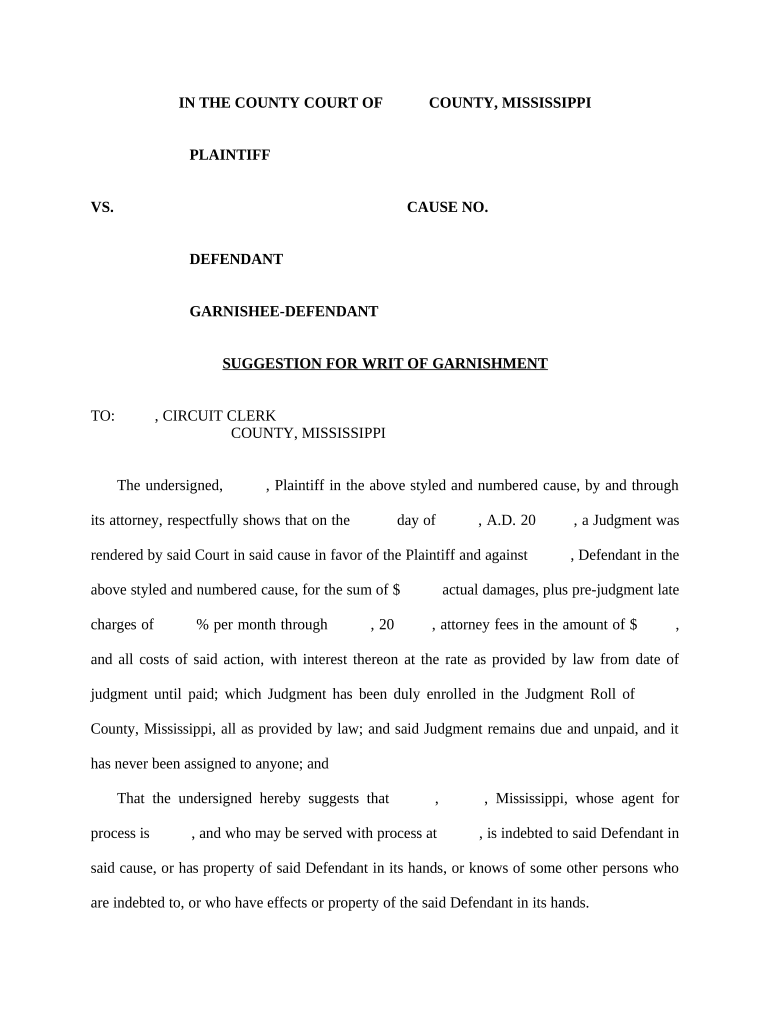
A properly prepared garnishment protects creditor rights while preserving legally required exemptions for debtors, reduces the risk of dismissal, and speeds collection.

Parties involved include judgment creditors, debtors, employers/financial institutions served as garnishees, and attorneys advising either side.
Timely compliance with procedural steps preserves rights and reduces the chance of sanctions or improper withholding.
Court name, docket number, and caption identify the underlying judgment and jurisdiction for enforcement.
Full legal name, last known address, and any identifying numbers help locate wage or bank assets.
Legal name and address of the employer or financial institution receiving the writ for service.
State the judgment balance, withholding formula, and applicable exemptions used in computations.
Include statutorily required debtor notices and instructions for asserting exemptions or requesting hearings.
Judge, clerk, or authorized attorney signature with date and certificate of service completes the form.
| Field | Configuration |
|---|---|
| Case Metadata | Map docket number, court name, and parties to form fields |
| Signer Authentication | Use at least email+SMS or ID verification for attorney or clerk signatures |
| Audit Capture | Enable IP, timestamp, and document history logs |
| Delivery Method | Select certified mail, e‑service, or process server options per local rules |
Ensure the platform you use supports PDF and DOCX imports, audit trails, and secure storage before eSigning or eFiling.
Often issued immediately after judgment; check local practice
Garnishee commonly has a statutorily defined period to answer (varies by jurisdiction)
Debtor typically has a short period to claim exemptions and request a hearing
After objections are resolved, funds are disbursed per court order
Keep filing and service proof for the retention period required by law
Identify judgment balance and entry date for calculation of interest.
Apply to the clerk for a garnishment writ to commence third‑party levy.
Serve employer or bank and file proof of service with the court.
Resolve exemptions and authorize payment or release of funds.
| signNow | DocuSign | Adobe Sign | PandaDoc | HelloSign | |
|---|---|---|---|---|---|
| Starting Price | $8/user/mo | $15/user/mo | $14/user/mo | $19/user/mo | $15/user/mo |
| Free Trial | Yes, 7-day trial | No | No | Yes, limited | Yes, limited |
| Bulk Send | Yes | Yes | Yes | Yes | No |
| Audit Trail | Yes | Yes | Yes | Yes | Yes |
| HIPAA Compliant | Yes | Yes | Yes | No | No |
A local creditor obtains a default judgment and needs wage garnishment to recover debt
A judgment creditor identifies a debtor bank account and seeks garnishment to levy funds