Establishing secure connection…Loading editor…Preparing document…

Deed Affidavit

This template is fully customizable. Edit the text, fill out the fields, and send it for signature. Give it a try!
Deed Affidavit

What a Deed Affidavit Is and when it’s used

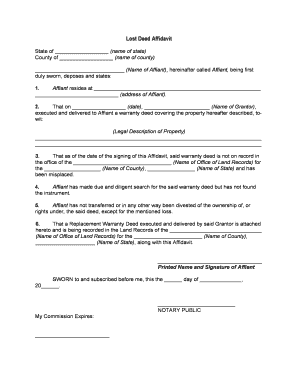
A Deed Affidavit is a sworn written statement used in real estate transactions to confirm facts about a property or deed when the original instrument is missing, ambiguous, or requires supplemental history. It typically attests to ownership, chain of title events, the identity of grantors or grantees, or the circumstances surrounding execution or delivery of a deed. Courts, title companies, and county recording offices accept Deed Affidavits to clear title defects, support re-recording, or establish facts for indexing. The affidavit must be signed under penalty of perjury and, in most states, acknowledged before a notary public.

Why a Deed Affidavit matters for title and recording

A Deed Affidavit reduces title risk by documenting factual history when deeds are unclear or missing. It facilitates title insurance issuance, recording corrections, and probate or closing duties, helping parties and lenders rely on an auditable sworn statement without requiring full litigation or re-conveyance.

Why a Deed Affidavit matters for title and recording

Who typically prepares and accepts Deed Affidavits

Typical users include title insurers, closing agents, attorneys, lenders, and property owners who need to confirm or correct deed facts before recording or issuance of title insurance.

  • Title companies preparing commitment and closing packages; rely on sworn affidavits to clear or explain defects.
  • Lenders requiring clear chain of title and recorded evidence before funding mortgage or refinance transactions.
  • Attorneys and private parties using affidavits to support probate, quiet title actions, or corrective filings.

Core elements a professional Deed Affidavit should include

A professional Deed Affidavit organizes sworn facts about title, execution, ownership history, and supporting exhibits to make a concise, recordable statement suitable for title review and recording.

Affiant Statement

A clear sworn declaration identifying the affiant, their relationship to the transaction, and a statement of facts under penalty of perjury describing why the affidavit is made.
Property Description

Legal description or assessor parcel number (APN) exactly as on prior instruments; include street address for convenience and to assist indexing and title searches.

Chain of Title

Concise chronology of transfers, dates, and instruments referenced by book and page or recording number to establish continuity or explain gaps in record.

Execution Facts

Details about how and when deeds were signed and delivered, including whether originals are lost, destroyed, or held by a third party.

Supporting Exhibits

Attach copies of related instruments, affidavits, receipts, recordings, or correspondence that corroborate the statements, and reference each exhibit in the body.

Notary Acknowledgement

An acknowledgment or jurat per state law including notary signature, seal, commission expiration, and date; remote notarization may be allowed where authorized.

Step-by-step: prepare, notarize, and submit a Deed Affidavit

Follow these steps to prepare, sign, notarize, and record a Deed Affidavit so it supports title clearance and recording procedures.

  • 01
    Gather Documents: Collect deeds, prior recordings, IDs, and supporting proofs.
  • 02
    Draft Affidavit: Use precise facts, cite instruments, and attach exhibits.
  • 03
    Notarize: Sign before a notary; include jurat or acknowledgment.
  • 04
    Record: File with county recorder or provide to title company.

Setting up an online workflow for a Deed Affidavit

Configure an e-sign workflow to assign roles, require authentication, and attach exhibits so the signed Deed Affidavit meets recording and title company expectations.

Field Configuration
Signer Role Affiant must sign and date in the signature field.
Authentication Email or SMS code; KBA where required by the recorder or title company.
Attachments Attach PDFs and reference exhibits by label for examiner review.
Notary In-person or RON where state permits; include jurat in workflow.

Typical routing: from drafting to title review and recordation

Typical routing for a Deed Affidavit moves from drafting to notarization, to title company review, and finally to county recorder for optional filing or indexing.

  • Draft: Prepare affidavit with factual statements and exhibit references.
  • Notarize: Affiant signs before notary with proper identification presented.
  • Title Review: Provide affidavit and exhibits to title company for acceptance.
  • Record/Index: File with county recorder if required; some counties accept affidavits for indexing.

Technical and platform considerations for eSubmission and eSigning

For eSubmission, use a platform that supports PDF, DOCX, RON options, audit trail, and configurable authentication to satisfy recording and title requirements.

  • Formats: PDF and Word DOCX supported
  • Authentication: Email, SMS, or advanced signer authentication
  • Integrations: Works with Salesforce, NetSuite, Microsoft 365

Timelines and typical processing expectations

Timing for Deed Affidavits depends on recording needs, title company requests, and notary or RON availability; some counties accept affidavits immediately, others require review.

When to File:

File when title insurer or recorder requests; no universal deadline.

Notary Validity:

Acknowledgement valid per state notary rules at signing.

RON Availability:

Use RON where state allows remote notarization.

Title Review Time:

Title companies typically respond within 3–10 business days.

County Processing:

Recording may take same day to several weeks depending on county.

Common preparation errors that create delays

  • Using vague or argumentative language rather than concise factual statements increases rejection risk by title examiners and recorders and can require supplemental affidavits.
  • Failing to provide precise prior instrument references (book/page or recording number) hinders title examiners from locating source deeds and delays clearance.
  • Mismatched affiant names or unsigned signature blocks often lead notaries to refuse acknowledgment or cause the county to reject the recording.
  • Submitting only a street address without a legal description can make the affidavit non-referable for indexing and may be rejected by the recorder.

Risks and potential consequences of incorrect affidavits

Recording Rejection: County may refuse recording
Title Insurance Delay: Insurer may require cure or exclude coverage
Perjury Risk: False statements can lead to criminal charges
Civil Liability: Subject to damages and indemnity claims
Recording Fees: Additional fees for re-filing or amendments
Delay Costs: Closing may be postponed; lender fees possible

Who signs and who reviews the affidavit

Affiant — Property Owner

The affiant is typically the current property owner or someone with direct knowledge of the transaction (executor, heir, or former owner). They must swear to the facts, present identification to the notary, and sign under penalty of perjury.

Title Officer — Company Representative

A title officer or abstractor reviews the affidavit, verifies instrument references, and decides whether the affidavit suffices for a title commitment. They may request additional evidence, corrective documents, or legal opinion before clearing exceptions for issuance.

Real-world examples of Deed Affidavit use

These short examples show how affidavits resolve recording or title issues in closing and title-review workflows.

Martin Properties

Martin Properties used a digital workflow to handle property documents and affidavits during closings, avoiding in-person signings while preserving compliance.

  • They streamlined remote notarization and document delivery.
  • I can process and execute all of these documents online with 100% compliance and built-in security. Whether on mobile or working offline, I can get forms back to their necessary parties efficiently.

Optica Ventures

Optica Ventures streamlined title correction workflows by attaching sworn affidavits to client closings, reducing repeated information requests and manual follow-ups.

  • This improved turnaround and client satisfaction.
  • By standardizing affidavit templates and attaching required exhibits, staff reduced back-and-forth with county recorders and shortened the title clearance process, saving administrative hours and improving predictability for closing schedules consistently.

eSignature pricing and feature comparison for Deed Affidavit workflows

Comparing baseline eSignature pricing and key features for executing and delivering Deed Affidavits; signNow is listed first per product comparisons.

signNow DocuSign Adobe Sign PandaDoc HelloSign
Starting Price $8/user/mo $15/user/mo $14/user/mo $19/user/mo $15/user/mo
Free Trial 7-day free trial No No Yes, limited Yes, limited
Bulk Send Yes Yes Yes Yes No
Audit Trail Yes Yes Yes Yes Yes
HIPAA Compliant Yes Yes Yes No No

FAQs: common questions about Deed Affidavits, notarization, and eSigning

Answers to common questions about preparing, notarizing, and filing a Deed Affidavit, and how electronic workflows affect validity.


Need help? Contact support

be ready to get more
Join over 28 million airSlate SignNow users