Establishing secure connection…Loading editor…Preparing document…

Mississippi Motion to Dismiss for Insufficiency of Service of Process

This template is fully customizable. Edit the text, fill out the fields, and send it for signature. Give it a try!
Mississippi Motion to Dismiss for Insufficiency of Service of Process

What this motion is and when it applies

A Mississippi Motion to Dismiss for Insufficiency of Service of Process asks a court to dismiss a complaint or other pleading because the plaintiff failed to serve process properly under applicable rules. The motion challenges personal jurisdiction and the court's ability to proceed, and it typically explains how service was defective, cites controlling procedure, and requests dismissal or re-service. Properly prepared motions focus on jurisdictional facts, affidavit evidence, and whether any defect was cured by alternative methods or by the defendant's conduct.

Why filing this motion matters

A successful motion can remove a case for lack of jurisdiction, avoid default judgments, and preserve defenses. It focuses the court on whether process rules were followed and can limit unnecessary litigation expenses when service was flawed.

Why filing this motion matters

Who commonly prepares and files this motion

Typical users include defendants and their attorneys who wish to preserve jurisdictional objections early in litigation.

  • Individual defendants seeking to avoid default or preserve jurisdictional defenses.
  • Defense attorneys who must protect client rights and present procedural objections.
  • Pro se litigants who received improper service and need to respond appropriately.

Primary signers and filers

Defendant

A named defendant or business entity served with process who denies proper service and requests dismissal. The defendant must present factual detail and may attach an affidavit to support the objection.

Defense Counsel

An attorney licensed in Mississippi who prepares the motion, files it with the court, and often appears at any hearing. Counsel coordinates proof of improper service and drafts proposed orders.

Required form data and metadata

Case Caption: Court, docket number
Party Names: Plaintiff and defendant
Service Date: Date served
Service Method: How served
Affidavit Attached: Yes/No
Relief Sought: Dismissal or re-service

Consequences of preparing the motion incorrectly

Waiver Risk: Objecting late may forfeit defense
Default Exposure: Missed deadlines can lead to default
Sanctions: Frivolous filings risk fees
Jurisdiction Loss: Court may retain jurisdiction
Evidentiary Gaps: Missing affidavit weakens motion
Delay Costs: Repeated filings increase expense

Common pitfalls to avoid

  • Failing to attach a sworn affidavit that details the lack of proper service and the facts supporting the jurisdictional objection.
  • Relying on conclusory statements rather than specific dates, times, and identities of persons who attempted or effected service.
  • Missing local rules about alternative service or substituted service that could cure a defect and negate the motion.
  • Waiting to object until after filing a responsive pleading and thereby potentially waiving the insufficiency objection.

How to prepare the motion: step-by-step

Follow a concise sequence to prepare a complete, court-ready motion that preserves jurisdictional defenses and supports requested relief.

  • 01
    Gather Facts: Document service attempts, dates, and who served.
  • 02
    Draft Motion: State grounds, legal standard, and requested relief.
  • 03
    Attach Evidence: Include affidavits, return of service, and exhibits.
  • 04
    File & Serve: File with court and serve opposing counsel.

Where the motion goes and what follows

Filing triggers a sequence: court review, possible response, and a hearing or ruling. Track deadlines and service of the motion itself.

  • File Motion: File with the clerk under the case number.
  • Serve Opponent: Serve opposing counsel per local rules.
  • Response Period: Allow time for plaintiff to respond.
  • Hearing or Ruling: Court may set a hearing or rule on papers.

Configuring an online workflow for the motion

Set up a repeatable digital workflow to produce, route, and file the motion with consistent fields and proof attachments.

Field Configuration
Case Caption Field Auto-fill from case metadata
Affidavit Upload Required attachment field
Signature Block Signer, date, and contact
Filing Export PDF/A export for court

Technical options for e-signing and e-filing

Choose a platform that supports secure signatures, PDF export, and audit trails compatible with court electronic filing requirements.

  • Authentication: Email, SMS code, or stronger
  • Export Formats: PDF, PDF/A, DOCX
  • Integrations: Court e-filing and cloud storage

Timing considerations and responsive deadlines

Deadlines vary by local rule and the court's scheduling order; check the circuit or chancery court rules for precise response windows.

Initial Response Window:

Varies by court; consult local rules

Motion Filing Time:

File promptly after service issue is discovered

Service of Motion:

Serve opposing counsel per rule

Hearing Scheduling:

Court sets date or rules on papers

Re-Filing Option:

Re-service may be allowed if denied

Key litigation milestones tied to service disputes

Sequence the major events so you can anticipate procedural effects and preserve jurisdictional objections.

01

Service Occurs

Date and method of attempted or completed service are recorded.

02

Motion Filed

Defendant files the insufficiency motion and supporting affidavit.

03

Opposition Filed

Plaintiff may respond with evidence of valid service.

04

Court Decision

Judge dismisses, orders re-service, or denies relief.

Essential components of a professional motion

A well-prepared motion organizes facts, legal argument, and supporting proof so the court can resolve the jurisdictional question efficiently.

Caption

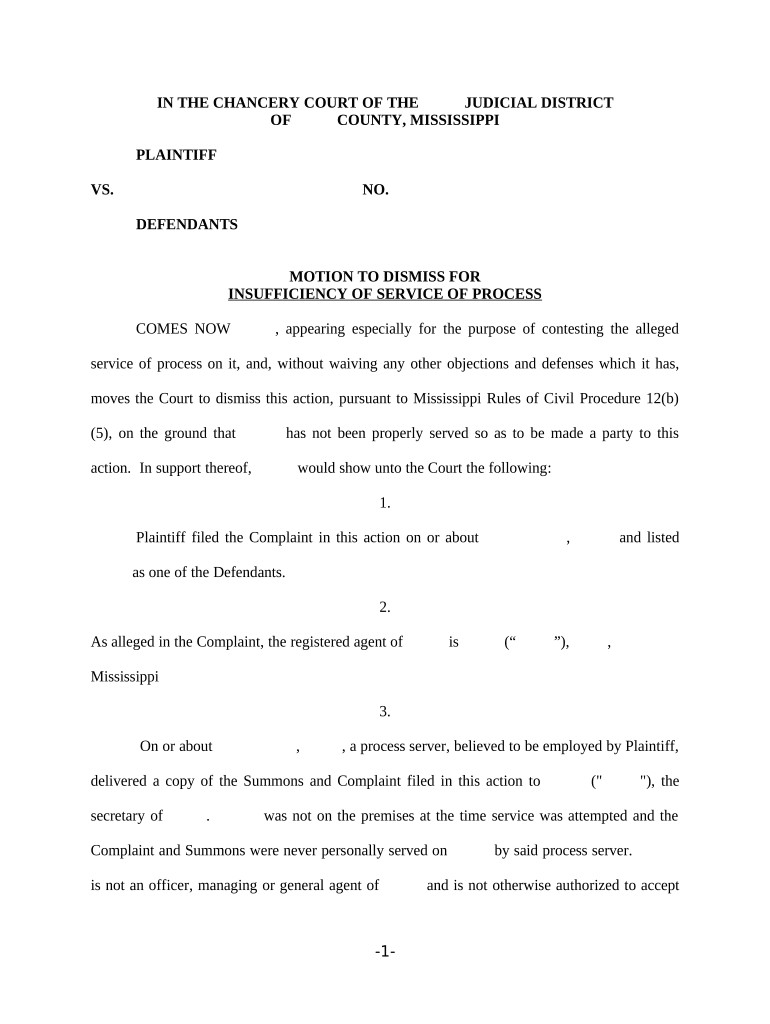
Complete court caption showing parties and docket number so the document is file-ready and clearly tied to the pending case.
Statement of Facts

Chronological, specific recitation of service attempts, dates, locations, and who executed service; attach return of service if available.

Legal Standard

Cite governing procedural rules and explain the legal standard for insufficiency of service of process under Mississippi practice.

Argument

Apply law to facts and explain why service did not confer personal jurisdiction or meet procedural requirements.

Relief Requested

Clearly state relief sought: dismissal without prejudice, dismissal with prejudice, or order for proper service.

Certificate of Service

Include proof the motion and attachments were served on opposing counsel with method and date specified.

Illustrative examples of typical outcomes

Two anonymized scenarios show how motions for insufficiency of service are used and decided in routine cases.

Case Study 1

A defendant received process delivered to a closed office with no authorized agent present, creating factual doubt about effective service.

  • Plaintiff later filed an affidavit claiming substituted service.
  • The court found service insufficient, dismissed the complaint without prejudice, and allowed re-service under corrected procedures with a new return.

Case Study 2

A sheriff's return listed the wrong street address and an incorrect recipient name, which the defendant disputed promptly.

  • Plaintiff produced corrected paperwork later.
  • The court ruled that the initial defect was not cured and granted dismissal, noting plaintiff could re-serve properly if timely.

eSignature vendor comparison for motion preparation and signing

Select a signing vendor that balances cost, compliance, and courtroom admissibility; the table compares typical starting prices and key features.

signNow DocuSign Adobe Sign PandaDoc HelloSign
Starting Price $8/user/mo $15/user/mo $14/user/mo $19/user/mo $15/user/mo
Free Trial 7-day free trial Varied Varied Varied Varied
Bulk Send Yes Yes Yes Yes No
Audit Trail Yes Yes Yes Yes Yes
HIPAA Compliant Yes Yes Yes No No

Frequently asked questions and clarifications

Answers address common procedural and evidentiary issues when a defendant challenges service as insufficient in Mississippi courts.


Need help? Contact support

be ready to get more
Join over 28 million airSlate SignNow users