Establishing secure connection…Loading editor…Preparing document…

Montana Affidavit of Service

This template is fully customizable. Edit the text, fill out the fields, and send it for signature. Give it a try!
Montana Affidavit of Service

What the Montana Affidavit of Service Is and When it’s Used

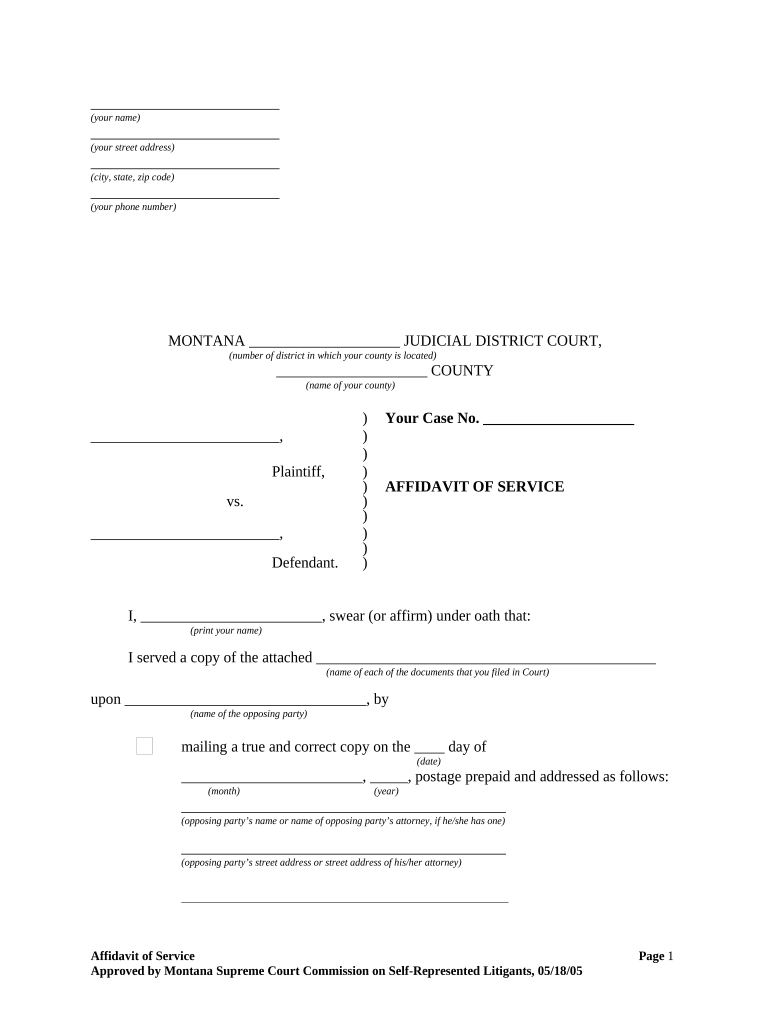
The Montana Affidavit of Service is a sworn written statement used to record and prove that a document or legal notice was properly delivered to a named recipient in Montana. It typically identifies the case or matter, the party served, the date, time, and method of service, the name and contact of the server, and a factual description of how service was made. The affidavit is signed under penalty of perjury and often notarized; courts and administrative agencies use it to verify that required process, notices, or pleadings reached their intended recipient.

Why a Complete Affidavit of Service Matters

A properly completed Montana Affidavit of Service preserves evidence of service, supports procedural compliance in litigation or administrative processes, and reduces the risk of case delays or challenges based on defective notice.

Why a Complete Affidavit of Service Matters

Who Typically Prepares and Relies on an Affidavit of Service

Parties in civil litigation, process servers, law firms, court clerks, landlords, and administrative agencies commonly prepare or require affidavits of service in Montana.

Accurate preparation helps ensure filings are accepted, statutory deadlines are preserved, and adverse parties cannot successfully claim lack of notice.

Step-by-step: Completing a Montana Affidavit of Service

Follow these sequential steps to prepare, verify, and file an affidavit of service for matters in Montana.

  • 01
    Prepare the caption: Copy court name and case number exactly from the case file.
  • 02
    Describe the document: List the document title and, if multiple pages, attach a document index.
  • 03
    Record service details: Enter date, time, precise location, and method of service.
  • 04
    Sign and notarize: Signer executes under penalty of perjury; obtain notary acknowledgement if required.

How Service Is Documented and Filed in Montana

This flow outlines the typical routing: service occurs, proof is completed, and the affidavit is submitted to the appropriate court or agency.

  • Perform Service: Server effects delivery using an approved method under Montana rules.
  • Complete Affidavit: Server records facts, signs oath, and adds contact information.
  • Notarize If Required: Obtain notarial acknowledgement to verify the oath and signature.
  • File or Serve Returned Copy: File the affidavit with the court clerk or attach to the record as directed by local rules.

Digital Workflow Settings for eSubmission and Tracking

When using an electronic workflow, configure fields and authentication to preserve evidentiary value.

Field Configuration
Signature Field Require signer name and signature image or draw; capture timestamp.
Notary Block Include a static notary block for in-person notary or RON metadata fields for online notarization.
Authentication Use email plus SMS code or knowledge-based authentication for stronger attribution.
Audit Trail Enable a tamper-evident audit log capturing IP, timestamp, and actions.

Digital Signing and eSubmission: Platform Capabilities to Look For

Select a platform that supports notarization workflows, reliable audit trails, and export in standard formats.

  • File formats: PDF and DOCX support preserves court-compatible originals.
  • Integrations: Connectors for case management and cloud storage (e.g., Google Workspace, Microsoft 365) streamline filing.
  • Audit & security: Strong encryption in transit and at rest plus detailed event logs improve evidentiary value.

Configure signer authentication, retain a complete audit trail, and export signed records in PDF/A or standard PDF for court submission.

Timelines to Keep in Mind When Serving Documents in Montana

Certain deadlines depend on the type of document served and the procedural rule that governs the underlying action; timely and documented service preserves procedural rights.

Response Window:

Service date establishes the start of any statutory response period.

Filing Proof:

File proof of service with the court as soon as reasonably possible after service.

Notary Retention:

If RON used, retain audio-video and journal records per state notary rules.

Service by Mail:

Add mailing time when calculating deadlines for responses and appeals.

Statutory Exceptions:

Certain matters (e.g., emergency relief) have accelerated timelines requiring immediate proof of service.

Key Milestones From Service to Court Acceptance

A typical milestone sequence from making service to filing the affidavit with the court is shown below.

01

Service Performed

Delivery completed and facts observed at the scene are recorded.

02

Affidavit Drafted

Server prepares the sworn statement describing actions and timing.

03

Notary Acknowledgement

Signer appears before notary or completes RON session to authenticate the oath.

04

File with Clerk

Affidavit is filed or attached to the pleadings and received by the clerk.

Essential Data Elements and Security Considerations

Server Identity: Full name and contact information for follow-up.
Recipient Details: Full legal name and address of the party served.
Service Facts: Exact date, time, location, and method used.
Document Identification: Title and description of the document served.
Notary Data: Notary name, commission number, and seal if notarized.
Audit Trail: Timestamp, IP address, and signature metadata for e-signed records.

Common Mistakes to Avoid When Preparing an Affidavit of Service

  • Using an incorrect or incomplete case caption that does not match court records.
  • Failing to describe the exact document served, causing ambiguity about what was delivered.
  • Omitting the precise time, location, or method of service required for jurisdictional proof.
  • Signing without notarization where the court or local practice requires a notary acknowledgement.

Consequences of Inaccurate or Incomplete Proof of Service

Case Delay: Missing or defective proof can postpone hearings and extend litigation timelines.
Vacated Orders: A judgment or order may be set aside if service cannot be proven.
Default Risks: Improper service may prevent entry of default where proper notice is required.
Sanctions: Intentional misstatements on an affidavit can expose the signer to sanctions or perjury charges.
Rejection by Clerk: Clerks may refuse to accept filings that lack required proof of service or notarization.
Increased Costs: Repeated service attempts or remedial filings raise time and legal expenses.

eSignature Pricing and Feature Snapshot Relevant to Affidavits of Service

Below is a concise vendor comparison focused on starting price, trial availability, bulk send capability, audit trails, HIPAA compliance, and envelope caps.

signNow DocuSign Adobe Sign PandaDoc HelloSign
Starting Price $8/user/mo $15/user/mo $14/user/mo $19/user/mo $15/user/mo
Free Trial 7-day free trial Yes, trial available Yes, trial available Yes, limited trial Yes, limited trial
Bulk Send Yes Yes Yes Yes No
Audit Trail Yes Yes Yes Yes Yes
HIPAA Compliant Yes Yes Yes No No
Envelope Cap No cap 100 envelopes/user/year No cap No cap No cap

Examples: How an Affidavit of Service Is Used in Practice

These short cases illustrate common situations where an affidavit documents service and affects next steps.

Civil Litigation

A process server delivers a summons and complaint to a defendant’s home

  • Server records time, method, and observations
  • The attorney files the affidavit with the court to trigger response deadlines and avoid motions to quash service.

Eviction Proceeding

A landlord serves a termination notice by certified mail and posts notice on the door

  • Server documents mailing details and physical posting
  • The affidavit and postal receipts are filed with the eviction petition to establish notice compliance.

Practical Tips for Accurate and Efficient Affidavit Preparation

Apply these best practices to reduce errors and preserve the affidavit’s probative value.

Verify Case Details
Confirm court name, case number, and party names before drafting to prevent clerical rejection and ensure proper indexing.
Be Specific
Record precise location, method, and observable facts rather than general statements to strengthen credibility and resist challenges.
Attach Evidence
Include copies of tracking receipts, photos, or contemporaneous logs as exhibits to the affidavit for corroboration.
Preserve Originals
Keep original signed affidavits, notarial records, and any RON audio-video recordings in secure storage for the retention period.

Frequently Asked Questions About the Montana Affidavit of Service

Answers to common questions about execution, notarization, and filing of affidavits of service in Montana.


Need help? Contact support

be ready to get more
Join over 28 million airSlate SignNow users