Establishing secure connection…Loading editor…Preparing document…

Motion for Alternate Service

This template is fully customizable. Edit the text, fill out the fields, and send it for signature. Give it a try!
Motion for Alternate Service

What the Motion for Alternate Service Is and When It Applies

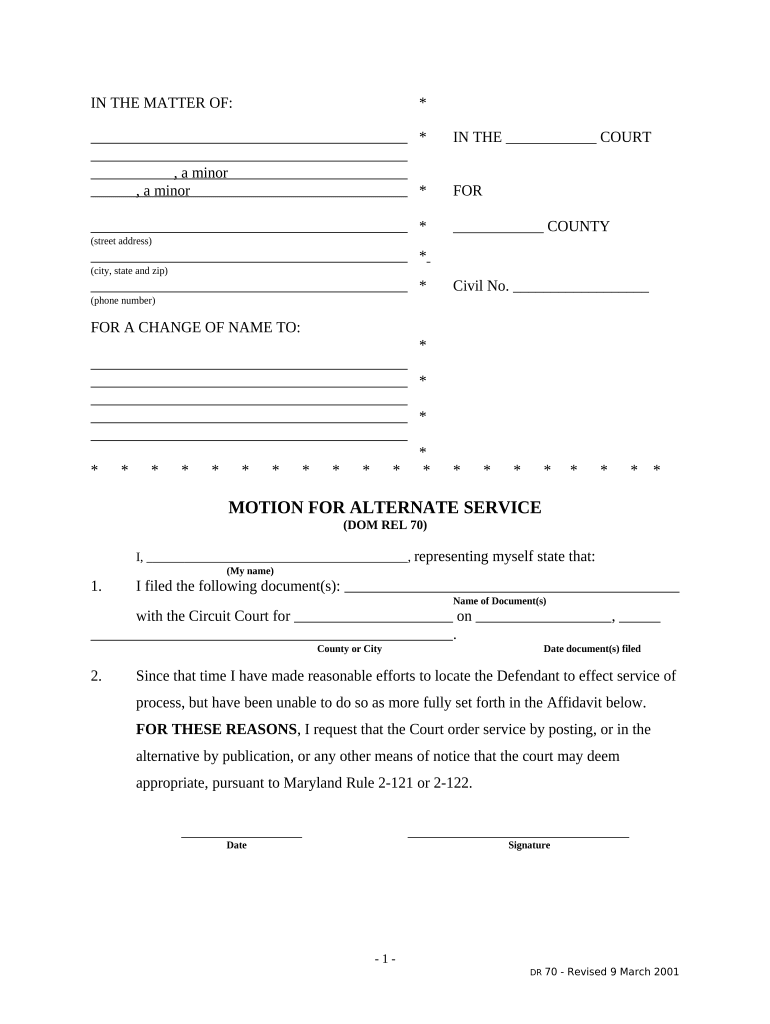
A Motion for Alternate Service asks a court to allow serving a party by a method other than personal delivery under the applicable civil procedure rules. It explains why standard service attempts failed, proposes an alternative method (for example, service by mail, publication, electronic delivery, or service on a third party), and asks the court to authorize that method so the action can proceed. Courts evaluate jurisdictional and notice concerns, proof of diligence, and statutory or rule-based limits before granting alternate service.

Why this Motion Matters for Moving a Case Forward

A granted motion preserves the court’s ability to resolve the dispute when a defendant cannot be located for personal service. It prevents dismissal for lack of service and protects the moving party’s right to a timely hearing.

Why this Motion Matters for Moving a Case Forward

Who Typically Prepares and Files a Motion for Alternate Service

Parties or their attorneys who cannot complete personal service use this motion to request judicial permission for another delivery method.

  • Plaintiffs and claimants seeking to notify a missing defendant about litigation.
  • Civil litigators or firms handling complex service-of-process questions.
  • Process servers documenting repeated unsuccessful personal service attempts.

Courts expect clear facts, an affidavit of attempts, and a narrowly tailored proposed alternative to protect due process.

Essential Elements to Include in a Professional Motion for Alternate Service

A complete motion organizes facts, legal authority, proposed method, supporting affidavits, and a proposed order so the judge can quickly evaluate whether the alternative provides reasonable notice.

Caption

Court name, case number, and party names placed exactly as on the complaint to ensure accurate docketing and judicial review.
Statement of Attempts

A concise chronology of diligent personal service attempts including dates, times, addresses visited, and who was contacted; attach a process server affidavit.

Proposed Method

Describe the requested alternate service (e.g., mail with return receipt, publication, email, social media, or service on an agent) and why it is likely to inform the defendant.

Legal Authority

Cite the procedural rule or statute allowing alternate service in the forum (for example, state civil procedure rules or court-local rules permitting substituted service).

Supporting Affidavit

Attach sworn affidavits from the process server or investigator describing attempts and the factual basis for the selected alternative.

Proposed Order

Include a clean order for the judge to sign specifying the authorized method, any time limits, and proof requirements to preserve clarity.

Step-by-Step: How to Draft and File the Motion

Follow these steps to prepare a defensible motion that the court can evaluate without additional briefing.

  • 01
    Gather facts: Compile all service attempts and contact information.
  • 02
    Draft motion: State attempts, propose alternate method, and cite rules.
  • 03
    Attach affidavits: Include sworn process server statements and supporting exhibits.
  • 04
    File and serve: File with the clerk and serve required parties per local rule.

How to Configure an Online Version for Electronic Filing and Service

Set up a digital workflow to produce the motion, combine supporting affidavits, and generate a proposed order for court filing.

Field Configuration
Signer Roles and Order Plaintiff attorney signs then uploads affidavits.
Authentication Method Use email plus access code for verification.
Conditional Attachments Auto-attach affidavit when 'Attempts' checkbox is checked.
E-filing Integration Export PDF/A and include required metadata for court e-filing systems.

Where to File, How to Serve, and What to Submit to the Court

Different jurisdictions have specific filing and service rules; use the clerk’s local rules and state statutes to determine proper routing and proof requirements.

  • File with clerk: File the motion and all affidavits in the court that has subject-matter jurisdiction.
  • Serve opposing parties: Serve all existing parties using the court-approved method for document service.
  • Provide proposed order: Submit a clean proposed order for signature by the judge.
  • Retain proof: Keep copies of attempted service documents and receipts for the court record.

Technical Considerations for eFiling and eService

Confirm the court accepts electronic filings, PDF/A format, and whether email-based service is permitted before relying on digital methods.

  • Document Formats: PDF, PDF/A, and DOCX accepted by many e-filing portals.
  • Authentication: Email plus access code is common; KBA or two-factor may be required.
  • Integrations: Supports common systems like Microsoft 365 and Google Workspace.

When planning electronic service include audit-ready evidence: timestamps, IP addresses, and a chain-of-custody for attachments to reduce later challenges.

Typical Timing and Deadlines to Track for Alternate Service Motions

Track local rule deadlines: time to file a motion, required advance notice for hearings, and any waiting periods imposed after court authorization.

Filing deadline:

File as soon as attempts fail to preserve prompt adjudication.

Proposed hearing date:

Schedule per local civil calendar rules and clerk availability.

Publication window:

If ordered, publication often requires specific frequency and duration.

Proof deadline:

File proof of alternate service within the time the order requires.

Appeal timing:

Service method disputes can affect later appeal time calculations.

Key Milestones from Motion to Proof of Service

The sequence below highlights typical stages from drafting to court approval and final proof of alternate service.

01

Draft and assemble

Prepare motion, affidavits, and proposed order before filing.

02

File with court

Submit the motion to the clerk and note official filing date.

03

Court consideration

Judge reviews and may set a hearing or rule on papers.

04

Execute alternative

Carry out the ordered method and file proof within required time.

Common Pitfalls to Avoid When Preparing the Motion

  • Failing to include a sworn process-server affidavit that documents dates, times, and specific addresses visited weakens the motion.
  • Proposing an overly broad or speculative alternative without factual support increases the chance the court will deny relief.
  • Using an incorrect caption, case number, or omitting a proposed order leads to clerk requests and administrative delays.
  • Neglecting to confirm local rule requirements for notice or publication frequency can cause noncompliance if the court grants alternate service.

Consequences of Improper or Insufficient Alternate Service Requests

Dismissal risk: Case may be dismissed for lack of proper service.
Sanctions: Court may impose monetary or procedural sanctions.
Delay: Improper service postpones hearings and resolution.
Default relief: Defendants can later attack jurisdiction and seek relief.
Contempt exposure: Misrepresentations in affidavits risk contempt charges.
Reservice required: You may need to repeat service at added cost.

Required Information and Supporting Items for the Motion

Court and Case Number: Exact docket identifier
Full Party Names: Plaintiff and defendant legal names
Last Known Address: Defendant’s most recent residence or business
Attempts Summary: Dates and outcomes of service attempts
Proposed Method: Precise alternative delivery details
Affidavit: Sworn process-server statement

Realistic Use Cases for a Motion for Alternate Service

These examples illustrate common factual patterns where courts frequently permit alternate service.

Disappearing Defendant

Plaintiff tried personal service at three addresses with no contact

  • Process server observed premises vacant and incoming mail returned
  • The court granted substituted service by publication and certified mail after reviewing affidavits and proposed order, allowing the case to proceed.

Corporate Agent Unknown

A business’s registered agent could not be located despite registry checks

  • Investigator traced activity to an officer's email and social accounts
  • The court approved service by email with a return/read receipt requirement and posting on the company website as reasonably calculated notice.

Practical Tips to Strengthen an Alternate Service Motion

Follow these best practices to improve the likelihood of court approval and reduce later challenges to jurisdiction or notice.

Document every attempt in detail
Record dates, exact times, physical descriptions of locations, and any contacts. Attach contemporaneous affidavits from the process server to show persistent diligence.
Choose the least intrusive effective method
Propose the alternate method most likely to reach the defendant and that best preserves due process while minimizing speculative or overly broad approaches.
Conform to local rules and statutes
Check court rules, state statutes, and published guidance for required notice periods, publication requirements, or specific methods courts prefer in your jurisdiction.
Provide a clear proposed order
Draft an order with exact language, defined deadlines for proof of service, and instructions for how return receipts or publications will be evidenced.

Representative eSignature Platform Comparison for Preparing and Serving Court Documents

Compare starter pricing and common capabilities for eSignature platforms used to prepare, sign, and archive motions, affidavits, and proof-of-service exhibits.

signNow DocuSign Adobe Sign PandaDoc HelloSign
Starting Price $8/user/mo $15/user/mo $14/user/mo $19/user/mo $15/user/mo
Free Trial Yes, 7-day free trial No No Yes, limited Yes, limited
Bulk Send Yes Yes Yes Yes No
Audit Trail Yes Yes Yes Yes Yes
HIPAA Compliant Yes Yes Yes No No

Frequently Asked Questions About Motions for Alternate Service

Common procedural and evidentiary questions about alternate service and how to avoid common errors are answered below.


Need help? Contact support

be ready to get more
Join over 28 million airSlate SignNow users