Establishing secure connection…Loading editor…Preparing document…

Motion to Advance Appeal

This template is fully customizable. Edit the text, fill out the fields, and send it for signature. Give it a try!
Motion to Advance Appeal

What the Motion to Advance Appeal Is and when it's used

A Motion to Advance Appeal is a formal court filing asking an appellate court to move an appeal up in the docket for earlier consideration than the normal schedule. Parties use it when delay would cause irreparable harm, when the issue is time‑sensitive, or when immediate appellate review can prevent unnecessary expense or ongoing prejudice. The motion explains why expedited treatment is necessary, cites governing appellate rules or local rules, and proposes a schedule or order for accelerated briefing, argument, or disposition.

Why filing a Motion to Advance Appeal matters

A timely motion can preserve rights and prevent harm by securing earlier appellate review, shortening briefing cycles, and avoiding additional burdens for the parties or court. It is the procedural tool to request case prioritization when ordinary timelines would produce unfair results.

Why filing a Motion to Advance Appeal matters

Who typically prepares and files this motion

The Motion to Advance Appeal is most often prepared by litigators but may be filed by any party with standing who identifies an urgent appellate need.

  • Appellate attorneys representing parties in civil or criminal appeals who need expedited relief.
  • Pro se litigants filing their own appeals who can show time sensitivity or imminent harm.
  • Government agencies or public defenders seeking priority for statutory or safety issues.

The motion's content and procedural posture vary by jurisdiction and by whether the appeal is to a state intermediary court, state supreme court, or federal circuit court.

Step-by-step: prepare and file the motion

Follow a standard sequence to prepare, file, and serve the motion while preserving the record and meeting local rules.

  • 01
    Draft motion: Prepare a concise motion stating urgency and proposed schedule.
  • 02
    Attach evidence: Include supporting exhibits showing prejudice or time sensitivity.
  • 03
    File with clerk: E-file or deliver to clerk per local appellate rules.
  • 04
    Serve parties: Serve all parties and certify service in the certificate of service.

Typical procedural flow after filing the motion

After filing, the court and opposing parties follow set steps that may include expedited response deadlines, scheduling conferences, and a judicial decision on relief.

  • Prepare motion: Draft motion, exhibits, and proposed order.
  • File motion: E-file or file in person with the appellate clerk.
  • Service: Provide required service and file certificate of service.
  • Court action: Court sets schedule, holds hearing, or issues written order.

What a complete Motion to Advance Appeal contains

A professional motion clearly organizes facts, argument, and procedural requests so the court can assess urgency quickly and schedule relief efficiently.

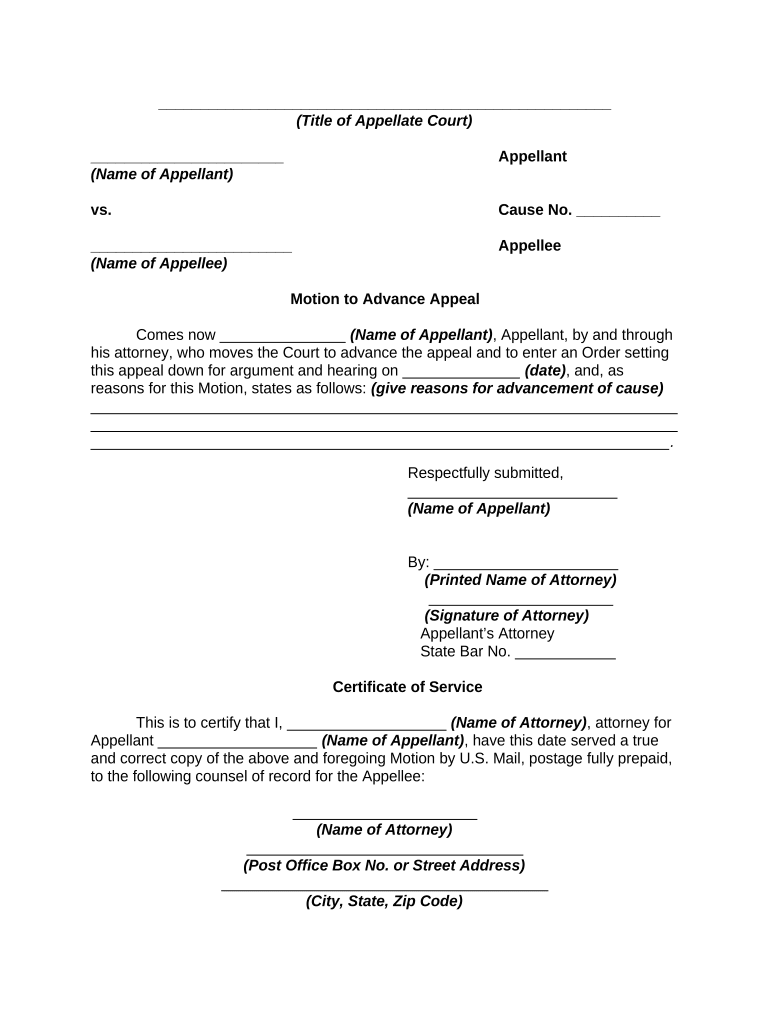
Case caption

Full caption and docket number at the top of the first page, identifying appellant, appellee, and court to ensure accurate filing and case tracking.
Statement of urgency

A short factual statement explaining why ordinary timelines cause irreparable harm or prejudice and why advancement is necessary now.

Legal argument

Concise legal authorities and standards showing the court has discretion to advance the appeal and why facts satisfy that discretion.

Supporting exhibits

Affidavits, orders, transcripts, or agency records that substantiate the urgent circumstances or risk of irreparable harm.

Proposed schedule

A clear proposed briefing and hearing schedule the movant asks the court to adopt if the motion is granted.

Certificate of service

A sworn or signed certificate listing how and when all parties were served, including delivery method and recipients.

Security and compliance considerations

ESIGN/UETA: Recognized for e-signature validity
HIPAA (if applicable): BAA required for PHI transmission
Audit Trail: Timestamped actions and signer records
Encryption: TLS in transit, AES‑256 at rest
Access Controls: Two‑factor and role permissions
Retention Policy: Secure archival with tamper logs

Common pitfalls to avoid when preparing the motion

  • Failing to tie urgency to concrete facts or imminent deadlines, which leaves the motion conclusory and unlikely to persuade the court.
  • Omitting or mislabeling supporting exhibits, causing confusion about the evidentiary basis for expedited relief and possible striking of materials.
  • Missing local appellate or circuit rules governing expedited motions, which can result in rejection, return, or denial on procedural grounds.
  • Serving parties improperly or failing to file a correct certificate of service, which may void the notice requirement and delay proceedings.

Consequences of an incorrect or deficient motion

Dismissal Risk: Motion denial
Waiver: Loss of timing arguments
Sanctions: Court may impose fees
Delay: Extended appellate timeline
Costs: Additional attorney fees
Record gaps: Incomplete evidentiary support

Setting up a digital filing and service workflow

Configure your e-filing and service steps to meet court and opponent notice requirements before submission.

Setting Configuration
Filing channel E-file or clerk's office, per local rule
Service method Email, e‑service, or U.S. mail as required
Document format PDF/A with bookmarked exhibits
Authentication Include signature block and audit trail

Technical requirements for e-filing and signing

Confirm accepted file types, signer authentication, and any court-specific e-filing constraints before uploading documents.

  • File formats: Use PDF or PDF/A as required
  • Integrations: Support for court portals and case systems
  • Authentication: Email, SMS code, or stronger ID checks

Ensure your chosen platform can produce a tamper-evident PDF, preserve an audit trail with IP and timestamps, and export signed copies for court filing and client records.

Timing and typical deadlines to track

Deadlines depend on local appellate rules; act promptly to avoid forfeiting the opportunity for advancement.

File promptly:

File the motion as soon as the urgency arises to allow the court time to respond.

Opposition deadline:

Local rules often set a narrow response window, commonly 7–14 days.

Hearing scheduling:

If granted, courts may schedule argument within days to weeks.

Expedited briefing:

Court may set shortened briefing cycles upon granting advancement.

Notice to parties:

Serve all parties and file certificate immediately after filing.

Key milestones from filing to court decision

Track these sequential milestones to manage filings, service, and expected court actions when a motion to advance is pending.

01

Motion filed

Clerk accepts or rejects, and service must be completed immediately.

02

Response window

Opposing parties file an opposition or consent within the rule-defined period.

03

Scheduling

Court schedules hearing or sets an accelerated briefing calendar.

04

Court decision

Court grants, denies, or partially grants relief with an amended schedule.

Typical eSignature vendor pricing and key features for filing and service

Compare core pricing and feature points used for document signing and secure delivery. Confirm final plan details with each vendor.

signNow DocuSign Adobe Sign PandaDoc HelloSign
Starting Price $8/user/mo $15/user/mo $14/user/mo $19/user/mo $15/user/mo
Free Trial 7-day free trial Varies by plan Varies by plan Varies by plan Varies by plan
Bulk Send Yes (Business Premium) Yes Yes Yes Varies by plan
Audit Trail Yes Yes Yes Yes Yes
HIPAA Compliant Yes (BAA available) Varies by plan Varies by plan Varies by plan Varies by plan
Envelope Cap No cap 100 envelopes/user/year Varies by plan Varies by plan Varies by plan

FAQs and troubleshooting for common issues

Answers to frequently asked procedural and technical questions when preparing, filing, or serving a Motion to Advance Appeal.


Need help? Contact support

be ready to get more
Join over 28 million airSlate SignNow users