Caption
Case caption with court, parties, case number, and motion title.
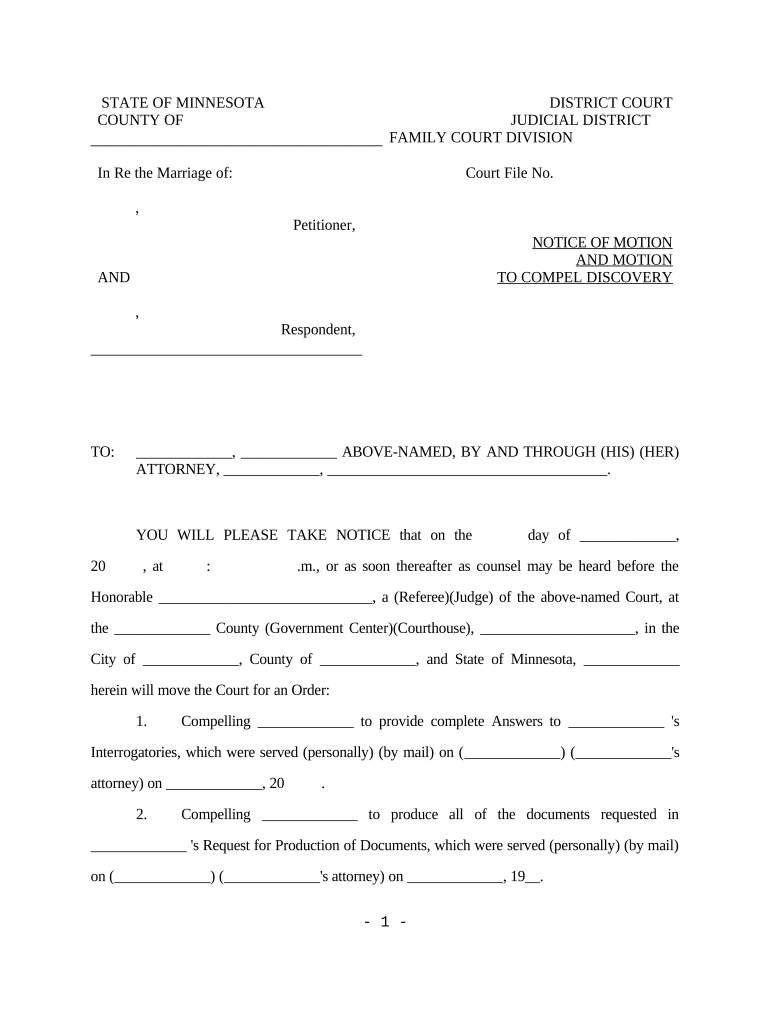
A clear motion helps the court identify specific discovery deficiencies, reduces delay, and increases the chance of a targeted order rather than broad sanctions.

Litigation counsel, range counsel, or self-represented parties who need judicial intervention to obtain discovery prepare motions to compel.
Lead counsel for the moving party signs and files the motion, certifies the meet-and-confer efforts, and represents the party at any discovery hearing before the court.
A named party or its corporate representative may need to verify factual statements or provide declarations supporting the motion and must be identified by name and title.
Case caption with court, parties, case number, and motion title.
Short summary of the dispute and relief sought in one or two paragraphs.
Chronology of requests, responses, and meet-and-confer efforts with dates.
Cite governing discovery rules (e.g., FRCP 26–37) and apply law to facts.
Attach discovery requests, responses, correspondence, and declarations.
Draft order specifying what must be produced and any deadlines.
| Stage | Configuration |
|---|---|
| Drafting | Template with auto-fill fields for caption and case number |
| Review | Role-based reviewer assignment and tracked comments |
| Signature | eSignature field for counsel and declarant |
| Filing | Export to PDF/A and attach exhibits for court upload |
Choose eSignature and e-filing methods that meet the court’s technical and authenticity expectations and preserve an audit trail.
Ensure the chosen provider supports exportable audit records and file formats required by the court; many firms use integrated eSignature platforms that comply with ESIGN and UETA while preserving chain-of-custody information.
Must occur before filing in most courts
Court may set 7–30 day production deadlines
Hearings often set 2–8 weeks after filing
Sanctions requests often accompany the motion
Follow district or county-specific filing timelines
Confirm which requests lack adequate responses and gather supporting documents.
Attempt resolution by written correspondence and meet-and-confer communications.
Draft, attach exhibits, and file the motion with the clerk per local rules.
Attend hearing or await the court’s written order and comply with any deadlines.
A venture firm documented discovery correspondence systematically to support a motion to compel.
A technology distributor centralized discovery responses across teams to respond to multiple subpoenas.
| signNow | DocuSign | Adobe Sign | PandaDoc | HelloSign | |
|---|---|---|---|---|---|
| Starting Price | $8/user/mo | $15/user/mo | $14/user/mo | $19/user/mo | $15/user/mo |
| Free Trial | 7-day free trial | Varies by vendor | Varies by vendor | Varies by vendor | Varies by vendor |
| Bulk Send | Yes | Yes | Yes | Yes | No |
| Audit Trail | Yes | Yes | Yes | Yes | Yes |
| HIPAA Compliant | Yes | Yes | Yes | No | No |