Establishing secure connection…Loading editor…Preparing document…

Motion Entry Default

This template is fully customizable. Edit the text, fill out the fields, and send it for signature. Give it a try!
Motion Entry Default

What a Motion Entry Default Is and when it applies

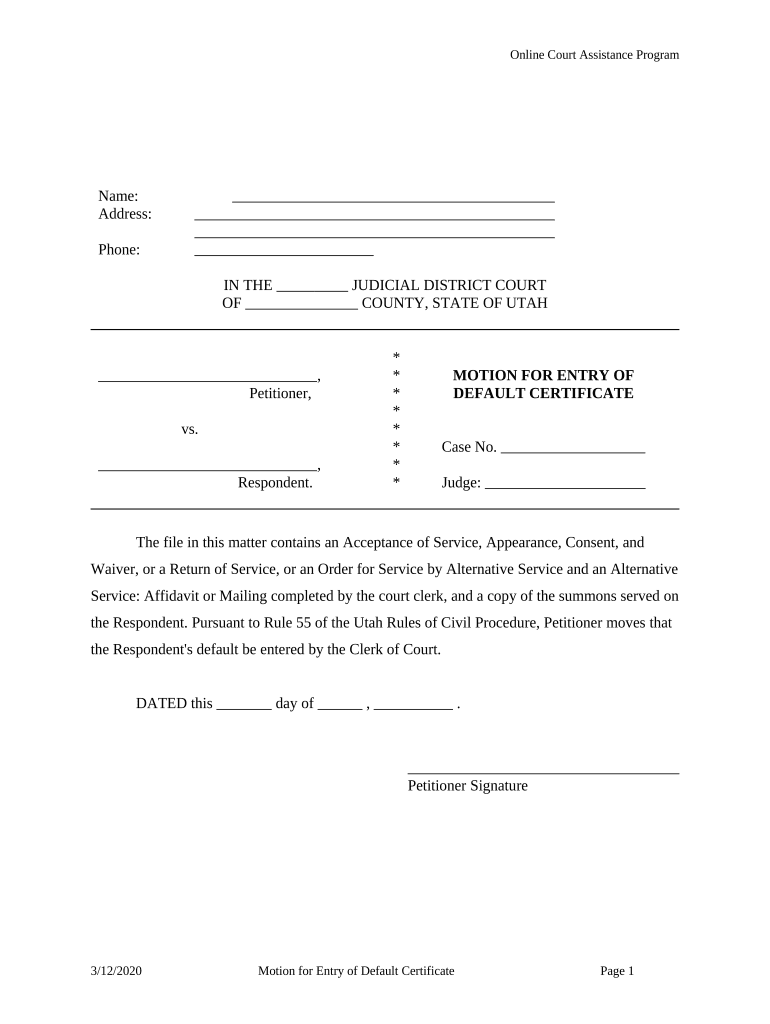
A Motion Entry Default is a court filing that asks a clerk or judge to enter a default against a party who failed to timely respond to a complaint or other pleading. Under the Federal Rules of Civil Procedure (Rule 55) and comparable state rules, the motion typically includes proof of service, a request for entry of default, and supporting affidavits showing the required notice and the party's failure to plead. Entry of default creates a procedural posture for obtaining a default judgment, but additional steps are usually required before a final money judgment is entered.

Why a clear Motion Entry Default matters

A correctly prepared Motion Entry Default documents the procedural basis for default, speeds clerk action, and preserves entitlement to relief while reducing grounds for later set-aside motions.

Why a clear Motion Entry Default matters

Who prepares and files a Motion Entry Default

Attorneys and pro se litigants file these motions after confirming a defendant’s failure to respond within the applicable deadline.

  • Civil litigators and plaintiff counsel who seek judicial relief after service and no timely answer
  • In-house counsel handling breach, collection, or contract disputes where default is a likely outcome
  • Court clerks and docketing staff who process default entries and maintain procedural records

Accurate preparation reduces the risk of procedural rejection and limits opportunities for an opposing party to successfully move to set aside the entry of default.

Essential parts of a professional Motion Entry Default

A complete motion groups statutory and procedural facts, proof of service, a proposed order, and any affidavits or declarations required by local rule.

Caption

Court caption showing party names, docket number, and case title formatted per local rules; ensures the clerk places the entry in the correct file and avoids clerical rejection.
Statement of Facts

Concise recitation of service date, method, and the deadline for response; explains why the defendant is in default and cites the controlling rule such as FRCP 55 or the relevant state rule.

Proof of Service

A signed affidavit or certificate showing who served the complaint, when and how it was served, and that service complied with rule or statute requirements.

Declaration/Affidavit

Affidavit from the moving party or process server verifying facts supporting entry of default, including lack of answer and any statutory notice requirements.

Proposed Order

A short, judge-ready proposed order for the clerk or judge to sign, stating the entry of default and identifying any subsequent deadline for default judgment or hearing.

Supporting Exhibits

Copies of the served complaint, summons, prior correspondence, and any contract or invoice that substantiates relief sought; labeled and paginated for easy clerk review.

Step-by-step: preparing and filing the motion

Follow this sequence to prepare a defensible and clerk-ready motion for entry of default.

  • 01
    Confirm deadline: Verify the defendant’s response due date under the controlling rule.
  • 02
    Gather proof: Assemble the complaint, summons, and proof of service documents.
  • 03
    Draft motion: Prepare a concise motion, affidavit, and proposed order.
  • 04
    File and serve: File with the court clerk and serve the defaulting party per rules.

Where to file and how the court processes the motion

Filing and processing steps vary by court; this sequence explains typical routing from filing to clerk action or judge review.

  • Clerk filing: File the motion with the clerk’s office according to local electronic filing rules.
  • Docket entry: Clerk assigns event code and adds the motion to the docket.
  • Clerk review: Clerk checks for proof of service and required affidavits before entering default.
  • Judge action: If required, the judge reviews and signs the proposed order or schedules a hearing.

Digital filing and eSubmission considerations

Many courts accept electronic filings and e-signed affidavits, but local rules vary; confirm e-filing and e-signature policies first.

  • eFiling: Requires registered portal account in most jurisdictions.
  • eSignatures: ESIGN/UETA-compliant e-signatures are generally acceptable.
  • File formats: Most courts accept PDF/A for submitted documents.

When submitting electronically, include a clear certificate of service and ensure signed affidavits meet the court’s acceptable signature and authentication standards to avoid rejection.

Key timing rules and typical deadlines

Observe the response window and any additional local deadlines; these govern whether a motion for entry of default is procedurally proper.

Response Deadline:

Check the summons and governing rule for the number of days to answer or respond.

Time to File Motion:

File the motion after the response deadline has passed and after confirming no timely pleading was filed.

Clerk Entry Timing:

Clerk may enter default upon receipt of proper documentation; timing varies by docket backlog.

Motion for Default Judgment:

Some courts require a separate motion for judgment after default entry.

Set-Aside Deadlines:

Opposing parties may file a motion to set aside default under the governing rule; act promptly to oppose or respond.

Common drafting and filing mistakes to avoid

  • Failing to attach or properly label proof of service, causing the clerk to reject the motion or delay entry of default.
  • Using an incorrect case caption, which can lead to misfiling or clerks returning the document for correction.
  • Submitting unsigned or improperly notarized affidavits that do not meet local rule requirements for declarations under penalty of perjury.
  • Omitting a clear proposed order, forcing the judge to reformat or delay signing and prolonging the entry process.

Consequences of errors or omissions

Delay in relief: Clerical rejection or incomplete evidence can postpone entry.
Set-aside motion: A timely motion to vacate may undo the default.
Judicial scrutiny: Incomplete proofs invite closer review by the court.
Loss of claims: Procedural defects can lead to partial denial of relief.
Sanctions risk: Improper service or misleading filings may trigger sanctions.
Additional costs: Extra filings and hearings increase legal fees and court costs.

Practical examples of Motion Entry Default use

Below are two concise scenarios showing when and how a motion for entry of default is typically used.

Collection Case

A creditor files suit and serves the defendant but receives no answer within the prescribed period

  • The creditor files a Motion Entry Default with proof of service
  • The clerk enters default and the creditor later files for default judgment supported by affidavits of amount due and contract.

Contract Dispute

A plaintiff sues for breach and properly serves a corporate defendant that fails to respond

  • Plaintiff submits a motion for entry of default and a proposed order
  • The court enters default, then schedules a hearing to determine damages under Rule 55 procedures.

eSignature options for affidavits and motion documents

Compare common vendor features relevant to e-signing affidavits and filing-ready PDFs; signNow appears first per vendor ordering rules.

signNow DocuSign Adobe Sign PandaDoc HelloSign
Starting Price $8/user/mo $15/user/mo $14/user/mo $19/user/mo $15/user/mo
Free Trial 7-day trial Varies Varies Varies Varies
Bulk Send Yes Yes Yes Yes No
Audit Trail Yes Yes Yes Yes Yes
HIPAA Compliant Yes Yes Yes No No

Frequently asked questions about Motion Entry Default

These answers address common procedural and e-filing questions; consult local rules or counsel for jurisdiction-specific guidance.


Need help? Contact support

be ready to get more
Join over 28 million airSlate SignNow users