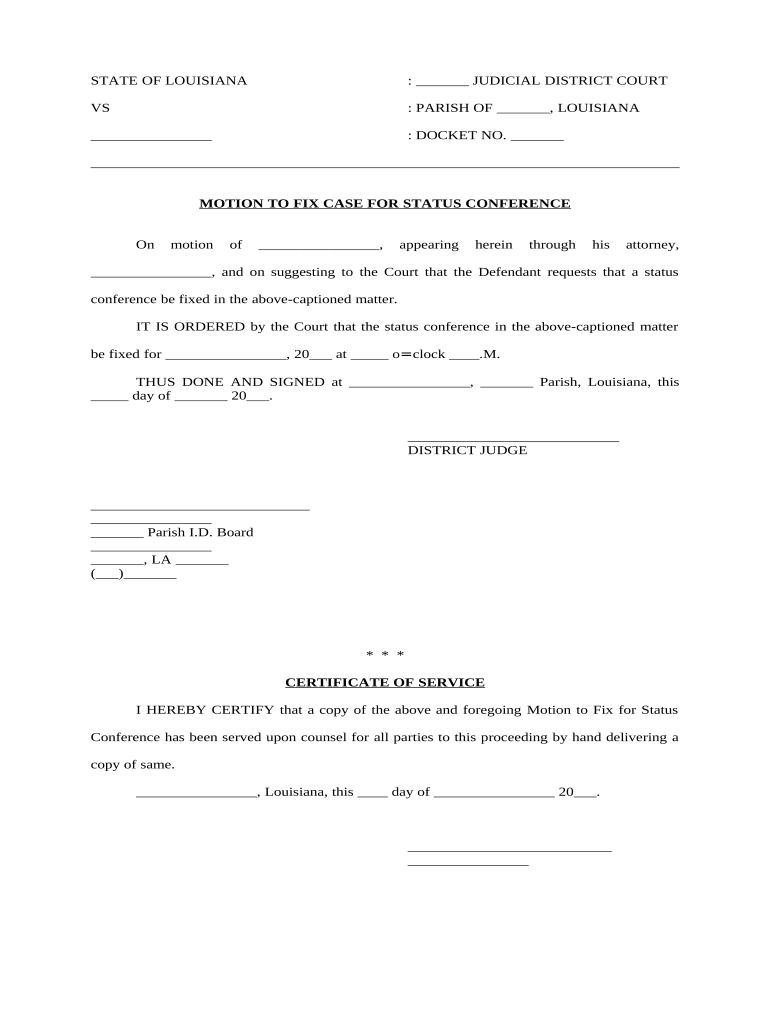
Motion Status Conference
What a Motion Status Conference Is
Why the Motion Status Conference Matters
Courts hold Motion Status Conferences to streamline case management, preserve judicial resources, and set clear deadlines for motion practice. For litigants, these conferences clarify outstanding issues, reduce duplicative filings, and help prioritize discovery or settlement efforts under applicable local rules and judge directives.
Who Typically Prepares and Attends
Typical users include federal and state litigants, their counsel, and court clerks coordinating schedules and mediators.
- Plaintiffs and defense counsel preparing concise status statements and exhibit lists for the conference.
- Court clerks tasked with scheduling, docket entries, and ensuring compliance with local rules and deadlines.
- Insurance adjusters, government attorneys, or third-party mediators attending to evaluate settlement readiness.
Step-by-Step: Prepare and File Your Statement
-
01Gather Case Info: Collect docket number, pending motions, and relevant deadlines.
-
02Draft Status Statement: Summarize active motions, positions, and requested relief in plain terms.
-
03Attach Exhibits: Include key filings, exhibit lists, and any proposed orders.
-
04File and Serve: File with court clerk per local rule and serve all parties.
Typical Filing and Service Workflow
-
Draft Document: Prepare concise status statement and list of pending motions.
-
Place Signature: Apply signatures and dates; verify signer identities.
-
File with Clerk: E-file the statement per court electronic filing system.
-
Serve Parties: Serve all counsel and file proof of service promptly.
Configure an Online Workflow for Submissions
| Field | Configuration |
|---|---|
| Signer Authentication | Email plus SMS code or stronger KBA as required. |
| Field Types | Signature, initials, date, checkbox, and document attachments. |
| Routing Order | Ordered signing for filing counsel then opposing counsel. |
| File Format | PDF/A preferred; DOCX accepted then converted to PDF. |
Platform and Format Considerations
Ensure your submission platform supports required file formats, signer authentication, and integrations with court e-filing systems where available.
- File Formats: PDF, PDF/A, DOCX accepted.
- Integrations: Salesforce, NetSuite, Microsoft 365 supported.
- Authentication: Email, SMS code, or KBA.
Common Deadlines and Timing Expectations
Deadline to Submit Status Statement:
Often seven to fourteen days before the conference.
Deadline to Serve and File Proof:
Serve opposing counsel and file proof before the statement deadline.
Deadline for Replies or Responses:
Some courts allow a short reply three to five days before conference.
Procedure to Request a Continuance:
File a motion to continue promptly with supporting reasons.
Reporting Emergency or Immediate Scheduling Issues:
Raise scheduling emergencies immediately with the clerk and opposing counsel.
Key Milestones Leading to the Conference
Notice Issued
Court issues conference date and filing requirements.
Statement Filed and Served
Parties file status statements and proof of service by deadline.
Pre-Conference Meet-and-Confer
Parties attempt to narrow issues and prepare joint statements if required.
Conference Held
Judge addresses scheduling, outstanding motions, and next deadlines.
How a Motion Status Conference Differs from a Case Management Conference
| Criteria | Motion Status Conference | Case Management Conference |
|---|---|---|
| Purpose | progress update | scheduling and discovery planning |
| Timing | mid-motion practice | early case lifecycle |
| Participants | parties, counsel | parties, counsel, case managers |
| Typical Filings Required | status statement | case management plan |
Penalties and Risks of Incorrect Filings
Common Preparation Mistakes to Avoid
- Omitting or mistyping the docket number leads to misrouting, delayed processing, and possible failure to appear at the correct calendar call.
- Failing to attach certificates of service or using incorrect service methods can result in the court disregarding your submission.
- Relying on unsigned or improperly signed status statements risks rejection by the clerk and potential sanctions for noncompliance.
- Submitting late or noncompliant filings without a motion for extension may lead to continuance, sanctions, or loss of relief sought.
Real-World Examples and Outcomes
Optica Ventures
Optica Ventures streamlined status conference filings to reduce calendar conflicts and accelerate resolution of procedural motions across multiple investor-related cases.
- Less time spent on administrative follow-ups.
- Using concise status statements and clearly labeled exhibits, the firm reduced clerical rejections and shortened scheduling cycles, enabling counsel to focus on substantive briefing and negotiation rather than administrative corrections and continuances.
Martin Properties
Martin Properties adopted consistent status reports for real estate disputes to meet tight escrow and closing timelines while preserving evidentiary records.
- Improved coordination with county clerks and counsel.
- Standardized submissions reduced missed deadlines, minimized on-site visits for signatures, and created a reliable electronic record for escrow officers and opposing counsel to review before scheduled status conferences.
eSignature Pricing and Feature Comparison
| signNow | DocuSign | Adobe Sign | PandaDoc | HelloSign | |
|---|---|---|---|---|---|
| Starting Price | $8/user/mo | $15/user/mo | $14/user/mo | $19/user/mo | $15/user/mo |
| Free Trial | 7-day trial | Varies | Varies | Varies | Varies |
| Bulk Send | Yes | Yes | Yes | Yes | No |
| Audit Trail | Yes | Yes | Yes | Yes | Yes |
| HIPAA Compliant | Yes | Yes | Yes | No | No |
| Envelope Cap | No cap | 100 envelopes/user/year | Varies | Varies | Varies |
Frequently Asked Questions and Troubleshooting
-
What is required in the statement?
Include a concise list of pending motions, a brief position summary for each, cited docket numbers, a proposed schedule or briefing timetable, and a proof of service. Follow the court's local rules for page limits, formatting, and any mandatory meet-and-confer statements.
-
How far in advance to submit?
Deadlines vary by jurisdiction. Many courts require status statements seven to fourteen days before the conference; some set shorter or longer periods. Always check local rules and the judge's standing orders to confirm exact submission and service deadlines.
-
Do I need a hearing appearance?
Some conferences are telephonic or resolved on the papers; others require in-person attendance. The court's notice and local rules specify appearance requirements. If the judge requests oral argument or live status updates, a representative familiar with the motions should attend.
-
Can the statement be e-signed?
Yes, electronic signatures are generally valid under the ESIGN Act (15 U.S.C. ch. 96) and UETA where adopted, provided the signature demonstrates intent and the court accepts e-filed documents. Check local electronic filing rules for permitted signature methods.
-
What if opposing counsel disagrees?
Attempt to resolve disputes in good faith before the conference through meet-and-confer correspondence. If disagreement persists, note the dispute in your status statement and be prepared to summarize positions succinctly at the conference per local rules.
-
Consequences of incomplete or late filings
The court may continue the conference, impose sanctions, strike filings, or deny requested relief for failure to comply with filing rules. Incomplete service or missing exhibits can result in a waiver of issues or adverse scheduling orders.