Establishing secure connection…Loading editor…Preparing document…

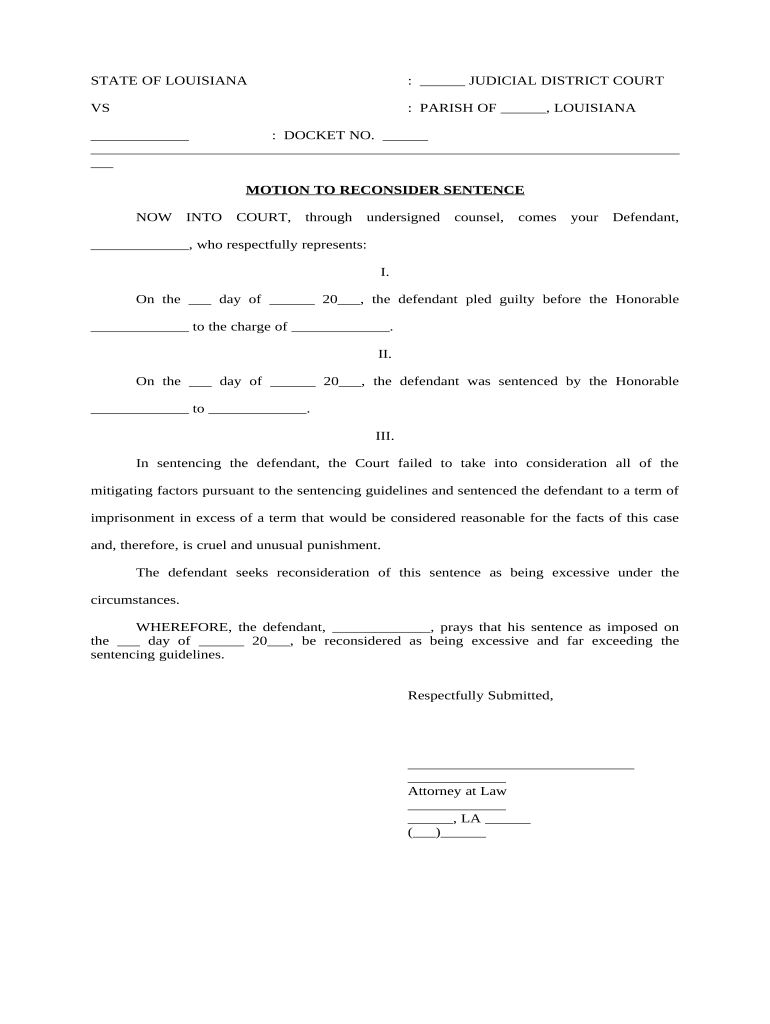
Motion to Reconsider

This template is fully customizable. Edit the text, fill out the fields, and send it for signature. Give it a try!
Motion to Reconsider

What a Motion to Reconsider is and when it applies

A Motion to Reconsider is a post-judgment or post-order filing asking the same court to review, correct, or clarify a prior decision. It focuses on alleged errors of law, newly discovered evidence, manifest injustice, or an intervening change in controlling authority. Motions to reconsider are typically narrower than appeals and are directed to the trial court that issued the original ruling. Procedural rules, timing, and available remedies depend on the governing rules of procedure (for example, Federal Rules of Civil Procedure 59(e) and 60(b)) and any applicable state or local court rules.

Why a Motion to Reconsider matters for case strategy

Use this motion to ask the deciding court to correct error, consider new evidence, or address manifest injustice before pursuing an appeal. It can preserve issues, narrow disputes, and sometimes avoid the expense and delay of appellate review.

Why a Motion to Reconsider matters for case strategy

Who typically prepares or files a Motion to Reconsider

Filing requirements and standards vary by jurisdiction; confirm applicable local rules and timing before submitting.

  • Civil litigants and attorneys seeking correction of trial-court errors before appeal
  • Responding parties asking clarification or modification of injunctive or interlocutory orders
  • Self-represented litigants (pro se) filing under local court procedures and deadlines

Typical signers and filers

Appellant — Litigation Attorney

A litigation attorney prepares the Motion to Reconsider to preserve legal issues for appeal, cite controlling authority, and present newly discovered evidence. The attorney verifies timing, serves opposing counsel, and files proof of service under court rules to avoid waiver.

Respondent — Pro Se Party

A self-represented litigant files to ask the court to re-evaluate a ruling that materially affects their rights. They must follow local formatting, timing, and service rules and may need court clerk assistance for procedural questions.

Key technical and legal details to include

Court Caption: Case style and court
Docket Number: Exact case number
Relief Sought: Specific remedy
Grounds Cited: Legal basis stated
Signature Block: Signer name and date
Service Certificate: How parties were served

Consequences of an incorrect or untimely motion

Waived Issues: Claims may be barred on appeal
Sanctions Risk: Court may impose sanctions
Missed Deadline: Relief can be forfeited
Denial on Merits: Motion may be denied outright
Fee Exposure: Costly briefing and fees
Appellate Delay: Further proceedings may be postponed

Common preparation mistakes to avoid

  • Missing the jurisdictional or local rule deadline causes procedural dismissal rather than a merits ruling.
  • Re-arguing previously litigated facts without new evidence or law rarely succeeds and may invite sanctions.
  • Failing to include a proper certificate of service or incorrect service method can void the filing.
  • Using vague relief statements instead of concrete, specific requests creates confusion and weakens the motion.

Step-by-step: drafting and filing a Motion to Reconsider

Follow these sequential steps to prepare a clear, compliant motion that addresses timing, grounds, and service.

  • 01
    Check deadlines: Confirm the governing rule and compute the final filing date.
  • 02
    Identify grounds: State precise legal or factual bases for reconsideration.
  • 03
    Draft motion: Include caption, relief, argument, and supporting exhibits.
  • 04
    Serve and file: Serve parties, file with court, and retain proof of service.

How to prepare and submit the motion using an online workflow

Configure a reproducible digital workflow to reduce errors and track service and filing steps.

Field Configuration
Template Upload Store a court-form template for reuse
Custom Fields Add case number, dates, and caption as Magic fields
Signer Order Set signer roles and sequence
Filing Export Export PDF/A or court-required format

Typical process from drafting to court ruling

This overview shows key actions and who performs them during the motion lifecycle.

  • Draft: Prepare motion and attach exhibits
  • Serve: Deliver motion to opposing counsel
  • File: Submit to the clerk and obtain stamping
  • Decision: Court schedules hearing or issues order

Digital submission: formats, integrations, and authentication

Use platforms that retain an audit trail and export court-ready PDFs to meet court clerk technical requirements.

  • Accepted Formats: PDF, PDF/A, DOCX
  • Integrations: Supports Google Workspace and Microsoft 365
  • Authentication: Email or SMS code verification

Common deadlines and timing rules to watch

Timing rules vary by jurisdiction; the federal rules provide typical examples that illustrate common deadlines.

Rule 59(e) Deadline:

File within 28 days of judgment under Fed. R. Civ. P. 59(e).

Rule 60(b) Timing:

Seek relief 'within a reasonable time'; certain grounds have a one-year limit.

State Rule Variations:

Many states set shorter deadlines; check local rules.

Service Timing:

Serve opposing parties according to local service rules before filing.

Appellate Tolling:

Filing a timely motion may toll appellate deadlines; confirm with procedure rules.

Milestones from filing to court action

Track these numbered milestones to monitor progress and trigger next steps in the case lifecycle.

01

Prepare Motion

Complete drafting, attach exhibits, and assemble certificate of service.

02

Serve Parties

Deliver per rule; obtain proof of service before or at filing.

03

File with Clerk

E-file or deliver paper copy and obtain stamped receipt.

04

Court Disposition

Court issues order, schedules hearing, or denies without oral argument.

How a Motion to Reconsider compares with other post-judgment options

Compare standard features, timing, and typical effects to choose the correct procedural vehicle.

Criteria Motion to Reconsider Motion for New Trial Appeal
Timing days to weeks days to weeks months to appellate deadline
Standard legal error/new evidence trial errors affecting outcome legal errors reviewed de novo
Court Level trial court trial court appellate court
Effect modify or clarify order new trial or vacatur reversal or remand

eSignature platform comparison for preparing and submitting the motion

Select a platform that supports PDF export, audit trails, and required authentication; pricing and enterprise features vary by vendor.

signNow DocuSign Adobe Sign PandaDoc HelloSign
Starting Price $8/user/mo $15/user/mo $14/user/mo $19/user/mo $15/user/mo
Free Trial 7-day free trial Varies Varies Varies Varies
Bulk Send Yes Varies Varies Varies Varies
Audit Trail Yes Yes Yes Yes Yes
HIPAA Compliant Yes Yes Yes No No

Frequently asked questions about Motions to Reconsider

Answers to common procedural questions that arise when preparing, serving, and filing a Motion to Reconsider.


Need help? Contact support

be ready to get more
Join over 28 million airSlate SignNow users