Establishing secure connection…Loading editor…Preparing document…

Idaho Parental Consent to Name Change (Minor)

This template is fully customizable. Edit the text, fill out the fields, and send it for signature. Give it a try!
Idaho Parental Consent to Name Change (Minor)

What the Idaho Parental Consent to Name Change (Minor) Is

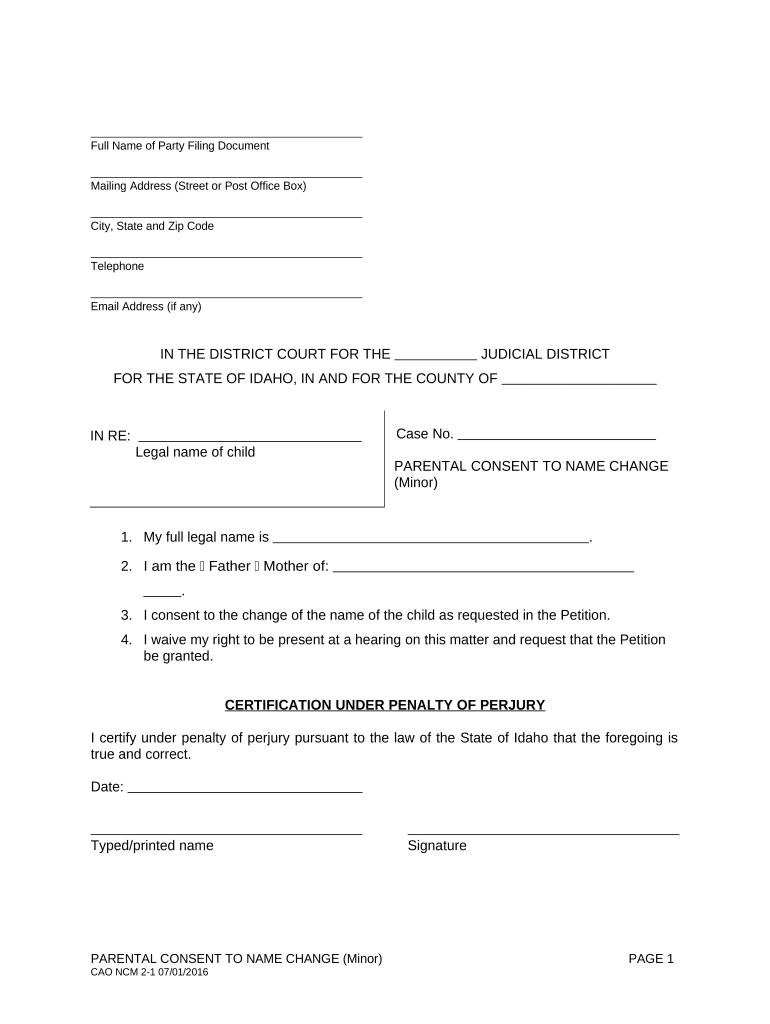
The Idaho Parental Consent to Name Change (Minor) is a signed declaration by a parent or legal guardian consenting to a court petition that requests a legal change of name for a child under Idaho law. The form documents identity, relationship to the minor, and the parent's voluntary approval and is typically filed with the district court handling the name-change petition. Courts use parental consent to verify that guardians agree with the proposed change and to reduce contested proceedings; if consent is absent, the court holds a hearing to determine the child's best interests.

Why a Parental Consent Form Matters in Minor Name Changes

A properly completed parental consent streamlines the name-change process, shows parental agreement to the court, and reduces the likelihood of contested hearings. It supports accurate court records and can speed case resolution when submitted with the petition.

Why a Parental Consent Form Matters in Minor Name Changes

Who Uses This Consent and When It’s Needed

Typical filers include one or both parents, legal guardians, or petitioners acting with guardianship authority where a minor’s name change is requested.

  • Parent or legal guardian of the minor filing the petition, providing identity, relationship, and clear consent language.
  • Non-parent petitioner when guardianship documentation accompanies the consent and shows legal authority to approve the change.
  • Court clerks and family law attorneys who review and submit the signed consent with the minor name-change petition.

Step-by-step: Completing and Submitting Consent

Follow this sequence to prepare a clean, verifiable consent that the court can accept with the name-change petition.

  • 01
    Prepare Documents: Gather birth certificate and ID for proof.
  • 02
    Complete Form: Fill each field carefully in MM/DD/YYYY format.
  • 03
    Sign and Notarize: Sign where indicated; notarize if required.
  • 04
    File With Court: Include consent when filing the petition.

How the Consent Fits into the Court Process

The consent is one element of the court packet and supports the petition; the court reviews it alongside background checks and required notices.

  • Petition Filing: Consent is attached to the name-change petition.
  • Court Review: Judge examines consent and supporting documents.
  • Hearing Decision: Court may grant without hearing if consent is clear.
  • Order Issued: Court signs the name-change order when approved.

Typical Digital Workflow for Completing Consent Forms

Configure a secure signing and submission workflow to reduce errors and maintain an audit trail.

Field Configuration
Identity Verification Use photo ID or two-factor authentication
Signature Type Allow typed or drawn signature per court rules
Document Attachments Require birth certificate and guardianship documents
Delivery Send signed package to court clerk email or portal

Technical Options for Signing and Submitting the Consent

Decide whether you will use a scanned wet signature, a local notary, or an e-signature platform that meets legal and court requirements.

  • Scan Quality: 300 DPI or higher
  • File Types: PDF preferred
  • Authentication: Email or SMS code

Penalties and Risks from Incorrect or Missing Consent

Rejection of Filing: Delays or denial by the court
Contested Proceedings: Opposing party may force hearing
Voidable Order: Order may be set aside if defect found
Privacy Exposure: Improper handling may violate privacy rules
Notarization Fault: Incorrect notary may invalidate signature
Eligibility Risk: Lack of guardianship proof may stop petition

Common Mistakes to Avoid

  • Failing to attach supporting documents such as a birth certificate or guardianship orders, which leads to processing delays or requests for supplemental filings.
  • Using inconsistent name formats across the petition and consent, causing clerks to request corrected forms or additional identity proof.
  • Skipping notarization where required by the court or county, which can result in rejected filings or the need to reappear before a notary.
  • Assuming electronic acceptance without verifying the local court’s e-filing or e-signature policies, leading to unusable electronic submissions.

Practical Tips for Accurate and Efficient Completion

Follow these practices to reduce friction with the court and make the consent defensible and easy to verify.

Verify Court Rules
Check the county court’s local rules or clerk’s office requirements in advance so you know whether notarization, witness signatures, or a specific form version is required.
Use Clear Identifiers
Include dates of birth, full addresses, and relationship details to make it simple for clerks to match records and avoid clerical returns.
Keep Originals
Retain original signed and notarized copies until the court issues a final order; scanned copies alone may be insufficient for certain subsequent actions.
Maintain Audit Trail
If you use electronic signing, keep the audit log showing signer identity, timestamps, and authentication method to support legal validity.

Core Components of a Professional Parental Consent Form

A complete, court-ready consent contains identifiable parties, a clear statement of consent, proof of authority, signature and notarization blocks, and an audit trail when signed electronically.

Child Identification

Full name, date of birth, and current residence to uniquely identify the minor and match supporting documents such as a birth certificate.
Proposed Name

Exact new name requested, written without abbreviations, so the court and agencies can update records consistently.

Parental Statement

A clear declaration that the parent or guardian consents to the minor’s name change and understands the legal effect of the petition.

Authority Proof

If the signer is not a biological parent, include guardianship orders, adoption decrees, or other documentation that proves legal authority.

Signature and Notary

Designated signature block and notary acknowledgment if required by local practice to authenticate the signer’s identity.

Attachments

Space to list or attach the birth certificate, proof of residence, and any court documents verifying guardianship or custody arrangements.

eSignature Platform Pricing Snapshot for Form Execution

Comparing typical plan starting prices and core capabilities for signing and managing parental consent forms; signNow is listed first per vendor convention.

signNow DocuSign Adobe Sign PandaDoc HelloSign
Starting Price $8/user/mo $15/user/mo $14/user/mo $19/user/mo $15/user/mo
Free Trial 7-day trial Varies Varies Varies Varies
Bulk Send Yes Yes Yes Yes No
Audit Trail Yes Yes Yes Yes Yes
HIPAA Compliant Yes Yes Yes No No

Frequently Asked Questions About Parental Consent Forms

Answers to common questions about completing, signing, and filing the Idaho Parental Consent to Name Change (Minor).


Need help? Contact support

be ready to get more
Join over 28 million airSlate SignNow users