Establishing secure connection…Loading editor…Preparing document…

New Jersey Trust

This template is fully customizable. Edit the text, fill out the fields, and send it for signature. Give it a try!
New Jersey Trust

What a New Jersey Trust Is and when it’s used

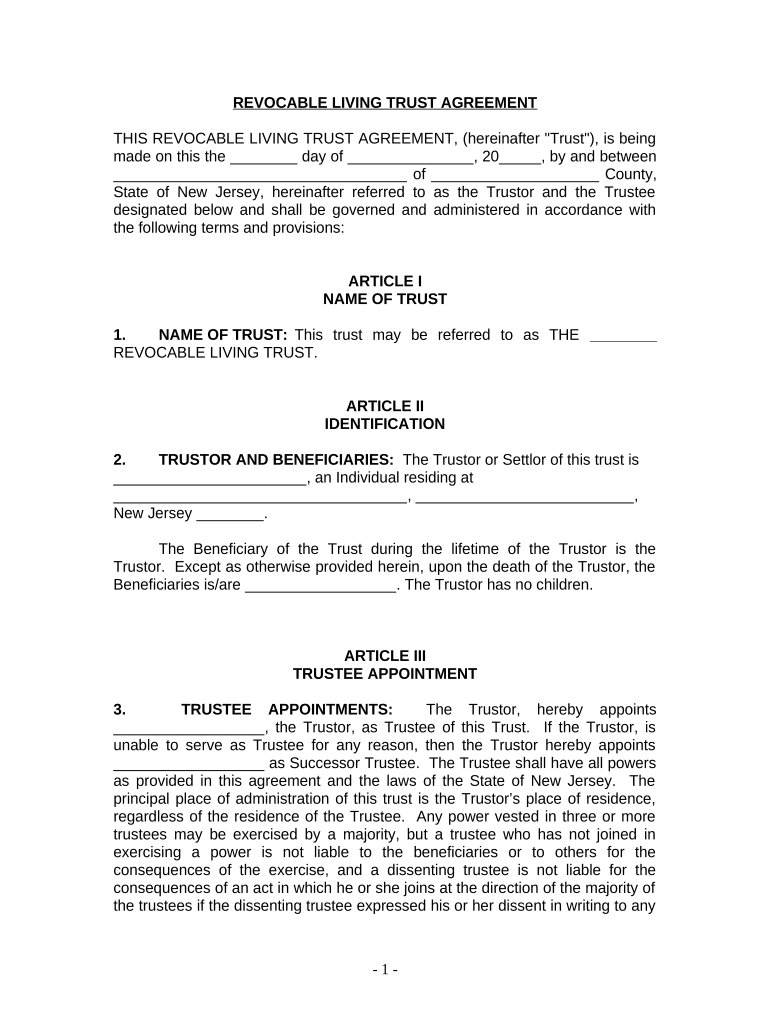
The New Jersey Trust is a legal instrument used to hold and manage assets for named beneficiaries under terms set by the settlor. It may be revocable or irrevocable, names one or more trustees, and sets powers, distribution schedules, and successor provisions. A well-drafted trust can reduce probate exposure, centralize asset management, and provide incapacity planning. To be effective it must reflect the settlor’s intent, identify trust property clearly, and comply with state formalities and applicable federal rules for electronic records and signatures.

Why a New Jersey Trust matters for estate and asset planning

A New Jersey Trust clarifies who controls assets, reduces probate costs, preserves privacy, and supports incapacity planning. It also lets the settlor set distribution timing and conditions to meet tax or creditor-protection objectives.

Why a New Jersey Trust matters for estate and asset planning

Typical parties who prepare or complete a New Jersey Trust

Common users include professionals and individuals who need durable, private estate arrangements in New Jersey.

  • Estate planning attorneys and law firms drafting New Jersey trusts for client estate administration and probate avoidance
  • Individual settlors creating revocable or irrevocable trusts to manage assets, control distributions, and plan for incapacity
  • Professional trustees and corporate fiduciaries administering distributions, investments, recordkeeping, and statutory reporting duties

Core components of a professionally prepared New Jersey Trust

A complete New Jersey Trust sets out parties, assets, trustee authority, beneficiary rights, distribution rules, and amendment or termination terms to support clear administration.

Declaration

Identifies the settlor, trustee, beneficiaries, trust name, effective date, and trust purpose; it creates the fiduciary relationship and establishes the document as operative authority.
Trustee Powers

Specifies express powers and limits on trustees, including investment authority, distribution discretion, delegation powers, and administrative duties to avoid ambiguity.

Beneficiaries

Names primary and contingent beneficiaries, describes distribution shares or conditions, and includes provisions for minors, spendthrift protections, or special needs.

Trust Property

Lists initial funding assets or provides instructions for funding; identifies how real estate, bank accounts, or securities will be titled or transferred into the trust.

Distribution Schedule

Defines timing and conditions for income and principal distributions, discretionary distributions, and successor distributions on death or termination.

Amendment

Explains how the trust may be amended or revoked (if revocable), and names successor trustees and procedures for termination and final accounting.

Step-by-step sequence to prepare and execute a New Jersey Trust

Follow these steps in order to prepare, execute, and fund a trust while preserving legal and tax integrity.

  • 01
    Gather documents: Collect IDs, asset titles, deeds, and beneficiary info.
  • 02
    Draft terms: Draft trust language with clear powers and distributions.
  • 03
    Execute formally: Sign with required witnesses or notary present.
  • 04
    Fund trust: Retitle assets and record deeds where necessary.

How to configure an electronic workflow for a New Jersey Trust

Set up fields and signer routing to match execution order, authentication level, and record retention needs.

Field Configuration
Signature Field Place signer and witness signature fields in execution order
Notary Block Include notary acknowledgement and date for county recording
Authentication Use email + SMS code or stronger KBA for signer identity
Audit Trail Enable full IP, timestamp, and action logging

Where to send, file, and retain trust documents

Routing depends on trust content: record deeds for real estate, provide copies to beneficiaries, and retain originals securely.

  • County Recorder: Record deeds conveying real property into the trust as required.
  • Trustee File: Keep signed original trust in trustee custody or attorney escrow.
  • Beneficiaries: Send executed copies to named beneficiaries for their records.
  • Tax Filings: Provide trust EIN and required returns to the IRS as applicable.

Technical and compliance requirements for eSigning a New Jersey Trust

Use a platform that supports secure PDFs, tamper-evident audit trails, and configurable signer authentication for legal records.

  • File formats: PDF and DOCX exports supported
  • Integrations: Connect with cloud storage and case management
  • Authentication: Email, SMS code, or stronger methods

Key timing considerations when executing or funding a trust

Some dates are critical: the trust effective date, funding actions, deed recording, and tax filing dates affect legal and tax outcomes.

Effective Date:

Enter as MM/DD/YYYY; controls when obligations begin

Funding Deadline:

Retitle assets promptly to avoid probate or ownership gaps

Deed Recording:

Record property transfers per county rules to perfect title

Trust Tax Return:

File Form 1041 by April 15 when required

Beneficiary Notices:

Provide distributions and notices per trust timing

Consequences of incorrect or incomplete trust documents

Invalid Funding: Property passes through probate
Tax Exposure: Unintended gift or estate tax consequences
Breach Liability: Trustee subject to fiduciary claims
Recording Defects: Title disputes or lien issues
Enforceability Risk: Ambiguous language defeats settlor intent
Costs Increase: Higher litigation and administration expenses

Common preparation errors to avoid when creating a New Jersey Trust

  • Failing to fund the trust after execution, leaving assets titled in the settlor’s name and subject to probate and creditor claims
  • Mismatched or informal names for parties and assets, which delays recording, title transfer, and tax reporting processes
  • Omitting required notary acknowledgements or witness blocks when local recording rules require them for deeds or related instruments
  • Drafting vague trustee powers or distribution standards that invite litigation and increase administration costs

Security and compliance considerations for electronic trust documents

Encryption: TLS 1.2/1.3 in transit
At-Rest Protection: AES-256 encryption
Certifications: SOC 2 Type II, ISO 27001
Regulatory: ESIGN and UETA compliant
Healthcare: HIPAA requires a BAA when PHI is processed
Audit Trail: Tamper-evident logs and timestamps

Who typically signs or approves a New Jersey Trust

Settlor — Grantor

The individual or entity that creates the trust and transfers assets. The settlor must have capacity and intent; name accuracy and signature validity are essential to avoid challenges.

Trustee — Fiduciary

The person or institution that accepts trustee duties and administers the trust according to its terms, including recordkeeping, investment management, distributions, and tax filing responsibilities.

Real examples of electronic signing in property and trust workflows

Organizations have used remote signing to complete trust-related transfers and trustee appointments while maintaining compliance and auditability.

Martin Properties — Tim Martin

Martin Properties executed a trust-funded deed remotely for a property closing in the region.

  • Single-signature mobile completion enabled the closing within 24 hours.
  • "I can process and execute all of these documents online with 100% compliance and built-in security," said Tim Martin, illustrating practical use for property-held trusts.

BIS — Dan Rotelli

BIS centralized trust document workflows to reduce turnaround time for trustee appointments and beneficiary notices.

  • Automated routing and audit trails reduced administrative bottlenecks.
  • Dan Rotelli cited the platform’s SOC 2 compliance and audit features as key to maintaining legal defensibility of executed trust records.

Comparison of common eSignature vendor pricing and features

Pricing and core features vary by vendor and plan; select an option that meets authentication, audit trail, and regulation needs without assuming vendor parity.

signNow DocuSign Adobe Sign PandaDoc HelloSign
Starting Price $8/user/mo $15/user/mo $14/user/mo $19/user/mo $15/user/mo
Free Trial 7-day free trial, no credit card required Varies by plan Varies by plan Varies by plan Varies by plan
Bulk Send Yes (Business Premium) Yes (paid plans) Yes (paid plans) Yes (paid plans) Yes (paid plans)
Audit Trail Yes Yes Yes Yes Yes
HIPAA Compliant Yes Yes Yes No No

Frequently asked questions about New Jersey Trust execution and eSignatures

Answers to common execution, notarization, signature, and retention questions for New Jersey Trusts, with references to federal e-signature standards and practical next steps.


Need help? Contact support

be ready to get more
Join over 28 million airSlate SignNow users