Establishing secure connection…Loading editor…Preparing document…

New York Quitclaim Deed

This template is fully customizable. Edit the text, fill out the fields, and send it for signature. Give it a try!
New York Quitclaim Deed

What the New York Quitclaim Deed Is

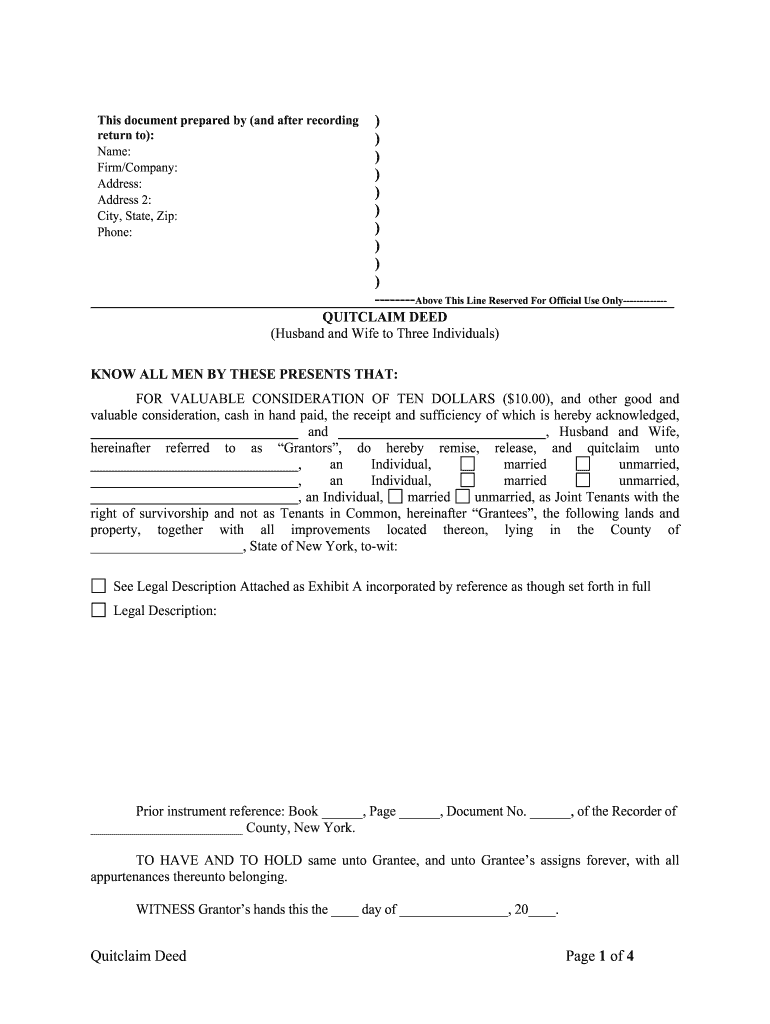
A New York Quitclaim Deed is a legal instrument used to transfer whatever interest the grantor holds in real property to a grantee, without warranties as to title. It conveys the grantor's current rights, if any, but does not guarantee the absence of liens, encumbrances, or superior claims. In New York the deed must be properly executed, acknowledged before a notary public, and recorded with the county clerk to provide public notice and preserve priority against later claims.

Why a Quitclaim Deed Is Used in New York

A quitclaim deed is fast and inexpensive for transferring property interests between known parties—family members, divorce settlements, or intra-entity transfers—because it conveys only the grantor's present interest without title warranties.

Why a Quitclaim Deed Is Used in New York

Who Commonly Prepares or Signs a New York Quitclaim Deed

Typical users include individuals and professionals who need to transfer property interests quickly and with minimal formalities; the parties often accept the absence of title guarantees because they have independent title knowledge.

  • Homeowners transferring property to a spouse or family member after a life event.
  • Parties resolving property interests in divorce settlements or quiet-title-related exchanges.
  • Entities or trusts moving an interest into or out of business entities or family trusts.

When used between related or cooperative parties, quitclaim deeds reduce transaction complexity; parties should still confirm recording requirements, tax implications, and potential title issues before signing.

Who May Sign as Grantor or Grantee

Grantor (Property Owner)

The grantor is the person or entity legally holding the property interest to be transferred. If the grantor is a business or trust, an authorized officer or trustee must sign in the entity's name and show authority supporting the signature.

Grantee (Recipient)

The grantee is the individual or entity receiving the interest. A grantee can sign to accept but does not always need to sign a quitclaim deed; signature requirements depend on local practice and any lender or title company conditions.

Essential Elements of a Complete New York Quitclaim Deed

A professional quitclaim deed includes formal identification, clear transfer language, precise property description, consideration clause, notarized grantor acknowledgement, and a recording-ready signature block.

Grantor Identification

Full legal name and capacity (individual, trustee, corporate officer) exactly as on government or entity records to avoid recording or title issues.
Grantee Identification

Full legal name and entity type for the recipient; include mailing address for post-recording return and tax notices.

Transfer Language

Unambiguous quitclaim statement conveying the grantor's interest, e.g., 'Grantor quitclaims to Grantee all right, title and interest in the described property.'

Property Description

Complete legal description from the deed or county records (metes and bounds or parcel identifier) — avoid street addresses only.

Consideration Clause

Specify amount (even nominal) or 'for love and affection' to satisfy recording requirements and transfer tax rules where applicable.

Notary Acknowledgement

Notary signature, seal, and date acknowledging the grantor's execution; required before recording in New York.

Step-by-Step: Preparing and Recording a Quitclaim Deed in New York

Follow these sequential steps to prepare, execute, and record a quitclaim deed so it becomes effective and protects priority.

  • 01
    1. Verify Title: Review existing deed and chain of title.
  • 02
    2. Draft Deed: Include exact legal description and transfer language.
  • 03
    3. Execute Before Notary: Grantor signs in notary's presence with ID.
  • 04
    4. Record with County: Submit to county clerk with recording fee.

Where to File and How Recording Works

Recording a quitclaim deed gives public notice of the transfer; submit it to the county clerk's office in the county where the property is located.

  • Local County Clerk: Physical or e-recording by the county clerk where the parcel is located.
  • E-Recording Vendors: Many counties accept electronic submissions through approved vendors.
  • Return Address: Provide return mailing address for recorded deed return.
  • Indexing and Public Record: County clerk indexes deed, affecting public notice and priority.

Configuring an Online Quitclaim Deed Workflow

Set up fields, signer roles, authentication, and return routing when preparing the deed for electronic completion and notarization.

Workflow field and setting name Configuration
Grantor signature placement and required attachment Signature field with signed PDF attached
Notary acknowledgement placement and evidence Dedicated acknowledgement block and seal image
Signer authentication method and strength Email + SMS code or stronger KBA as required
Return routing and copy distribution Send recorded copy to specified mailing address

Digital Signing and eSubmission Requirements

Ensure your eSigning platform supports notarization workflows, PDF/A output, audit trails, and the authentication level required for property transfers.

  • File formats: PDF, DOCX supported
  • Integrations: Connects to county e-recording vendors
  • Security: AES-256 at rest

Use a platform that produces a tamper-evident PDF, records a complete audit trail (timestamps, IPs), and supports notarization steps; verify county e-recording acceptance before relying on electronic submission.

Timing Considerations and Expected Processing

Recording timelines and related deadlines depend on county workload, notarization completion, and whether electronic recording is used; plan accordingly to protect priority.

Notarization before recording:

Complete notarization prior to submission to avoid rejection.

County recording turnaround:

Same-day to several weeks depending on county queue.

Tax reporting window:

Transfer tax or conveyance forms may have separate filing windows.

Title insurance update timing:

Inform title insurer immediately to update policy and prevent gaps.

Dispute statute timing:

Recording preserves priority; earlier recorded deeds generally take precedence.

Common Preparation Mistakes to Avoid

  • Using a street address instead of the full legal description leads to recording rejection or ambiguous conveyance.
  • Mismatched grantor or grantee names versus title records can require corrective documents and delay recording.
  • Failing to notarize or omitting the notary seal will typically result in the county clerk refusing to record.
  • Neglecting to check transfer tax or municipal requirements can produce unexpected fees or penalties.

Risks and Consequences of an Incorrect Quitclaim Deed

Clouded Title: May create defects requiring quiet title action
Recording Rejection: County clerk may refuse improperly executed documents
Transfer Tax Liability: Omitted taxes can lead to assessments
Fraud Allegations: Improper execution risks civil or criminal claims
Costly Litigation: Remedies can include costly court proceedings
Insurance Gaps: Title insurance may not cover defects from quitclaim transfers

Practical Tips for Accurate and Efficient Completion

Follow these best practices to reduce rework and protect both parties' interests when using a New York quitclaim deed.

Verify Recorded Legal Description
Obtain the precise legal description from the existing deed or county records and paste it exactly into the quitclaim deed to avoid ambiguity and recording delay.
Confirm Signatory Authority
If an entity or trustee signs, include documentation of authority (resolution, trust certification) to prevent later challenges to the conveyance.
Use a Notary Acknowledgement Block
Place a New York-compliant notary acknowledgement with space for seal and date; insist the grantor sign in the notary's presence to ensure recordability.
Check Transfer Tax Rules
Review New York State and local transfer tax rules before submission and include the consideration language and any required tax forms to avoid assessments.

Real-World Use Cases with Document Workflows

Signatures and secure workflows reduce friction for property transfers; the following examples show practical applications across real estate operations.

Martin Properties — Tim Martin, Founder

Tim Martin needed to complete multiple property transfers remotely with compliance

  • Small property firm required notarized quitclaim deeds rapidly
  • Using digital workflows allowed same-day execution, consistent notary acknowledgement capture, and reliable document return for recording.

Optica Ventures — Brian Fitzgibbons, COO

A venture firm transferred an ownership interest to an affiliated entity during restructuring

  • The parties used standardized templates and coordinated notarization
  • The result was faster internal approvals, fewer drafting errors, and timely county recording without in-person meetings.

Common eSignature Vendor Comparison for Deed Workflows

Key vendor attributes for signing and notarization workflows: starting price, trial availability, bulk send, audit trails, HIPAA support, and envelope or usage caps.

signNow DocuSign Adobe Sign PandaDoc HelloSign
Starting Price $8/user/mo $15/user/mo $14/user/mo $19/user/mo $15/user/mo
Free Trial 7-day free trial Varies by plan Varies by plan Free trial available Free tier available
Bulk Send Yes (Business Premium) Yes Yes Yes No
Audit Trail Yes Yes Yes Yes Yes
HIPAA Compliant Yes (BAA required) Yes Yes No No
Envelope Cap No envelope cap 100 envelopes/user/year Varies by plan Varies by plan Varies by plan

Frequently Asked Questions About New York Quitclaim Deeds

Answers to common questions about execution, recording, e-signing, notarization, and practical risks when using quitclaim deeds in New York.


Need help? Contact support

be ready to get more
Join over 28 million airSlate SignNow users