Establishing secure connection…Loading editor…Preparing document…

Non-Representation Notice

This template is fully customizable. Edit the text, fill out the fields, and send it for signature. Give it a try!
Non-Representation Notice

What a Non-Representation Notice Is and When It Applies

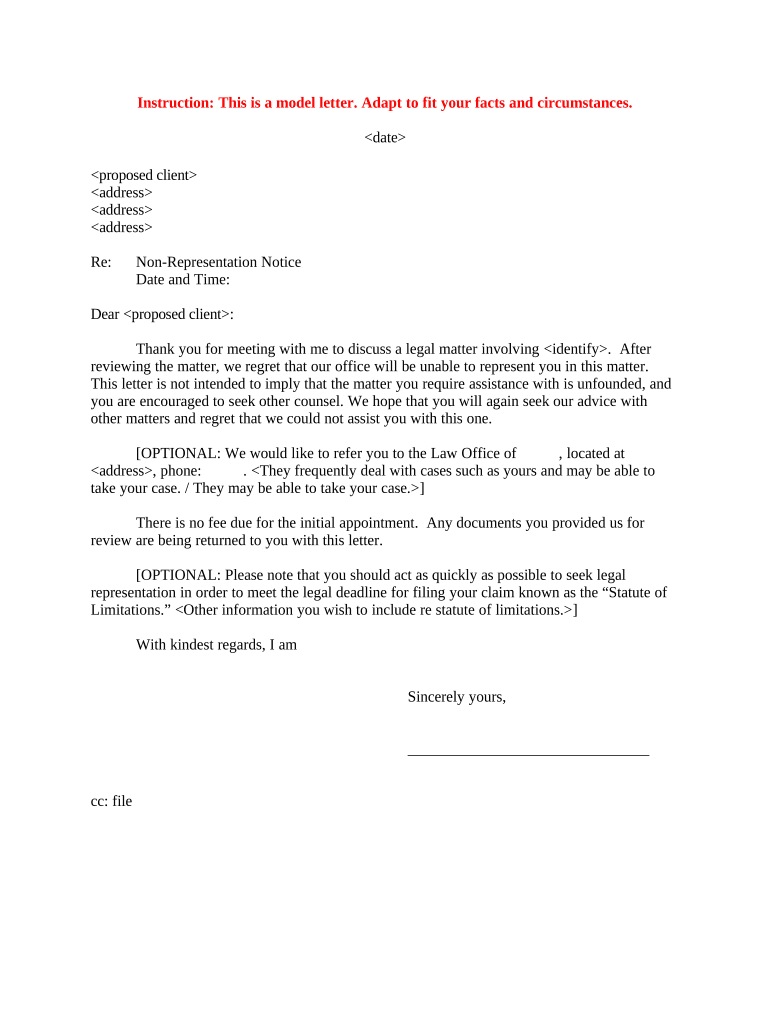
A Non-Representation Notice is a short written statement a party or professional sends to clarify that they are not acting as the recipient’s legal representative, agent, or fiduciary for a particular matter. Commonly used in legal, real estate, financial, and transactional contexts, the notice prevents misunderstanding about the scope of relationships, duties, and potential conflicts. It typically states which party is not representing whom, the specific matter or transaction excluded from representation, and any limited assistance being provided. Clear notices reduce ethical risks and support accurate recordkeeping when multiple parties or professionals are involved.

Why issuing a Non-Representation Notice matters

Issuing a clear Non-Representation Notice protects both sender and recipient by documenting intent, limiting liability, and avoiding implied attorney-client or agent-principal relationships. It provides an auditable record that can prevent later disputes over duties, conflicts of interest, or confidentiality obligations in regulated contexts.

Why issuing a Non-Representation Notice matters

Who typically prepares and receives these notices

Use the notice whenever a relationship or duty could reasonably be misconstrued; keep it concise, dated, and retained in your files.

  • Law firms and solo attorneys notifying clients or third parties they are not representing an interested party in a transaction.
  • Real estate agents clarifying they do not represent buyers or sellers in a given deal when acting in a limited capacity.
  • Financial advisors, accountants, or brokers confirming the absence of retained advisory or fiduciary duties for a specific engagement.

Core elements to include in a professional Non-Representation Notice

A properly constructed notice is brief but specific: it identifies parties, the excluded matter, the effective date, and any limited assistance or disclaimers. Below are six key components that make the notice unambiguous and defensible.

Identifying Parties

Name the sender and the recipient using full legal names to avoid identity confusion and ensure enforceability.
Scope of Matter

Describe the transaction, matter, or claim being excluded (dates, property identifiers, or contract titles) so the limitation is clear.

Statement of Non-Representation

A direct sentence stating that the sender is not representing, advising, or acting as agent for the recipient in the named matter.

Limited Assistance Clarified

If any limited help is provided (e.g., factual updates, referrals), state it precisely and deny any fiduciary obligations.

Effective Date

Give a clear effective date for the notice so parties know when the limitation took effect.

Signature and Contact

Include a dated signature, printed name, title, and contact information for traceability and follow-up.

Step-by-step: drafting and delivering the Notice

Follow these steps to prepare, approve, and deliver a Non-Representation Notice that is clear and legally useful.

  • 01
    Draft the text: Write a concise statement stating who is not representing whom and the matter excluded.
  • 02
    Confirm identities: Verify legal names and entity types to ensure accuracy in the notice.
  • 03
    Date and sign: Add the effective date and obtain an original or e-signed signature with signer capacity.
  • 04
    Deliver and retain: Send via a trackable method and keep a copy in your records for the applicable retention period.

Where to send the notice and how parties receive it

Choose delivery methods that create proof of receipt and preserve the content for compliance and dispute resolution.

  • Registered Mail: Use certified or registered mail for postal proof and official delivery records.
  • Email with read receipt: Send to a verified business address; preserve the sent message and server headers.
  • eSignature platforms: Use an eSignature provider to capture the signed document, audit trail, and delivery logs.
  • In-person delivery: Provide a stamped receipt or obtain a signed acknowledgment where immediate proof is required.

Digital signing, storage, and submission considerations

Retain signed records and delivery logs in secured storage and ensure the selected platform meets your legal and industry obligations.

  • Audit Trail: Record timestamps, IP addresses, and signer actions to show intent and attribution.
  • Authentication: Use at least email or SMS verification; stronger methods (KBA, SSO) when identity is contested.
  • File Formats: Save signed notices as PDF/A for long-term retention and portability.

How to set up an online Non-Representation Notice workflow

Configure a repeatable digital workflow to reduce errors and speed delivery when notices are issued frequently.

Field Configuration
Template Create a reusable notice template with locked non-representation language.
Signer Roles Define sender and recipient roles and required signer authentication.
Delivery Select email with optional SMS code and set reminders.
Retention Enable automatic PDF export and chain-of-custody audit logs.

Risks and possible consequences of an incorrect or omitted notice

Misleading Parties: May create unintended fiduciary obligations or ethical conflicts.
Professional Liability: Could increase malpractice or error exposure for advisors.
Contract Disputes: Ambiguity can lead to litigation over duties and expectations.
Regulatory Exposure: Regulated industries may view unclear notices as compliance violations.
Evidence Weakness: Poor recordkeeping weakens defenses in disputes or audits.
Reputational Harm: Confusion about roles can damage trust with counterparties.

Common preparation mistakes to avoid

  • Using vague language that fails to identify the specific matter or timeframe.
  • Leaving out legal names, signing only with initials, or unsigned notices.
  • Delivering informally without retaining proof of receipt and the signed copy.
  • Combining notice with other documents without checking state notarization or witness rules.

eSignature vendor comparison for delivering and retaining Non-Representation Notices

This table summarizes common vendor pricing and key features relevant to signing, audit trails, and compliance when issuing Non-Representation Notices.

signNow DocuSign Adobe Sign PandaDoc HelloSign
Starting Price $8/user/mo $15/user/mo $14/user/mo $19/user/mo $15/user/mo
Free Trial 7-day trial Varies by plan Varies by plan Varies by plan Varies by plan
Bulk Send Yes Yes Yes Yes No
Audit Trail Yes Yes Yes Yes Yes
Envelope Cap No cap 100 envelopes/user/year Varies Varies Varies

Essential data elements and secure storage practices

Full Names: Sender and recipient full legal names
Matter ID: Transaction or case identifier
Effective Date: MM/DD/YYYY effective date
Signed Copy: Signed PDF with audit trail
Delivery Log: Proof of transmission and receipt
Retention Location: Secure file store with access controls

Practical tips for clear, enforceable notices

Small drafting and process choices materially reduce ambiguity and downstream disputes.

Keep language plain
Use a single clear sentence to state non-representation and avoid legalese that could be misread.
Be specific
Identify the transaction, dates, and any limited assistance to prevent broader interpretations.
Use durable records
Capture a signed PDF with an audit trail and store it in a secured repository for the retention period.
Coordinate with counsel
Have a lawyer review templates if notices are used in regulated or high-risk matters.

Sample scenarios showing how notices are used

These case outlines illustrate typical wording and why the notice was necessary.

Broker Clarifying Role

A listing agent sends a one-paragraph notice to a buyer stating they represent the seller

  • The buyer receives a referral to a buyer’s agent
  • The record prevented a later claim of dual agency and clarified commission discussions.

Attorney Declining Representation

An attorney provides limited factual assistance for due diligence but sends a non-representation letter

  • The letter states no attorney-client relationship exists
  • The written record avoided an expectation of confidential legal advice during a subsequent dispute.

FAQs and troubleshooting for Non-Representation Notices

Answers to common questions about drafting, delivery, and legal effect of Non-Representation Notices.


Need help? Contact support

be ready to get more
Join over 28 million airSlate SignNow users