Establishing secure connection…Loading editor…Preparing document…

North Carolina Lien

This template is fully customizable. Edit the text, fill out the fields, and send it for signature. Give it a try!
North Carolina Lien

What a North Carolina Lien Is and when it applies

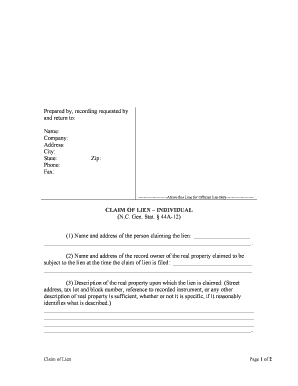
The North Carolina Lien is a legal claim filed against real property in North Carolina to secure payment for labor, materials, or services provided to improve that property. Commonly used by contractors, subcontractors, suppliers, and certain professionals, it creates an encumbrance that can lead to foreclosure if unpaid. Filing and enforcement follow state statutes and local recording procedures; deadlines, notice requirements, and required forms differ from other states. This guide explains the lien’s purpose, required information, filing steps, digital signing options, and practical considerations for accuracy, enforceability, and record retention.

Why filing a correct lien matters

A properly prepared North Carolina lien protects contractors’ and suppliers’ right to payment by creating a recorded security interest in the property. Accurate filing preserves enforcement options, reduces disputed claims, and supports remedies such as foreclosure or settlement under applicable state law and recorded evidence.

Why filing a correct lien matters

Who prepares or responds to a North Carolina lien

Construction contractors, subcontractors, material suppliers, equipment lessors, and property owners are typical parties who prepare, file, or defend against a North Carolina Lien.

  • General contractors protecting payment rights on commercial and residential projects.
  • Suppliers filing notices to secure unpaid material invoices against improved property.
  • Property owners disputing improper liens or confirming clear title before sale/transfer.

Essential fields and required information

Claimant Name: Full legal name on invoice or contract
Property Description: Street address, parcel ID, legal description
Amount Claimed: Exact unpaid sum with itemized breakdown
Dates of Work: Start and end dates (MM/DD/YYYY)
Owner Information: Recorded owner name and mailing address
Claimant Signature: Signed and dated; notarize if required

Step-by-step: prepare and record a North Carolina lien

Follow these sequential steps to prepare, verify, and record a North Carolina lien to maximize enforceability and meet statutory deadlines.

  • 01
    Gather Documents: Collect contracts, invoices, delivery tickets, and lien waivers showing unpaid balances.
  • 02
    Confirm Statutory Deadlines: Verify notice and filing timeframe under state law before missing deadlines.
  • 03
    Complete Claim Form: Enter claimant, owner, property, amount, and dates accurately.
  • 04
    Record and Serve: Record at county register of deeds and serve owner per statutory method.

Where to file and how the filing flows

Typical filing flow for a North Carolina lien includes preparation, county recording, and statutory service of notice to preserve enforcement rights.

  • Prepare Claim: Draft signed claim with attachments
  • Record Claim: File at county register of deeds office
  • Serve Notice: Deliver statutory notice to property owner or agent
  • Enforce/Litigation: File suit or foreclose if payment not received

Configuring an online workflow for lien preparation

Configure an online workflow to collect signatures, attachments, and service evidence while preserving an auditable record for lien filings.

Field Configuration
Signature Type Email link permitted; use RON when notarization required
Attachment Requirements Attach invoices, lien waivers; PDF preferred
Authentication Email verification; SMS OTP or ID proof for higher assurance
Retention Store PDFs with audit trail; export for recording

Technical and compliance requirements for eSubmission

Digital submission requires a platform that supports PDF uploads, audit trails, and signer authentication while preserving the signed record.

  • File Formats: PDF/A, DOCX accepted
  • Integrations: Title companies, cloud storage, ERPs
  • Authentication: Email, SMS, KBA, RON support

Timelines, deadlines, and processing expectations

Statutory deadlines and processing times determine enforceability; missing a filing or notice deadline can forfeit lien rights in many jurisdictions.

Notice Deadlines:

Varies by state; some require preliminary notice before lien.

Filing Window:

File claim at county recorder within statutory period after last work.

Recording Processing:

County recording can take 1–10 business days depending on office.

Service Proof:

Retain evidence of owner/service delivery for enforcement.

Statute of Limitations:

Enforcement suits often have years-long limits; check state civil code.

Key milestones from notice through enforcement

Milestone sequence from initial notice through enforcement highlights critical filing and action windows to preserve and execute lien rights.

01

Pre-Lien Notice

Send required pre-lien notices when statute or contract mandates.

02

Record Claim

Record the lien document at county register of deeds promptly.

03

Serve Owner

Provide statutory service to owner and interested parties with proof.

04

Enforce in Court

File foreclosure or enforcement action before limitations expire.

Common preparation mistakes to avoid

  • Missing or inaccurate legal description is a common rejection cause; incomplete parcel identification or county errors can make the claim ineffective and complicate title clearance for sale or refinancing.
  • Failing to serve statutory notices or to follow prescribed service methods often voids enforcement rights even if the claim was recorded; preserve proof of delivery.
  • Incorrect claimant name, amounts, or date ranges create grounds for disputes; include itemized invoices and delivery records to substantiate the claim and reduce litigation risk.
  • Assuming electronic signatures substitute for required notarization or RON where statute mandates an acknowledgement leads to invalid filings; verify state notarization rules before eSubmission.

Penalties and legal risks of incorrect filings

Loss of Lien: Failure to timely file forfeits rights
Civil Liability: Wrongful lien may trigger damages
Title Encumbrance: Hinders sales and refinancing
Penalties: Court fines or fee awards
Increased Legal Costs: Litigation and defense expenses
Reputational Risk: Business credibility affected

Anatomy of a professional North Carolina lien

A professional North Carolina lien combines precise legal description, supporting invoices, claimant identity, notarization where required, service evidence, and clear breakdown of the amount claimed.

Legal Description

Provide the parcel's full legal description as recorded, including lot, block, subdivision, or metes and bounds; a correct description ensures county recorder indexes and title searches link the lien to the right property.
Claimant Details

Include the claimant's full legal name, business entity type, contact information, and taxpayer identification where applicable to support attribution and any statutory notice obligations.

Amount Breakdown

Itemize unpaid labor, materials, retainage, and agreed change orders; show calculations clearly and attach invoices to substantiate the claimed sum during title review or litigation.

Supporting Docs

Attach contracts, change orders, delivery receipts, certified payroll, and lien waivers; contemporaneous records strengthen the evidence and reduce disputes during enforcement.

Notarization

When state or county requires an acknowledgment, notarize the claimant signature or use approved RON workflows; lack of required notarization can invalidate filing.

Service Proof

Document how and when notices and the recorded claim were served to the property owner and interested parties; proof of service is critical for enforcement proceedings.

Real-world filing scenarios

Representative scenarios illustrate how claims are documented, recorded, and resolved in practice.

Contractor Scenario

A general contractor files a lien after a subcontractor defaults on payment to preserve claims against improved commercial property.

  • Documented unpaid invoices and change orders.
  • Recording the claim and serving statutory notice allowed the contractor to negotiate a settlement and secure payment without prolonged foreclosure, supported by contemporaneous delivery tickets and signed change orders.

Supplier Scenario

A materials supplier records a lien when final payment is withheld on a residential build to protect recovery of unpaid materials.

  • Provided delivery receipts and invoices.
  • Preserving and attaching delivery manifests, bills of lading, and email confirmations reduced litigation and enabled a negotiated cure payment with interest and recorded releases upon settlement.

eSignature pricing comparison for lien workflows

Compare common entry-level costs and enterprise features relevant to filing and managing liens; signNow is listed first for comparison.

signNow DocuSign Adobe Sign PandaDoc HelloSign
Starting Price $8/user/mo $15/user/mo $14/user/mo $19/user/mo $15/user/mo
Free Trial 7-day free trial Varies by plan Varies by plan Varies by plan Varies by plan
Bulk Send Yes Yes Yes Yes No
Audit Trail Yes Yes Yes Yes Yes
HIPAA Compliant Yes Yes Yes No No

Who may sign on behalf of parties

Contractor Signer

An authorized company officer, project manager, or contract signatory may execute the lien on behalf of a business claimant; ensure corporate resolution or power of attorney authorizes signature for enforceability.

Owner Agent

The recorded owner or an authorized agent receives notices and can dispute liens; service methods and agent authority should be verified to ensure proper delivery and defense.

Frequently asked questions about North Carolina liens

Answers to common questions cover timing, signatures, notarization, supporting documents, retention, and post-release steps.


Need help? Contact support

be ready to get more
Join over 28 million airSlate SignNow users